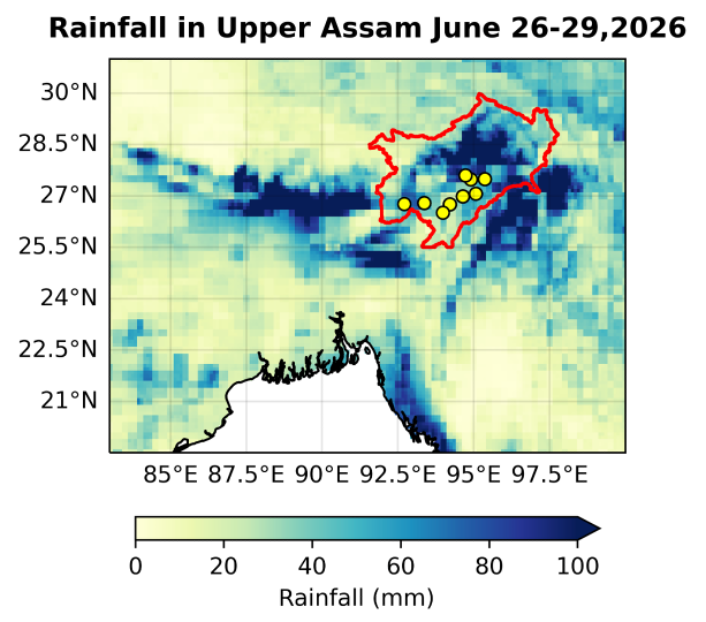
Between late June and early August 2026, the region of Upper Assam (specifically the primary districts of Sivasagar, Charaideo, and Jorhat) and the surrounding hill catchments of Nagaland and Arunachal Pradesh in Northeast India witnessed multiple spells of heavy to extremely heavy rainfall that triggered repeated waves of flash flooding and widespread inundation across the region.
An initial spell of intense rainfall around 28 June 2026 triggered a first wave of flooding, affecting more than 22,000 people across six districts and causing early infrastructure failures (The News Mill, 2026; ANI, 2026; Hindustan Times, 2026). A second and more severe period of heavy rainfall between 18 and 21 July inundated 16 districts and 794 villages, with floodwaters persisting through late July and into early August (ReliefWeb SitRep 1–4, 2026).
These events affected a region characterised by high population density in the downstream Brahmaputra Valley, alongside widespread poverty and strong dependence on agriculture. The topography of Upper Assam also increases flood risk, as its low-lying basin receives intense runoff from the neighbouring Naga and Arunachal hills. The resulting floods disrupted the lives of hundreds of thousands of people, destroyed extensive areas of cropland, and damaged critical infrastructure across the wider region (BBC, 2026; NDTV, 2026). Overall, the floods and associated landslides affected more than 500,000 people across the region. As of today, at least 99 deaths had been reported in Assam alone, while hundreds of thousands of residents were displaced into relief camps (The Economic Times, 2026; ReliefWeb SitRep 3, 2026).
Researchers from India, Sweden, the United States, the Netherlands and the United Kingdom collaborated to assess to what extent human-induced climate change altered the likelihood and intensity of extreme rainfall that led to devastating landslides and floods. To characterise the initial event as well as the subsequent flooding and effect of the saturated soils, we analyse the 3-day maximum rainfall (RX3day) and the 30-day maximum rainfall (RX30day) during the monsoon season from June to September, focusing on a region of the Upper Assam division (red outline, figure1).