1. Home
  2. Knowledge Base | PreventionWeb
  3. Hazards

Landslide

Landslide is the downslope movement of soil, rock and organic materials under the effects of gravity, which occurs when the gravitational driving forces exceed the frictional resistance of the material resisting on the slope. Landslides could be terrestrial or submarine (Varnes, 1978).

Landslides can be triggered by geological and physical causes such as glacier or snow melts, heavy rains and water pressure, earthquakes, volcanic eruptions and overly steep slopes. Landslides can also be triggered by human action, the most common being building on unstable slopes. Submarine landslides, or massive slides and rock falls hitting the sea can also cause tsunamis.

Landslides can reach speeds of over 50 km/h and can bury, crush or carry away people, objects and buildings. Landslides cannot be predicted but warning systems measuring rainfall levels can provide warning to people living in landslide-prone areas.

Instrumental monitoring to detect movement and the rate of movement can be implemented, for example, extensometers, global positioning system (GPS), seismometers, aerial photography, satellite images, LiDaR (Highland and Bobrowsky, 2008), with varying degrees of success. Increasingly, the science of landslide physics is allowing the nature of these hazards to be understood, which is leading to better techniques through which they can be managed and mitigated (HIP).

Risk factors

  • Population growth
  • Rapid urbanisation
  • Environmental degradation (deforestation and inappropriate use of lands and slopes)
  • High population density, heavy rainfall and rapid land use changes increase the instability of slopes

Risk reduction measures

  • Early warning systems to observe and alert before landslides happen
  • Hazard maps to identify landslides risk and vulnerabilities
  • Integrate landslide risk assessment into urban planning strategies
  • Building codes and standards for materials that reinforce landslide resilience
  • Improve drainage, building tunnels and trenches to stabilise slopes
  • Protect forest cover and regulate logging
  • Raise awareness of landslide risk
  • Regular drills and community evacuation exercises
  • Establish national, regional, and local evacuation plans

Latest Land Slide additions in the Knowledge Base

Uploaded on
Repairs to an active landslide on U.S. Route 101 in 2021
Update
New Zealand: Why does it still tolerate landslide risk?

The recent deaths of eight people in two New Zealand landslides has left the public searching for answers. Some questions will be technical, about what failed and why.

Conversation Media Group, the
Training course
Location: Nepal
Online
Come alongside the COPE squad as they embark on another risk-reduction adventure. This time to the beautiful region of Lamjung, Nepal, an area prone to landslides. Look out for signs when a landslide may occur and be ready and prepared to know what to do.
  • COPE Disaster Champions
Research briefs
Using data to reduce subjectivity in landslide susceptibility mapping

Can we build landslide susceptibility maps that are more objective, transparent, and useful for local authorities and residents?

PhysOrg, Omicron Technology Ltd
Children in Colombia colouring in COPE Disaster Champion books
Martha Keswick Lina Suárez
In each of the COPE books, the squad heads off on missions to disaster-prone areas to teach other kids how to be ready for disasters, how to become agents of change in their communities and deliver a clear key DRR message.
Update
Insights for making quick clay landslides less quick

Quick‑clay landslides occur when salt‑depleted marine clays suddenly liquefy. New modelling shows divalent salts strengthen clay more effectively, offering potential for safer, more sustainable soil‑stabilisation methods.

Eos - AGU
Border Roads Organization clear the road to Leh affected by landslide on August 29, 2012 in Manali, India. Landslides are regular phenomenon of this high altitude region.
Research briefs
Brazil: Statistical method more accurately predicts landslide risk

A relatively simple statistical analysis method can more accurately predict the risk of landslides caused by heavy rain, according to a study coordinated by Brazilian researchers.

São Paulo Research Foundation (Agência FAPESP)
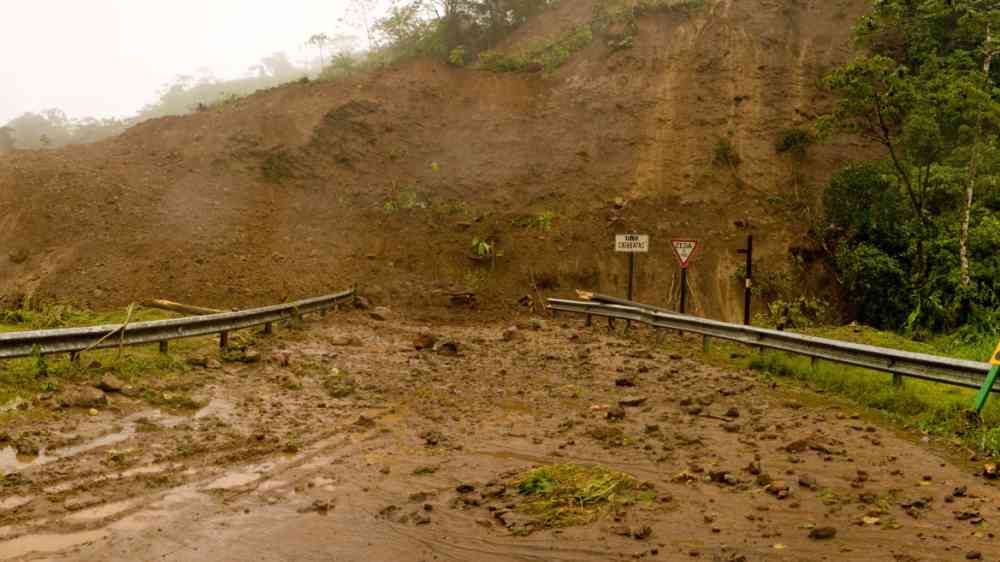
Mudslide blocking a road in Costa Rica
Update
NZ: Do trees prevent landslides? Here's what science says

Landslides in New Zealand’s hilly terrain typically result from a combination of preconditioning factors, many of which are influenced by human activity.

Conversation Media Group, the
Review article: Deep learning for potential landslide identification: data, models, applications, challenges, and opportunities thumbnail
Documents and publications

This review systematically examines and synthesizes over 400 studies, with a primary focus on literature from the last six years (2020–2025), alongside key foundational works.

European Geosciences Union
Uploaded on