Building resilience by design: from wildfires to broader challenges

As extreme weather events become more frequent and complex, building resilience requires inclusive approaches that connect science, policy and community action.
PreventionWeb spoke with Dr Sofia Karma, Director of the European Centre for Forest Fires (ECFF), about her career path, ECFF’s work and her perspective on growing wildfire risks and related challenges.
Tell us about your work and position
As Director of the European Centre for Forest Fires (ECFF), I coordinate activities aligned with the objectives and priorities of the EUR-OPA Major Hazards Agreement, a platform of the Council of Europe dedicated to disaster risk reduction, and with the priorities of the General Secretariat for Civil Protection in Greece, where the Centre is situated. These activities are implemented with the support of the Centre’s Administrative and Scientific Committee.
Our work combines scientific research, policy advice and capacity development to strengthen community resilience to wildfires and related hazards.
How did your career path lead you to ECFF?
My career has been shaped by both academic study and applied research. I have a background in chemical engineering, and during my PhD at the National Technical University of Athens I studied the impacts of wildfire smoke on human health and exposed communities. I also focused on state-of-the-art field technologies for air quality monitoring.
Over the years, I have worked on research projects related to wildfire risk assessment and community-based disaster preparedness, with a particular focus on Southern Europe and the Mediterranean region.
These experiences, together with my engagement in international disaster risk reduction networks, led me to ECFF, where I have been able to apply my expertise at a broader European and international level.
What are the objectives of ECFF?
Following the adoption of the Sendai Framework for Disaster Risk Reduction, ECFF strengthened its focus on understanding how wildfires, smoke and related hazards affect populations, particularly groups at higher risk in disasters, such as persons with disabilities, older persons and children.
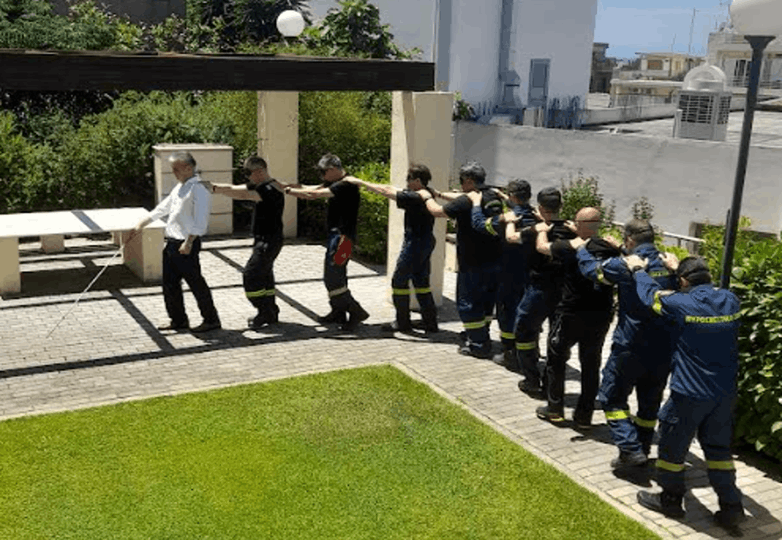
In this context and in line with the Sendai Framework priorities, since 2023 we have expanded our work on inclusive disaster preparedness. Activities have included organising inclusive evacuation exercises, producing accessible awareness-raising videos and developing accessible disaster preparedness procedures for multi-hazard scenarios.
In addition, we have implemented a training course for firefighters on supporting persons with different types of disabilities during emergencies. An accessible video has also been produced on disability inclusion and emergency response techniques.
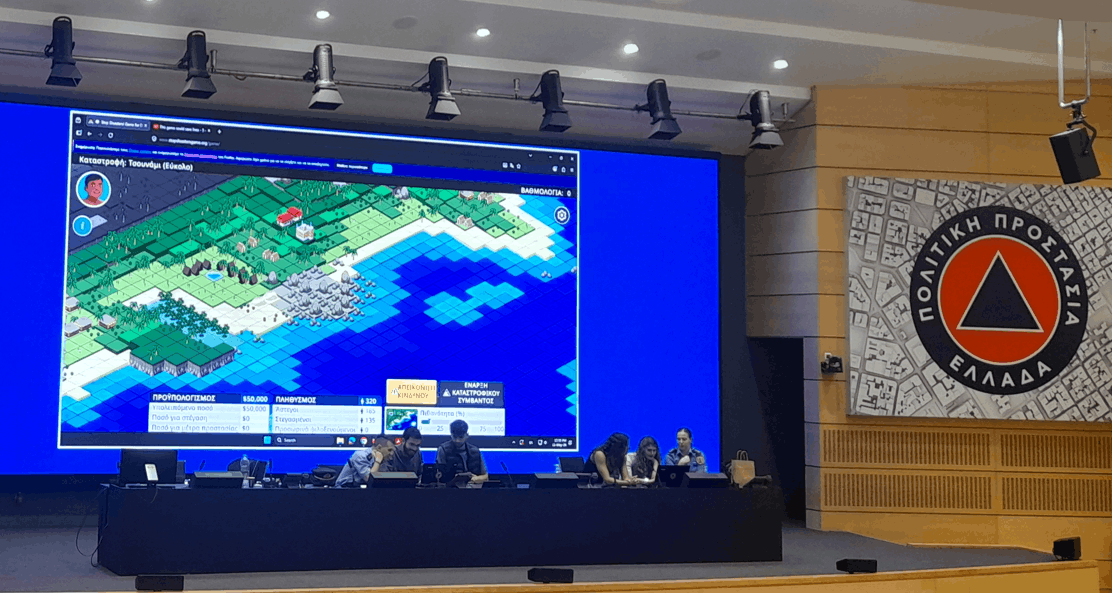
As part of efforts to strengthen inclusive disaster prevention and preparedness, ECFF has expanded its work with young people through innovative and interactive tools. One example is the Stop Disasters game, originally developed by the United Nations Office for Disaster Risk Reduction (UNDRR).
ECFF translated the game into Greek and tested it for the first time with university students, engineers and fire academy students during an educational workshop aimed at bridging academic and operational perspectives.
What are the key learnings from your collaborations?
To implement activities on inclusive disaster preparedness, ECFF collaborated with the National Confederation of Persons with Disabilities Greece (ESAmeA) and the Institute of the National Confederation of Persons with Disabilities and Chronic Diseases Greece (IN-ESAmeA), under joint projects with the European Centre on Prevention and Forecasting of Earthquakes, funded by EUR-OPA.
ECFF has also actively contributed to initiatives and knowledge-sharing activities organised by the United Nations Office for Disaster Risk Reduction (UNDRR), reflecting its engagement with international efforts to strengthen disaster resilience and inclusive risk governance. These include contributions to the report Flames of Change: Innovating Heat and Wildfire Governance for Inclusive Communities and the Special Report on Disability Inclusion in Disaster Risk Reduction and Prevention, as well as presentations at UNDRR Regional and Global Platforms and participation in the MCR2030 City-to-City Learning Forum. ECFF has also contributed to the Heat Scorecard document for extreme heat risk management.
A key takeaway is that addressing today’s complex risk landscape requires aligning scientific expertise with global policy frameworks. Interdisciplinary collaboration helps bridge the priorities of the Council of Europe’s EUR-OPA Agreement with the objectives of the UNDRR Sendai Framework. By combining technical and operational knowledge, we can ensure that risk reduction approaches remain practical, science-based and inclusive.
How do wildfires impact populations today?
Extreme weather events such as prolonged droughts, heatwaves and extreme temperatures are increasing in frequency globally. These conditions contribute to more severe wildfires, which burn hundreds of millions of hectares each year. For example, global wildfire burned area reached 367 million hectares in 2024, ranking 17th since 2001.
Wildfire smoke can travel across borders and affect populations far from the source of the fire. During the 2024 Canadian wildfires, smoke plumes crossed the Atlantic Ocean and reached Greece and the eastern Mediterranean, illustrating the transboundary nature of wildfire smoke transport.
However, the health risks associated with wildfire smoke are not yet widely known by the general public or even among emergency responders. Impacts depend on factors such as smoke composition, the characteristics of the burned landscape, and the duration and intensity of exposure.
Smoke from rural areas, urban environments or waste disposal sites may contain different pollutants, while individual vulnerabilities also influence health outcomes. Wildfires can also damage soil and water quality and affect biodiversity and ecosystems. Given their transboundary movement and wide-ranging impacts, wildfire smoke should be recognised as a significant hazard.
Strengthening community resilience through inclusive approaches and ensuring participation in preparedness and response can help reduce vulnerabilities and support more effective disaster risk management.
What advice would you give to young people interested in disaster risk management?
Disaster risk management is a dynamic and rewarding field, particularly as climate change increases the frequency and intensity of disasters. A strong technical or academic foundation is important, but curiosity and continuous learning are equally essential.
Practical experience is invaluable. Volunteering with civil protection agencies, non-governmental organisations or research institutions can provide important insights into how disaster risk management works in practice.
Every system produces the results that it is designed to produce.
It is also important to develop a global perspective. Disasters are increasingly interconnected, and effective solutions often require international cooperation. Engaging with international networks, attending workshops and participating in exchange programmes can help broaden both knowledge and skills.
The field of wildfire prevention and management is increasingly important and requires expertise from multiple disciplines, including fire engineering, forestry, environmental sciences, meteorology, urban planning, emergency management and public health, as well as data analysis, accessible early warning systems and risk assessment. Addressing wildfire risk requires interdisciplinary collaboration.
From an engineering perspective, I often refer to the idea that “every system produces the results that it is designed to produce”. Building resilience is therefore a long-term process that must be embedded in system design and strengthened through experience, training and learning.
Resilience is a shared responsibility, and young people have a vital role to play in shaping more resilient systems in the future. Inclusive community engagement is essential from the outset to ensure that diverse needs and perspectives are reflected in disaster risk management approaches.
Disaster risk management that indeed results into effective disaster risk reduction is challenging, but it also offers the opportunity to make a tangible difference in protecting lives, livelihoods and communities.