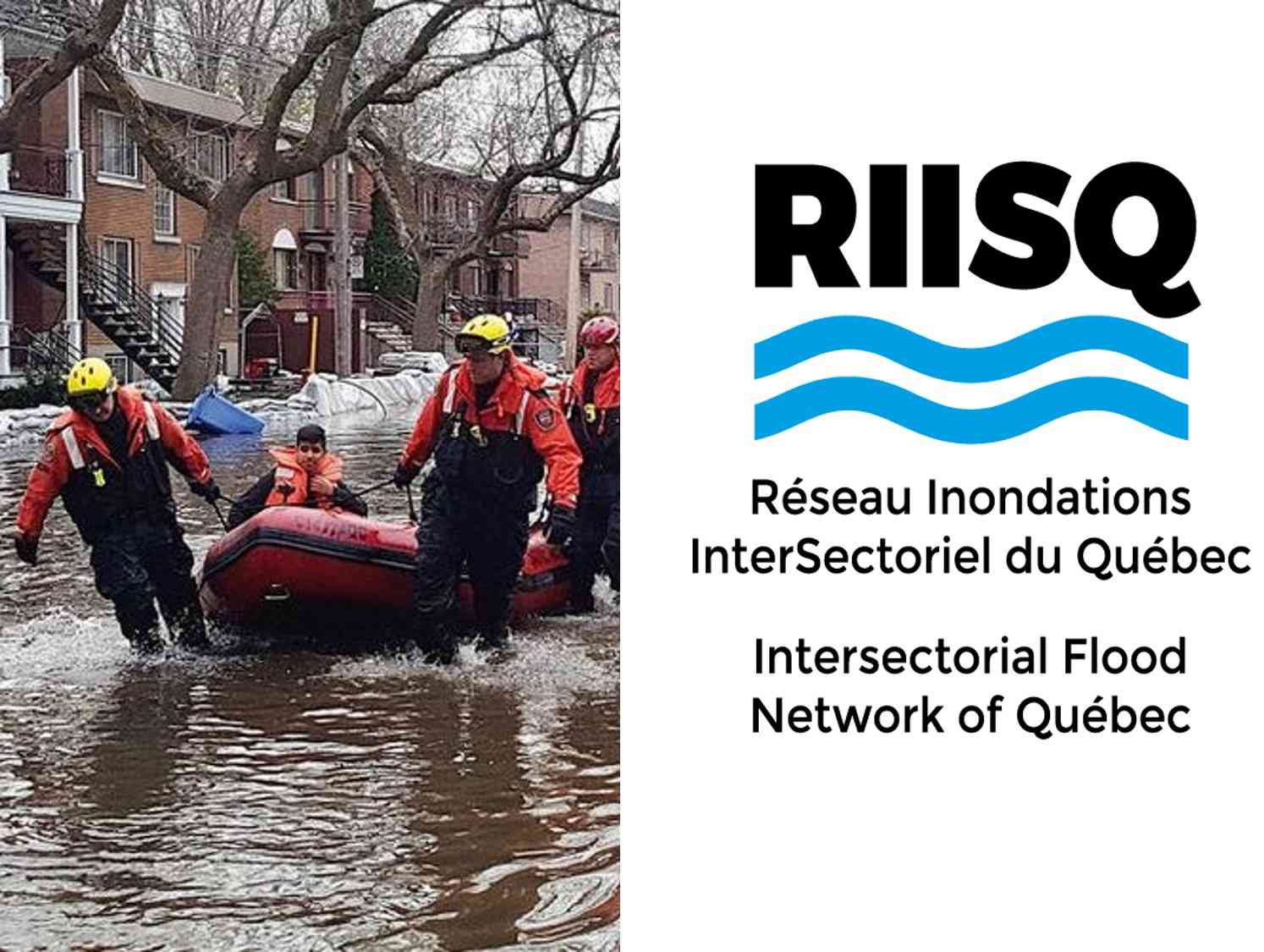
InterSectoral Flood Network of Quebec (RIISQ)
Quebec has been caught off guard during major floods, despite years of active research and protection efforts. Disciplinary silos failed to provide integrated solutions. The RIISQ network is committed to facilitate exchange and integration to improve preparation and protection against floods.
Description
The mission of the Réseau Inondations InterSectoriel du Québec (RIISQ) is to contribute to the reduction of flood risks and their consequences, and to facilitate the resilience of organizations, communities and individuals in the face of these events, which are worsening as a result of climate change. It promotes links between civil society and universities through the combined actions of (academic) researchers and government ministries, relying on new knowledge in science and technology, social and health sciences to develop concrete and sustainable solutions.
These last years, Quebec has been caught off guard during major floods, despite years of active research and efforts in the field of flood protection. Research has remained restricted to disciplinary silos, and as a result, failed to provide integrated solutions to the complex issue of flooding. The RIISQ network, in Quebec, funded by the Fonds de Recherche du Québec (FRQ), was therefore created. It’s a platform of exchange and integration that brings together all government stakeholders, socio-economic partners, as well as researchers from the social, scientific, technological, medical, economic and political fields, to improve Quebec's ability to get prepared for and protect against floods.
RIISQ is an inter-institutional, multi-communities and intersectorial network of innovative research partnerships and training to build a society that is more resilient to floods. The primary objective of RIISQ is to contribute to the development of advanced transdisciplinary research on flood risk management and its consequences in the context of climate change. Ultimately, we aim to provide answers and solutions to the needs of communities and individuals exposed to floods.
As a result of our commitment, we aim to provide: 1) Research and training, including the development of knowledge and the training of researchers and actors of change; 2) Networking and mobilization, including knowledge sharing activities among network members and partners help to better identify partner's needs and better equip them to deal with floods; and 3) Strategic influence and positioning in Canada and abroad, including contributions to flood risk management beyond Quebec's borders.
Did the Sendai Framework change or contribute to changes in your activities/organization? If so, how?
The Sendai Framework further encourages “the public and private sectors and civil society organizations, as well as academia and scientific and research institutions, to work more closely together and to create opportunities for collaboration.” Under this spirit, it provides a key role to coordination mechanisms within and across sectors and at all levels where networks can focus on the disaster risk factors and scenarios, including emerging disaster risks, in the medium and long term; increase research for regional, national and local application; support action by local communities and authorities; and support the interface between policy and science for decision-making.
What led you to make this commitment/initiative?
What was your position before making this Voluntary Commitment / prior to the Sendai Framework?
RIISQ contributes to reducing the risks of floods and their consequences by facilitating the resilience of vulnerable organizations, communities, and individuals and by promoting links between civil society and universities, while calling on new scientific knowledge in order to develop concrete and sustainable solutions. We have the following objectives:
- To combine field expertise and research on flood risks, including lessons learned (post mortem)
- To improve the understanding of the risks of floods and their consequences (domino effect)
- To improve our understanding of the vulnerability, adaptation, and resilience of individuals, organizations and communities to floods
- To contribute to renewed and improved flood risk governance and management
- To contribute to better awareness, prevention, preparedness, response, and recovery from flood events for stakeholders
- To synthesize existing knowledge and generate useful knowledge to provide decision-makers and populations with evidence-based and sustainable solutions
- To train the next generation and highly qualified personnel in flood risk management
Deliverables and Progress report
Deliverables
Deliverables are the end-products of the initiative/commitment, which can include issuance of publications or knowledge products, outcomes of workshops, training programs, videos, links, photographs, etc.
The RIISQ makes available dissertations, thesis, scientific articles, book chapters, research, and technical reports produced by RIISQ members as well as Partners.
The Intersectorial Flood Network of Québec (RIISQ) and the Réseau Québec maritime (RQM) launched its first joint call for projects, with the aim of strengthening intersectoral collaborations in flood risk management in the maritime environment.
The projects must support research related to flood management throughout Quebec's maritime territory, including the St. Lawrence system (river-estuary-gulf continuum) and the coastal areas of northern Quebec.
FRQNT-MITACS GLOBALINK RESEARCH GRANTS
The objective of the Globalink research grant (internship) is to promote the international mobility of students whose research activities are part of the scientific program of the Intersectorial Flood Network of Québec (RIISQ).
3rd RIISQ SCHOLARSHIP PROGRAM
RIISQ is pleased to launch its 3rd scholarship program, in which students are invited to apply for graduate scholarships or undergraduate internship grants.
RIISQ periodically organizes a series of webinars, workshops, symposiums, and conferences, among others.
The RIISQ makes available communication materials related to the network.
The RIISQ makes available dissertations, thesis, scientific articles, book chapters, research, and technical reports produced by RIISQ members as well as Partners.
Organizations and focal points
Implementing Organization(s)
Focal points
If a VC's contact information has been hidden, the SFVC team can forward a message.Partners
- Université de Sherbrooke
- Université du Québec à Trois-Rivières
- Université du Québec en Outaouais
- Université du Québec en Abitibi-Témiscamingue
- Université du Québec à Rimouski
- HEC Montréal
- École de technologie supérieure
- École nationale d'administration publique
- Institut National de la Recherche Scientifique
- Université du Québec à Chicoutimi
- Université du Québec à Montréal
- Concordia University
- Laval University
- McGill University
- Université de Montréal