The Great Hanshin-Awaji Earthquake Video Footage Archive for Public Viewing
The Video Footage Archive of the Great Hanshin-Awaji Earthquake is to share the lessons conveyed by these images and to contribute to public awareness raising and learning for the future generations to be prepared for future disasters.
Description
The Great Hanshin-Awaji Earthquake was the first major earthquake in history where the fateful moment and the subsequent reconstruction process were recorded in detail on video. The Asahi Broadcasting Corporation (ABC) Group retains an expansive library of archived footage from event and the aftermath. We wish to share the lessons conveyed by these images for the benefit of future generations. Therefore, the ABC Group has decided to release portions of our Great Hanshin-Awaji Earthquake Video Footage Archive to the public online. We hope that many will view these valuable images and use them as a basis for disaster prevention and mitigation in the future. We also hope this initiative will encourage a worldwide movement to release archived video records of disasters caused by natural hazards to the public for sustainable use and application.
Did the Sendai Framework change or contribute to changes in your activities/organization? If so, how?
The Sendai Framework for Disaster Risk Reduction called for media to take an active and inclusive role at the local, national, regional and global levels in contributing to the raising of public awareness, understanding, and disseminating disaster risk information in a simple, transparent, easy-to-understand and accessible manner. The work of ABC Groups aims to contribute to this important call.
What led you to make this commitment/initiative?
What was your position before making this Voluntary Commitment / prior to the Sendai Framework?
While we were already quite active within Japan for public awareness activities by using our media products, by learning the Sendai Framework and global DRR efforts coordinated by UNDRR, we are motivated by the possibility that our media products could be shared with the international community and also could contribute to stimulating a culture of prevention and strong community involvement in DRR, in accordance with local/national/international practices.
We also believe in the message shared by the Sendai Framework to strengthen the utilization of media, including social media, traditional media, big data, etc., to support national measures for successful disaster risk communication.
Deliverables and Progress report
Deliverables
Deliverables are the end-products of the initiative/commitment, which can include issuance of publications or knowledge products, outcomes of workshops, training programs, videos, links, photographs, etc.
We have released approximately 38 hours of footage in this project, taken from our coverage of the Great Hanshin-Awaji Earthquake over a period of about seven months, from the time immediately after the earthquake to August 23 in 1995. We are releasing this footage unedited to the greatest extent possible to communicate the unusual conditions surrounding a disaster.
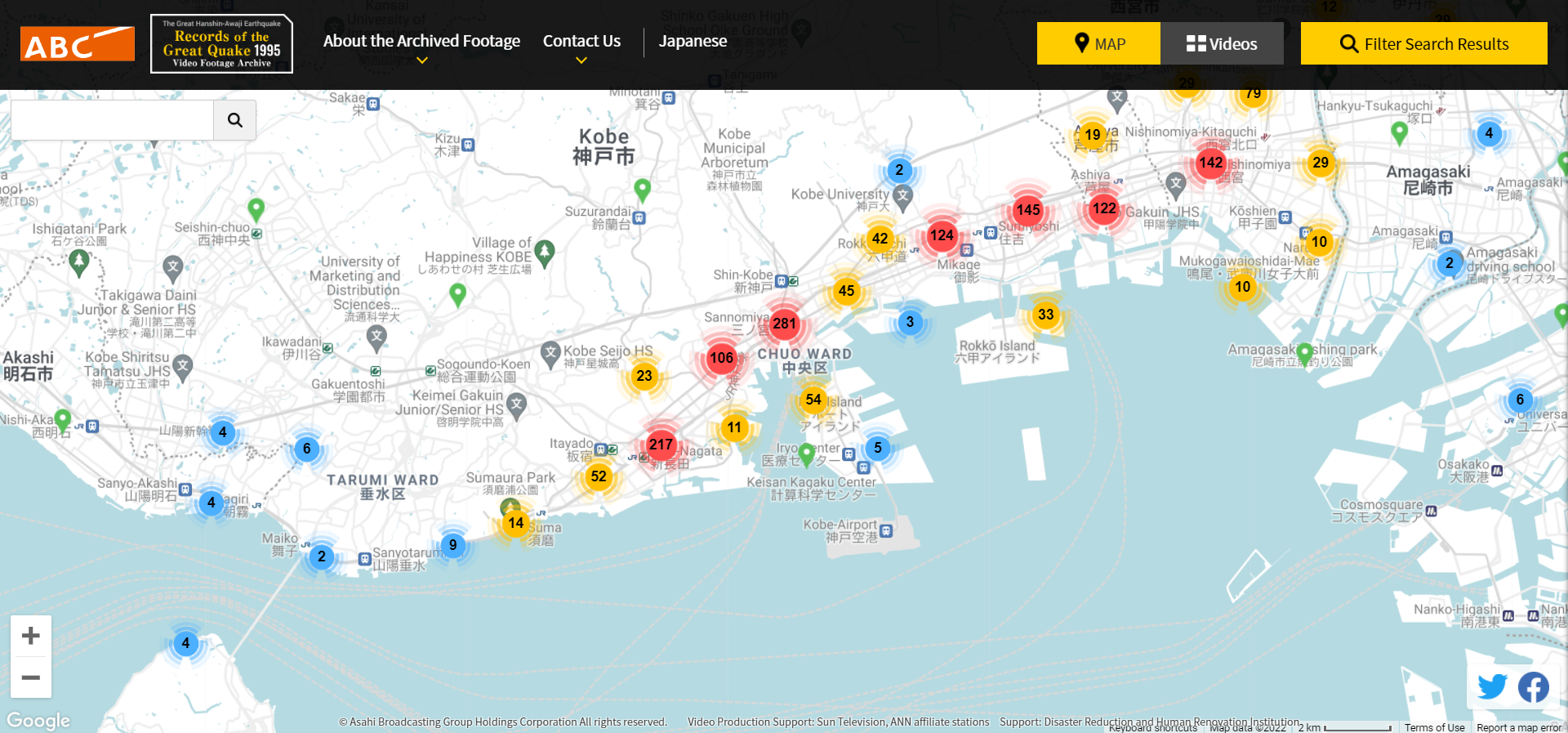
The approximate locations of these video clips are shown on the map indicating the affected areas. We segregated the videos into the following 12 categories to allow search by date and scene.
Fire/House Collapse/Infrastructure/Rescue/Evacuation Shelters/Medical Care/Living/Education /Transportation/Recovery and Reconstruction/Self-Defense Forces, Police, Firefighters/Support and Volunteers/
We hope this video footage archive will be viewed widely by individuals, families, and schools for use in disaster prevention and mitigation.
Our Video Footage Archive now links to the Japanese National Diet Library Great East Japan Earthquake Archive HINAGIKU via metadata. This link allows the full search of The Great Hanshin-Awaji Earthquake, Records of the Great Quake 1995 Video Footage Archive from the HINAGIKU portal site.
HINAGIKU is an earthquake archive portal site established in the wake of the 2011 Great East Japan Earthquake. The site provides search access across a large number of archives curated up by various public and private organizations. The site also links to other archives, including the Mid Niigata Prefecture Earthquake of 2004 and the Kumamoto Earthquake of 2016.
This archive of the Great Hanshin-Awaji Earthquake is the third in addition to the Great Hanshin-Awaji Earthquake Disaster Materials Collection of Kobe University and the library of the Disaster Reduction and Human Renovation Institution.
We added a free-to-use e-learning function to The Great Hanshin-Awaji Earthquake, Records of the Great Quake 1995 Video Footage Archive. The new function makes the archive easier to use in the classroom, etc., for disaster prevention education. Based on joint research with the Disaster Prevention Research Institute of Kyoto University, we developed a feature for the website to identify videos depicting the reality of urban earthquakes. This new feature encourages discussions among children and students, helping them become more aware of disaster preparation. Several elementary schools and junior high schools already use this e-learning function in disaster prevention classes.
For example, Kanokodai Elementary School in Kobe City, Hyogo Prefecture, uses this Video Footage Archive e-learning function in a disaster prevention class for fifth-grade students.
We added more than 200 clips of eyewitnesses to The Great Hanshin-Awaji Earthquake, Records of the Great Quake 1995 Video Footage Archive on the 30th anniversary of the disaster.
Young staff members who knew relatively little about the earthquake searched for eyewitnesses who submitted footage to ask about the conditions surrounding the footage. We hope these new clips serve as social assets that convey the lessons learned from the disaster in a much more personal way for many years to come.
In December 2020, we published a book entitled The Great Hanshin-Awaji Earthquake: Smartphone-Compatible Disaster Footage Teaching Lessons for the Future. To make our archive more accessible, we included 357 curated pieces of footage linked via scannable codes for convenient viewing by smartphone. In addition, Asahi Television Broadcasting reporters provide supplementary written coverage of the historical background and on-site conditions at the time to help viewers better understand the disaster footage.
Public Recognitions (Awards) were received for The Great Hanshin-Awaji Earthquake, Records of the Great Quake 1995 Video Footage Archive as follows:
- Broadcasting Culture Award, Awards for Outstanding Individual/Group Performance, 46th HBF (Hoso Bunka Foundation) Prize
- Outstanding Broadcasting for Public Interest, JBA (Japan Commercial Broadcasters Association) Awards 2020
- Prize for Contribution, Digital Archive Industry Award 2020
- 2021 GOOD DESIGN AWARD
- Special Prize, 35th Regional Publishing Culture Awards
- Practical Implementation Award, 6th Japan Society for Digital Archive Awards
We published an expanded edition of The Great Hanshin-Awaji Earthquake: Smartphone-Compatible Disaster Footage Teaching Lessons for the Future to include some of the eyewitness accounts collected, available via scannable code.
Porgress report
・In December 2020, we published a book entitled “The Great Hanshin-Awaji Earthquake: Smartphone-Compatible Disaster Footage Teaching Lessons for the Future.” To make our archive more accessible, we included 357 curated pieces of footage linked via scannable codes for convenient viewing by smartphone.
・In March 2022, our Video Footage Archive was linked to the National Diet Library Great East Japan Earthquake Archive HINAGIKU via metadata.
・In March 2023, we added a free-to-use e-learning function to Video Footage Archive. Several elementary schools and junior high schools already use this e-learning function in disaster prevention classes.
・In December 2024, we made more than 200 new clips of eyewitnesses public.
・In December 2024, we published an expanded edition of “The Great Hanshin-Awaji Earthquake: Smartphone-Compatible Disaster Footage Teaching Lessons for the Future.”
In Dec 2020, we published a book entitled “The Great Hanshin-Awaji Earthquake: Smartphone-Compatible Disaster Footage Teaching Lessons for the Future” (“Video Footage Archive”). To make our archive more accessible, we included 357 curated pieces of footage linked via scannable codes for convenient viewing by smartphone. In Mar 2022, our Video Footage Archive linked to the National Diet Library Great East Japan Earthquake Archive HINAGIKU via metadata. In Mar 2023, we added a free-to-use e-learning function to Video Footage Archive. Several elementary schools and junior high schools already use this e-learning function in disaster prevention classes. ・In Dec 2024, we added more than 200 clips of eyewitnesses to Video Footage Archive on the 30th anniversary of the disaster. ・In December 2024, we published an expanded edition of “The Great Hanshin-Awaji Earthquake: Smartphone-Compatible Disaster Footage Teaching Lessons for the Future” to include some of the eyewitness accounts collected, available via scannable code.
Organizations and focal points
Implementing Organization(s)
Focal points
Partners