Building Seismic Insights by Global Seismic Data
Global Seismic Data (GSD) is a global, full-service Structural Health Monitoring Software-as-a-Service company. Integrating innovation, technology and structural engineering into a single professional solution with its industry partners.
Description
Global Seismic Data (GSD) was established in New Zealand in 2018. Proponents in the development of affordable cloud service solutions that measure seismic activity of buildings and infrastructure. Resulting data is used to flag vulnerabilities, allowing engineers to assess and strengthen structures – providing economic resilience for building owners. In addition, alerts are broadcast during a large event to notify stakeholders of a buildings status – protecting lives and allowing businesses to resume as soon as possible after an event.
Earthquakes are a global hazard which pose a threat to life and cause significant business interruption and social upheaval. Our Structural Health Monitoring System™ protects lives and reduce recovery costs. Furthermore, our system bring benefits for the whole community: Personal safety and economic preparedness; Rapid informed building occupancy decisions during an event; Improved life safety decisions; Reduced business interruption; Prevents unnecessary evacuations; Co-ordination of emergency response; and Reduction of costly downtime and distress.
An example of the way we do this is by strategically placing trademarked sensors within a building. Sensors relay seismic movement within millimetre accuracy to our cloud-based data centre 24/7. Spectra data is measured and analysed, measuring a buildings structural health – like an electrocardiogram (ECG) check for buildings. Engineers and building owners have access to real-time and historical data in order to assess: Immediate needs in a live event, allowing decisions on building occupancy, to stay or evacuate; or To plan and futureproof for safety and economic recovery and to identify workplace hazards.
GSD has a valuable team of skilled individuals working together to provide excellence in the delivery of affordable seismic monitoring services. We provide ongoing support to our growing network of dedicated partners around the world. The shareholder mix of technology, engineering and natural hazards sector experts provides a valuable resource to lead and build seismic insights that will benefit whole communities.
Did the Sendai Framework change or contribute to changes in your activities/organization? If so, how?
The Sendai Framework calls for the promotion of real-time access to reliable data, make use of space and onsite information, and use information and communications technology innovations to enhance measurement tools and the collection, analysis and dissemination of data for better disaster risk management. Furthermore, it indicates that investing in technology and research is a key component to enhance multi-hazard early warning systems, preparedness, response, recovery, rehabilitation and reconstruction. At GSD we aim to contribute to this and other aspects of the Sendai Framework.
What led you to make this commitment/initiative?
What was your position before making this Voluntary Commitment / prior to the Sendai Framework?
Among several aspects relevant to science, the Sendai Framework identified research and technology gaps as an important issue. In particular for promoting and supporting the availability and application of science and technology to decision-making.
Within this framework, GSD’s vision is to see businesses and communities benefit from a system of safety by continuing to grow joint venture partnerships locally and globally with engineering companies, telecommunication companies, and insurers.
“We want to enable building owners, property managers, facilities managers along with government local authorities and engineering companies to prepare, be well equipped with a high quality, sustainable valid risk matrix. We want to see lives saved and rapid recovery during large seismic events.”
Deliverables and Progress report
Deliverables
Deliverables are the end-products of the initiative/commitment, which can include issuance of publications or knowledge products, outcomes of workshops, training programs, videos, links, photographs, etc.
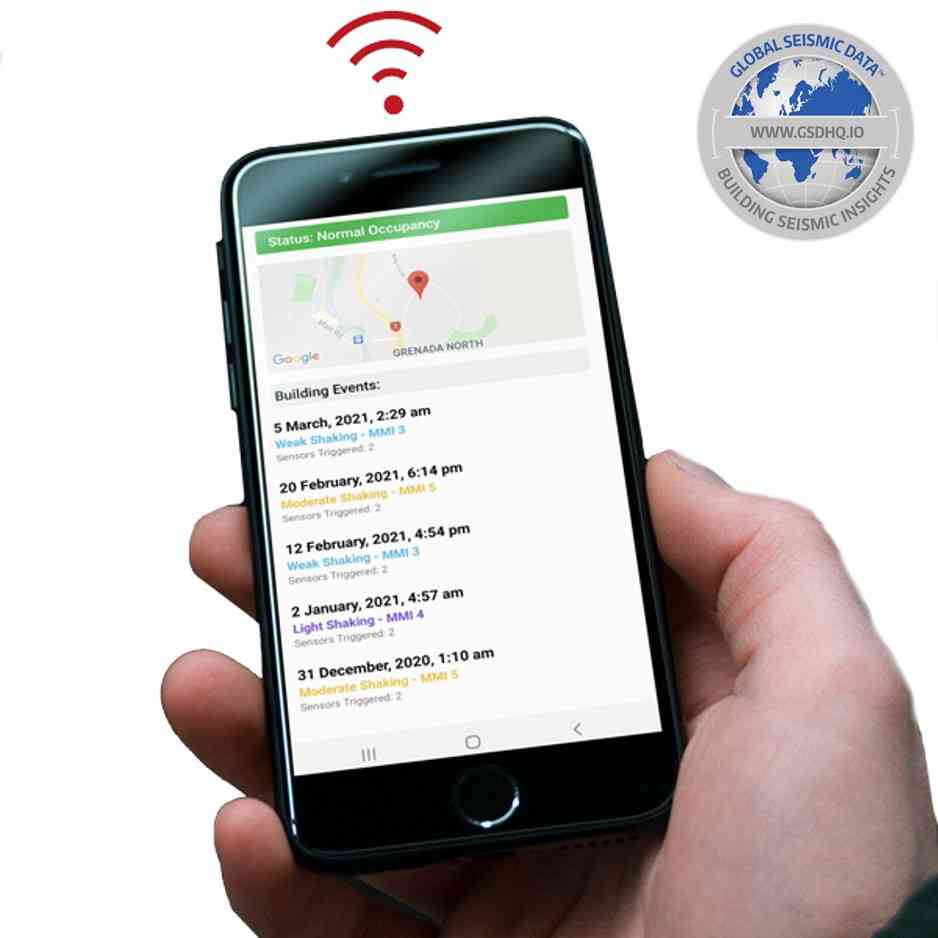
Engineers need to easily and quickly assess building structural safety at any given moment in time. Engineers are able to instantly access building specific performance metrics to make informed decisions. This has proven to enable rapid data-based triage of multiple buildings and target specific buildings or floors for physical inspection. Along with providing building occupancy status to aid critical life safety decisions, our real-time Alerting Service App improves business continuity outcomes. See examples of our spectra data analysis in the link below.
Our Five Phase System Solution provides ongoing access and assessment of seismic data on buildings and infrastructure, communities can better prepare for, and manage seismic events across the resilience index, of risk, readiness, response and recovery.
We can learn a lot from historical events and understand critical needs from communities managing emergency response to current seismic events. Our news feed includes industry insights from engineers and historical events.
You may access a curated list of seismic events from around the world in the link below.
GSD’s strategically-located sensors constantly monitor a building’s movement and behaviour. These sensors measure any changes in its orientation, safety and capacity to keep people safe.
More information in the link below.
Organizations and focal points
Implementing Organization(s)
Focal points
If a VC's contact information has been hidden, the SFVC team can forward a message.Partners