UN Plan of Action 2023 Progress Report
UN Plan of Action 2023 Progress Report

The UN Plan of Action on Disaster Risk Reduction for Resilience is the contribution by the UN to ensure the implementation of the Sendai Framework contributes to a risk-informed and integrated approach to the achievement of the 2030 Agenda for Sustainable Development.
The 2025 UN Plan of Action Progress Report focuses on pooling capacities and resources for prevention. It summarizes progress reported by UN entities, reflecting on collective achievements, opportunities, challenges and gaps in advancing disaster risk reduction and resilience in the context of shrinking resources and shifting priorities.
Shared impact: inter-agency success stories in DRR
Across regions, demand-driven and inter-agency cooperation is key to building resilience against disaster and climate impacts.
Examples from Timor-Leste and Cuba show how pooling UN capacities and resources through risk-informed Cooperation Frameworks, joint analysis and coordinated support to national partners helps sustain and scale disaster risk reduction in the face of escalating risks and uncertainty.
Discover in detail the following impact stories:











Good practices in action
This interactive map spotlights good practices curated through UN Plan of Action on Disaster Risk Reduction reporting since 2021. It captures field-tested approaches to strengthening disaster risk reduction, resilience and risk-informed sustainable development across countries, regions and global initiatives. The practices cover key themes including gender, climate change, early warning, inclusion and preparedness, among many others.
To access each case study, hover your cursor over a circle, click on it, and then click on the case study hyperlink.
Global case studies
Two case studies are global in nature and listed here:
UN Plan of Action implementation
Year 2025 in numbers
A total of 35 organizations submitted reporting under the UN Plan of Action for 2025: DCO, DESA, DPPA, ECE, ECLAC, ESCAP, ESCWA, FAO, IFAD, ILO, IOM, ITU, OCHA, UNCCD, UNCTAD, UNDP, UNDRR, UNEP, UNESCO, UNFCCC, UNFPA, UN-Habitat, UNHCR, UNICEF, UNITAR, UN-OHRLLS, UNOPS, UN Tourism, UNU, UNV, UN-Women, UPU, WFP, WHO and WMO.
 9 out of 11 targets
have already been reached in 2025.

- Commitment 1
Commitment 1
Strenghten system-wide coherence in support of the Sendai Framework and other agreements, through a risk/informed and integrated approach.
The 2025 target has been surpassed for support to the implementation of risk-informed UN system policies, guidelines, and inter-agency initiatives.
- Commitment 1 achievements
Commitment 1 achievements
- 30 risk-informed UN system policies [FD8] being implemented.
- 16 UN organizations supported the application of 36 risk-informed UN system guidelines.
- 18 UN organizations supported the implementation of 24 DRR/resilience-related inter-agency initiatives.
- 86 per cent of programme countries (131 out of 152) reported on progress towards the common DRR-indicators through the Sendai Framework Monitor, in 2025.
- 10 UN organizations provided support to 107 programme countries on disaster-related statistics, including on the disaggregation of data by sex, age, disability, displacement status. Disaggregation by income status
- Commitment 1 progress against indicators
Commitment 1 progress against indicators

- Commitment 2
Commitment 2
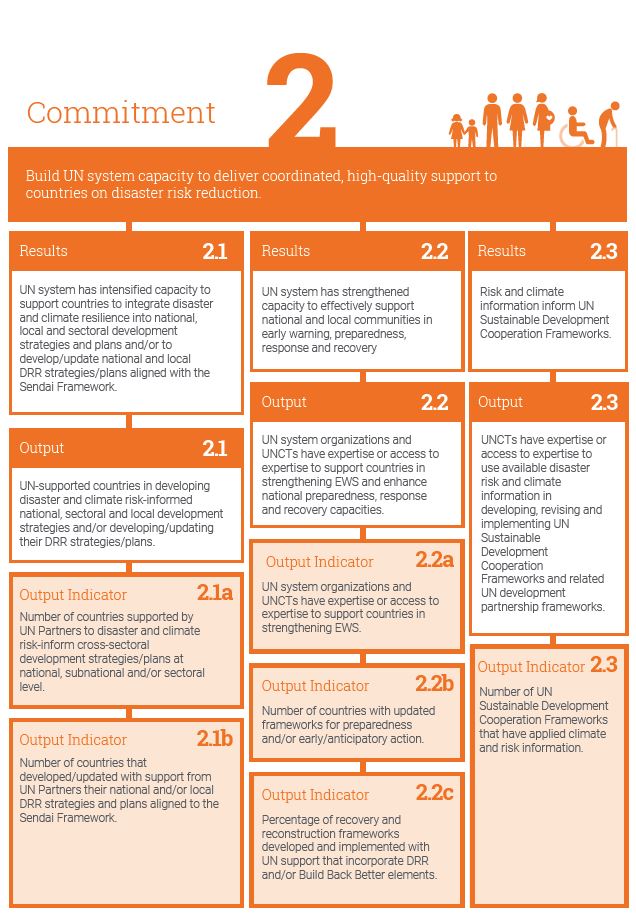
Build UN system capacity to deliver coordinated, high-quality support to countries on disaster risk reduction.
The 2025 Target has been surpassed.
92 per cent (140 out of 152) Programme Country Governments have been supported in developing/updating or implementing national DRR strategies between 2019 and 2025. Between 2019 and 2025, 140 programme countries have been supported on developing, updating or implementing national DRR strategies, and 125 countries have been supported on local DRR strategies. Progress continued in 2025 with 4 additional countries supported. A continued focus on programme countries that have not been supported so far is needed to reach the target for support to the implementation of national DRR strategies.
- Commitment 2 achievements
Commitment 2 achievements
- 102 countries were supported in risk-informing national cross-sectoral development strategies/plans in 2025. Cumulative number of countries supported: 149.
- 89 countries were supported in risk-informing sectoral development strategies/plans in 2025. Cumulative number of countries supported: 139.
- 73 Programme Country Governments were supported in developing national DRR strategies in line with Target E of the Sendai Framework in 2025.
- 51 Programme Country Governments were supported in developing local DRR strategies in 2025.
- 85 Programme Country Governments were supported on national and/or local DRR strategies in 2025.
- 26 countries were supported through global early-warning mechanisms, 126 through national early-warning mechanisms, and 82 through regional early-warning mechanisms (143 programme countries were supported in total).
- 114 countries supported with national preparedness frameworks were reported. Until the end of 2025, the total number of countries supported with national preparedness frameworks was 152 (100 per cent of programme countries).
- 82 countries supported with frameworks for early/anticipatory actions were reported. The total number of supported countries with frameworks for early/anticipatory actions until the end of 2025 was 146.
- 72 Programme Country Governments received support in 2025 to develop Recovery and Reconstruction Frameworks. Of these, 88 per cent included elements to Build Back Better.
- 151 countries have been supported to develop recovery/reconstruction frameworks, until the end of 2025.
- More than 100 Cooperation Frameworks / UNSDCFs have integrated DRR or applied climate and disaster-risk information since 2019.
- Commitment 2 progress against indicators
Commitment 2 progress against indicators

- Commitment 3
Commitment 3
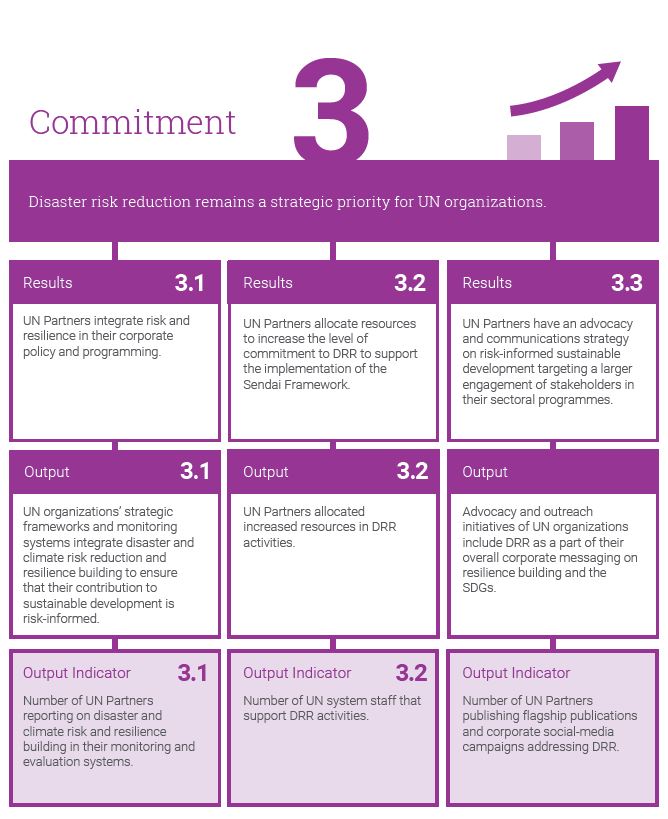
Ensure disaster risk reduction remains a strategic priority for UN Partners.
The 2025 target has been surpassed with DRR staff having more than doubled since 2020.
- Commitment 3 achievements
Commitment 3 achievements
- 34 organizations (67 per cent) have indicated including disaster / climate risk and resilience-building indicators in their monitoring and evaluation systems and strategic frameworks.
- As this target has been surpassed every year with DRR staff having more than doubled since 2020, no reporting was requested on this indicator for 2025. In 2023, 8022 UN staff members with 32 UN organizations supported risk reduction activities. In addition, in 2025, UNV deployed 491 assignments related to DRR, early warning, resilience, climate change and disaster management.
- 14 UN organizations produced flagship publications related to DRR, in 2025. Cumulative number of UN organizations reporting flagship reports until the end of 2025: 37.
- 9 UN organizations produced social media campaigns on DRR (1 new in 2025). Cumulative number of UN organizations reporting social media campaigns until the end of 2025: 29.
- While there has been significant progress since 2018, with 67 per cent of UN organizations reporting inclusion of climate/disaster risks and resilience-building in their monitoring and evaluation systems and strategic frameworks, progress needs to be accelerated in order to reach the target.
- Commitment 3 progress against indicators
Commitment 3 progress against indicators
Accelerating DRR through joint action
In 2023, the UN SLG adopted five recommendations to accelerate progress in the implementation of the UN Plan of Action by 2030.
Progress was made across Risk-informing Humanitarian-Development-Peace Planning, Finance, Inclusion and Early Warning.
- Risk governance
Risk governance
- DRR featured strongly in global intergovernmental agreements and processes in 2025, including the Sevilla Commitment / Financing for Development 4, UNEA-7, the Awaza Political Declaration on Landlocked Developing Countries, and the Our Ocean, Our Future resolution of the United Nations General Assembly.
- DRR was mainstreamed in key UN system-wide policies and processes. In 2025, 73 programme country governments were supported in developing, updating or implementing national DRR strategies in line with Target E of the Sendai Framework.
- Good practices continued to demonstrate how reducing risk can enable SDG acceleration and strengthen integrated approaches across sectors.
- Risk-inform humanitarian, development and peace actions
Risk-inform humanitarian, development and peace actions
- 82 countries were supported with frameworks for early/anticipatory actions in 2025
- Methods to develop inter-agency, multisectoral and multidimensional risk analysis continued to be strengthened, with examples of risk-informed programming and analysis in countries including Ecuador, Honduras, the Lao People’s Democratic Republic, the Niger, Peru and Viet Nam.
- The integration of DRR in humanitarian action continued, including through preparedness, early/anticipatory action and emergency response preparedness frameworks.
- More than 100 Cooperation Frameworks signed since 2019 have integrated DRR or applied climate and disaster-risk information.
- Invest in DRR and reform the financial system to better consider risks
Invest in DRR and reform the financial system to better consider risks
- DRR was integrated into the Fourth International Conference on Financing for Development, with the Sevilla Commitment including dedicated language on disaster risk reduction and multiple references to disaster and climate risk financing.
- Country-level support to risk financing and Integrated National Financing Frameworks advanced, including through climate finance, blended finance, innovative risk transfer solutions, national and local budget allocations and risk-informed public and private investment.
- The High-Level Principles for Investing in DRR were endorsed by the G20.
- Inclusive DRR measures
Inclusive DRR measures
- 22 countries have started integrating the Sendai Gender Action Plan into their DRR efforts, with UN support.
- Across the support provided to governments on national DRR monitoring and reporting, 10 UN entities supported 107 programme countries on disaster-related statistics / national DRR monitoring and reporting. This included support for data disaggregation by sex, age, disability, income and displacement status. 6 UN entities supported sex-disaggregated data, 7 supported age-disaggregated data, 5 supported disability-disaggregated data, 1 supported income-disaggregated data and 3 supported displacement-status-disaggregated data.
- A wide range of good practices on Gender Equality and Women’s Empowerment, child-responsive DRR, and Leaving No One Behind were collected, informing further DRR support to countries.
- Strengthen multi-hazard early warning systems
Strengthen multi-hazard early warning systems
- In 2025, 143 programme countries were supported on early warning systems or mechanisms: 26 countries through global early-warning mechanisms, 126 through national early-warning mechanisms, and 82 through regional early-warning mechanisms.
- The Early Warnings for All initiative continued to advance political commitment, expand national technical capacities and strengthen global action to scale up multi-hazard early warning systems. EW4All roadmaps were under development in 46 countries, with technical assistance provided to more than 65 countries.
Sendai Gender Action Plan
The Sendai Gender Action Plan was launched and rolled out at global, regional and country levels, advancing gender equality and women’s empowerment in DRR planning and implementation.
- Across all the support provided to governments on national DRR monitoring and reporting, 11 of the UN organizations supported the disaggregation of data by sex, 11 supported the disaggregation by age, 9 the disaggregation by disability, and 6 organizations supported countries on the disaggregation by displacement status.
- A wide range of good practices on Gender Equality and Women’s Empowerment, child
-responsive DRR, and Leaving No One Behind were collected, informing further DRR support to countries.
Key publications
These flagship reports are key examples of individual and collaborative achievements under the 2030 UN Senior Leadership Group on Disaster Risk Reduction for Resilience (UN SLG) Recommendations reported by UN entities to advance resilience-building.






Recent DRR content by UN partners
View content produced by UN Funds, Programmes, Specialized Agencies and others which support the UN Plan of Action on Disaster Risk Reduction for Resilience.