United Nations University (UNU)
Mission
The United Nations University (UNU) is the academic arm of the United Nations with the mission to contribute, through collaborative research and education, to efforts to resolve the pressing global problems of human survival, development, and welfare that are the concern of the United Nations, its Peoples, and Member States.
The overarching goal of the United Nations University is to contribute to global sustainable development that will enable present generations to live a decent life in peace, in freedom, in safety, and in good health, without compromising the ability of future generations to do the same. In pursuit of this ideal, the UN University employs a systems-oriented, interdisciplinary, problem-solving approach that integrates the methodological rigor of the natural and physical sciences with the insights of the social sciences and humanities.
The programme space within which UNU undertakes its academic activities encompasses five interdependent thematic clusters within the overarching thesis of “sustainability”:
- Population and Health;
- Development Governance;
- Peace, Security and Human Rights;
- Global Change and Sustainable Development;
- Science, Technology and Society.
These five thematic clusters, and the topics of focus that they encompass, are interlinked and interdependent in the sense that none can be addressed in isolation.
Disaster Reduction Goal
Some of the UNU Institutes have at the core of their mandate to contribute to disaster risk reduction and increase resilience of exposed communities. Notably, the UNU Institute for Environment and Human Security addresses the risk and vulnerability aspects of human security and the consequences of complex environmental hazards for sustainable development.
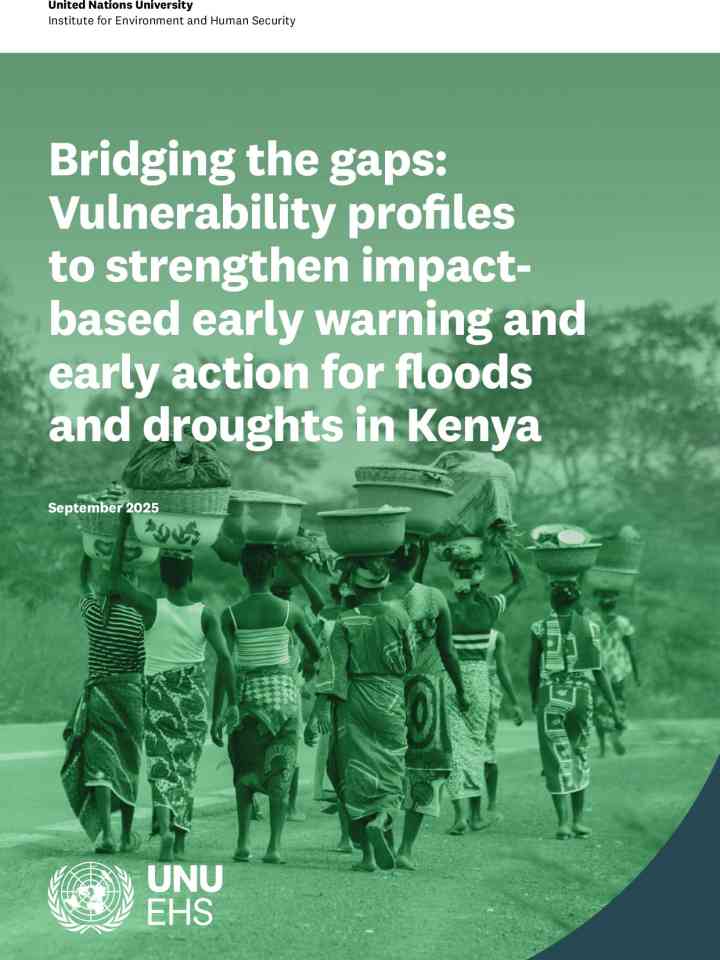
1. UNU-EHS has continued to support the UN's Early Warnings for All initiative through various projects: (1) as part of our project on early warning systems in four Indian Ocean Island States, we conducted two simulation exercises: a national workshop on Emergency Operation Centres in Mauritius (19-23 August 2024) and Madagascar's largest-ever National Simulation Exercise (18-20 September 2024) to test early warning, early action, and emergency response systems. (2) As part of the UNDRR-funded EarlyWarning4IGAD project, we held consultations in Kenya and Ethiopia, including a workshop in Naivasha (February 2024) and follow-up interviews. Discussions focused on impact-based early warning for floods and droughts, vulnerable groups, and data availability. We also provided training on impact-based forecasting with participants from 11 countries.
2. The Sustainability Nexus AID program, a joint initiative of UNU-FLORES[1] and UNU-INWEH[2] launched in 2023, continued in 2024, addressing drought, floods, wildfires, and infrastructure resilience. It advances disaster risk understanding (Priority 1) and risk governance (Priority 2) under the Sendai Framework by facilitating data exchange, analytical tools, and best practices. By maintaining up-to-date resource inventories, the program enhances disaster preparedness and recovery (Priority 4), equipping stakeholders with advanced tools to support effective response and "Building Back Better" post-disaster.
3. In the scope of the project "Developing a framework to assess climate change and disaster-induced losses of biodiversity and ecosystem services (FRAME-LES)" UNU-EHS develops the said framework that can accelerate the implementation of the Sendai Framework as it enhances understanding these losses as specific dimension of risk, hence it enhances overall risk understanding and management. Additionally, such a framework facilitates better data collection and international cooperation, helping countries meet Sendai Framework targets. Relevant targets include reducing the number of affected people (Target B), reducing direct disaster economic loss (Target C), protecting critical infrastructure (Target D), and improving risk information systems (Target G). Further, the project holds significance countries' Biennial Transparency Reports (BTRs) and Loss & Damage Reporting through national Adaptation Plans and Nationally Determined Contributions.
4. UNU-IAS[3] research and policy engagement on the Noto Peninsula Earthquake, including the importance of well water use in disaster resilience, has helped to integrate the biodiversity and SDGs agendas into recovery policies, as well as amplifying youth perspectives. The research has recorded significant post-earthquake ecological changes, including expanded beaches and new habitats for wildlife, highlighting their importance as resources for recovery. UNU-IAS also strengthened understanding of resilience through the 40th UNU Global Seminar (Ishikawa Prefecture, Japan; 21-24 August 2024), which engaged 21 participants from Japan and five other countries. It shared knowledge and lessons from recovery efforts in Noto Peninsula, and activities at Mt. Hakusan designated as UNESCO Biosphere Reserves and World Geopark, with a focus on integrating traditional knowledge and nature-based solutions.
5. The Munich Climate Insurance Initiative (MCII) hosted by UNU contributes to strengthening DRR with projects that advance climate policy, expanding risk transfer solutions like parametric insurance, and enhancing climate risk analytics through open-source modeling and stakeholder engagement tools. Through regional initiatives such as the Climate Risk Adaptation and Insurance in the Caribbean (CRAIC) and the Pacific Insurance and Climate Adaptation Programme (PICAP), MCII helped close the protection gap in climate-vulnerable countries. Additionally, the Multi-Actor Partnership on Climate and Disaster Risk Financing (MAPs) has supported risk finance preparedness in Laos, Sri Lanka, Malawi, Madagascar, Senegal, the Philippines, and several Caribbean nations. Similarly, MCII collaborated with GIZ, KfW, UNCCD, and IDMC to apply innovative climate risk modeling in Egypt, Thailand, Pakistan, Vietnam, and Niger, further integrating risk analytics into policy and finance strategies.
[1] UNU Institute for Integrated Management of Material Fluxes and of Resources.
[2] UNU Institute for Water, Environment and Health
[3] UNU Institute for the Advanced Study of Sustainability
Membership in Key Networks
- International Flood Initiative (IFI)
- International Programme on Landslides (IPL)
- Associated Programme on Flood Management (APFM)
- Global Risk Identification Programme (GRIP)
- Global Environment Fund (GEF)
- International Council for Science (ICSU)
- International Consortium of Landslides (ICL)
- DesertNet International
- Group on Earth Observation (GEO) - Institutions and Development Implementation Board
- Munich Climate Insurance Initiative (MCII)
- Partnership for Environment and Disaster Risk Reduction
- In the year 2007 alone, UNU worked with almost 50 UN system partners.
National Counterpart
National universities, research institutions, ministries, depending on the system of governance and focus of the activities.
Disaster Reduction Focal Point(s)
Dr. Fabrice Renaud, Head of Section, UNU-EHS, UN Campus, Hermann-Ehlers-Str. 10, 53113 Bonn, Germany ([email protected])
Alternate: Dr. Joerg Szarzynski, Head of Section (same address as above, ([email protected])
HFA activities
Risk assessment and early warning systems (HFA 2)
Research in Africa, Asia and Europe on vulnerability, resilience and risk assessment. The work consists in developing new assessment concepts and frameworks, as well as assessing risks to environmental hazards.
Education, information and public awareness (HFA 3)
Joint International MSc Programme on the Geography of Environmental Risks and Human Security. The joint international MSc Programme, developed by the United Nations University Institute for Environment and Human Security (UNU-EHS) and the University of Bonn is expected to launch in October 2013. The main purpose of the MSc Programme is to educate students on how to investigate and manage various resources related to environmental hazards by implementing science-based principles and methodologies in disaster risk management.
UNU-EHS PhD Block Courses: From Vulnerability to Resilience in Disaster Risk Management. The UNU-EHS PhD Block Courses highlight the complexity and importance of vulnerability and resilience in disaster risk management. They are offered every year in collaboration with the University of Bonn; Germany, as well as with the Disaster Management Training and Education Centre for Africa (DiMTEC), University of the Free State, Bloemfontein, South Africa. The courses are designed for postgraduate candidates in the early stages of PhD research (or about to begin PhD studies) and advanced Master's degree students.
West African Science Service Centre on Climate Change and Adapted Land Use (WASCAL) Graduate Research Programme. Starting in 2013 UNU-EHS is contributing to the WASCAL Graduate Research Programme, which is supporting and facilitating academic education amongst West African universities, in association with German counterpart institutions. Out of a total of nine different PhD and Master programmes, UNU-EHS actively supports the following programmes: Climate Change and Human Security (University of Lomé, Togo); and Climate Change and Education (University of The Gambia, Serrekunda, Gambia).
Reducing underlying risk factors (HFA 4)
The Climate Risk Adaptation and Insurance in the Caribbean project led by the Munich Climate Insurance Initiative (MCII), in St. Lucia and Jamaica, implements parametric insurance products for people in the low income sector to help them cope with losses to their livelihoods caused by excess rain and heavy winds.
UNU-EHS contributes scientific knowledge and capacity development modules as part of the Partnership for Ecosystems and Disaster Risk Reduction (PEDRR).


Voluntary Commitments
The Sendai Framework Voluntary Commitments (SFVC) online platform allows stakeholders to inform the public about their work on DRR. The SFVC online platform is a useful toolto know who is doing what and where for the implementation of the Sendai Framework, which could foster potential collaboration among stakeholders. All stakeholders (private sector, civil society organizations, academia, media, local governments, etc.) working on DRR can submit their commitments and report on their progress and deliverables.