
Strengthening climate resilience WASH systems in Cox’s Bazar and Bashan Char
WASH investments through piped water, improved drainage, and waste management can help curb water-related disease risks and boost climate resilience for refugees and host communities.
Introduction
The residents of Cox's Bazar and Bhasan Char in Bangladesh face high vulnerability to water-related diseases such as cholera, dengue fever, and acute respiratory and skin infections. Climate change compounds these risks: rising temperatures are linked to greater disease incidence, while floods and cyclones disrupt access to water, sanitation, and hygiene (WASH) services essential for disease prevention.
Bangladesh, located in the Bay of Bengal, ranks among the world's most climate-vulnerable countries. In this context, conventional WASH designs are no longer sufficient. Investments that integrate climate considerations-from planning to implementation-can play a crucial role in protecting public health.
Climate-resilient WASH refers to services and behaviors that continue to deliver benefits, or can rapidly recover, under climate-induced shocks and stresses. It involves understanding local climate hazards and assessing how WASH systems-and the people that rely on them-are exposed and vulnerable. These insights guide risk-informed design and delivery of services.
A systemwide focus is essential. This includes strengthening linkages between WASH and water resources management; embedding redundancy, contingency, and durability into service provision to ensure reliability; improving monitoring and oversight; and ensuring sustainable management and financing over the long term.
Against this backdrop, an Asian Development Bank (ADB) study assessed how climate-resilient WASH investments can reduce the impacts of climate-induced water-related disease outbreaks. While data from Cox's Bazar provide valuable insights into the health risks, the study's broader objective is to strengthen resilience and service delivery for host communities and other vulnerable populations across coastal Bangladesh.
Climate Change, Water-Related Diseases, and WASH
A scoping literature review examined the qualitative and quantitative links between WASH, climate change, and water-related diseases. The review aimed to identify measurable relationships and integrate them with climate projections for southern Bangladesh for the short term (2021-2040) and medium term (2041-2070) under two scenarios (Figure 1). The first climate scenario, SSP2-4.5, represents a future with intermediate greenhouse gas emissions leading to an increase in global temperature between 2.1°C and 3.5°C by 2100, relative to 1850-1900. The second scenario, SSP5-8.5, shows a high greenhouse gas emissions scenario leading to increases from 3.3°C to 5.7°C globally by the end of the century compared to pre-industrial times.
Figure 1: Climate Projections for Southern Bangladesh in the Short Term (2021-2040) and Medium Term (2041-2070) Under SSP2-4.5 and SSP5-8.5
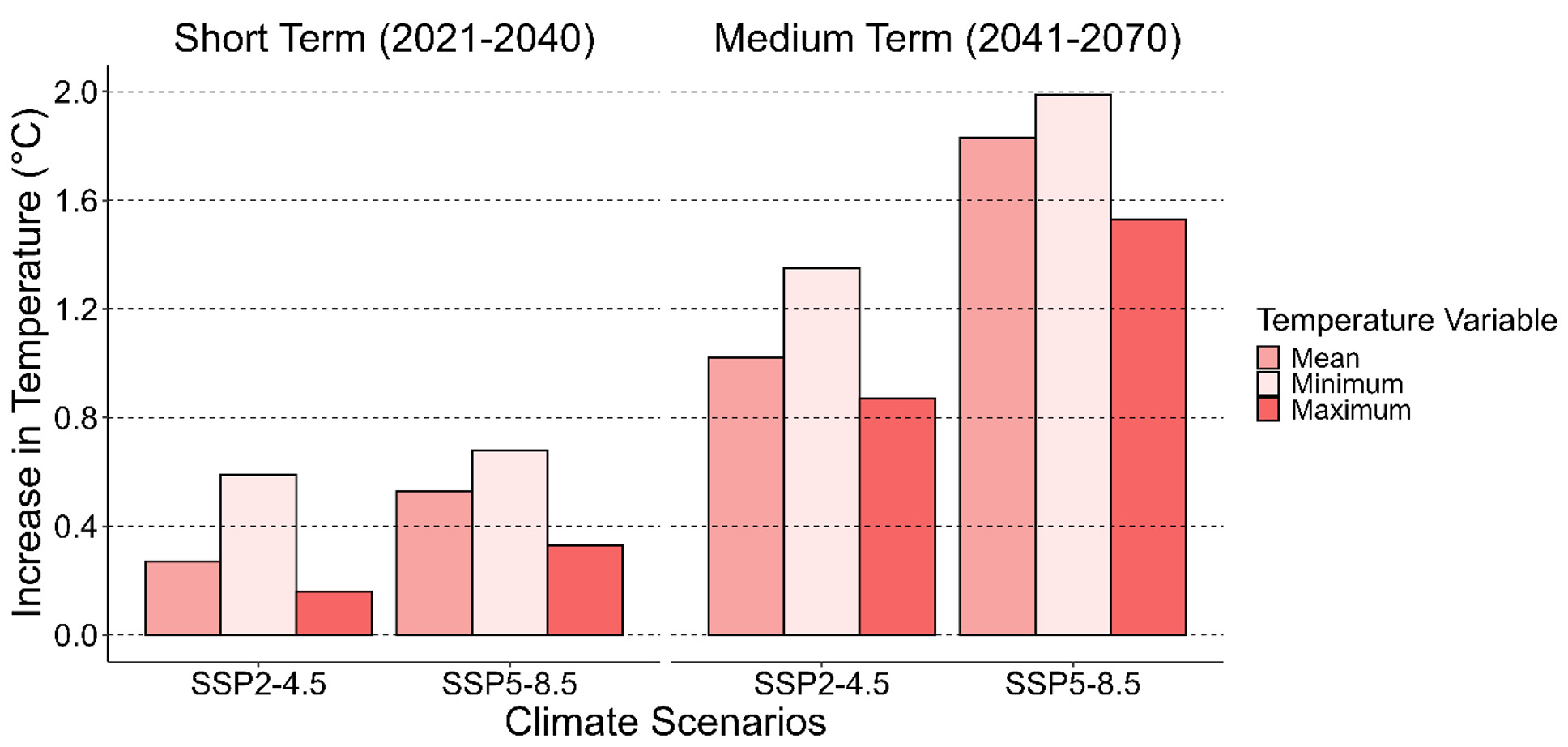
Note: Values represent changes relative to the period 1995-2014. Source: Deltares.
Changes in mean, minimum, and maximum temperature affect water-related diseases differently (Table 1). Studies show rising mean temperatures increase childhood diarrhea hospitalizations, while higher maximum temperatures correlate with greater malaria incidence.
Table 1: Projected Increases in Dengue Fever, Malaria, and Childhood Diarrhea Hospitalization in Cox's Bazar Under Two Climate Scenarios (SSP2-4.5 and SSP5-8.5) for the Short Term (2021-2040) and Medium Term (2041-2070)
| Variable | Short Term SSP2-4.5 | Expected Consequence 2021-2040 |
| Mean temperature | +0.27°C | +1% new diarrhea hospitalizations +7% new dengue cases |
| Maximum temperature | +0.16°C | +2% new dengue cases no new malaria cases |
| Minimum temperature | +0.59°C | +5% new dengue cases |
| Variable | Short Term SSP5-8.5 | Expected Consequence 2021-2040 |
| Mean temperature | +0.53°C | +2% new diarrhea hospitalizations +14% new dengue cases |
| Maximum temperature | +0.33°C | +3% new dengue cases no new malaria cases |
| Minimum temperature | +0.68°C | +6% new dengue cases |
| Variable | Medium Term SSP2-4.5 | Expected Consequence 2041-2070 |
| Mean temperature | +1.02°C | +4% new diarrhea hospitalizations +27% new dengue cases |
| Maximum temperature | +0.87°C | +8% new dengue cases +1% new malaria cases |
| Minimum temperature | +1.35°C | +12% new dengue cases |
| Variable | Medium Term SSP2-8.5 | Expected Consequence 2041-2070 |
| Mean temperature | +1.83°C | +7% new diarrhea hospitalizations +48% new dengue cases |
| Maximum temperature | +1.53°C | +15% new dengue cases +2% new malaria cases |
| Minimum temperature | +1.99°C | +18% new dengue cases |
Source: Deltares
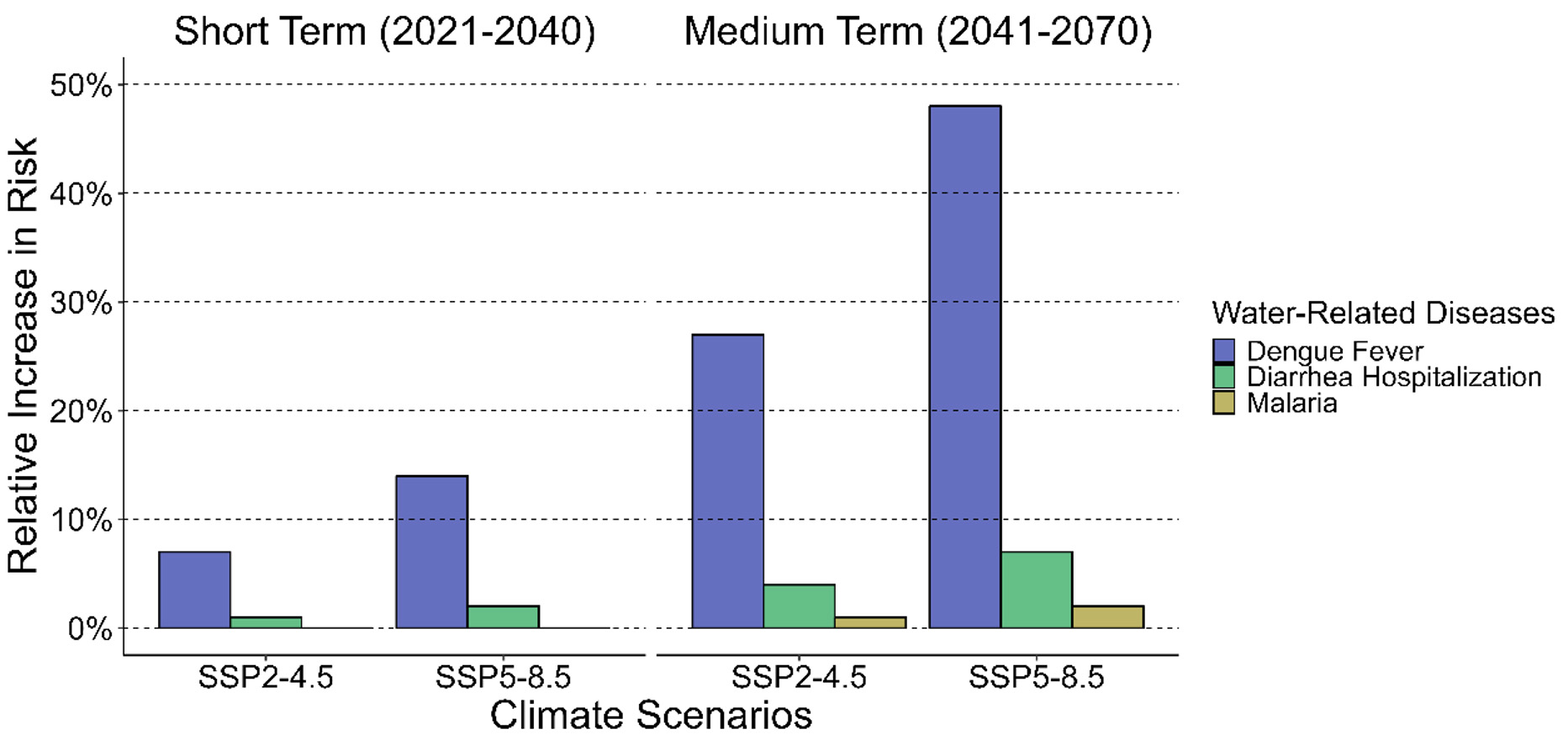
The study projects that under the SSP5-8.5 scenario, a short-term rise of 0.53°C in mean temperature could lead to a 14% increase in dengue fever cases and a 2% rise in diarrhea hospitalizations. By 2041-2070 (Figure 2), hospitalizations for all three diseases-dengue, malaria, and diarrhea-are expected to rise further, with dengue posing the greatest concern. These findings echo recent national trends, including the 2023 severe outbreak when dengue cases in Bangladesh exceeded 300,000. In the medium term, dengue cases could rise by 48% under SSP5-8.5, linked to a 1.83°C rise in mean temperature.
Figure 2: Projected Maximum Increases in Water-Related Diseases in Cox's Bazar Under Two Climate Scenarios (SSP2-4.5 and SSP5-8.5) for the Short Term (2021-2040) and Medium Term (2041-2070)
Source: Deltares
Potential Impacts of WASH Investments
Investments in WASH, drainage, and solid waste management that explicitly integrate climate considerations can enhance resilience and significantly reduce water-related diseases (Table 2). In the camps, chlorination of water-with residual chlorine maintained-helps prevent contamination in household storage containers. Combined with hygiene-focused interventions, these measures can reduce post-collection contamination and exposure to waterborne pathogens.
Improved access to sanitation facilities and safe disposal of child feces can significantly reduce environmental contamination with fecal pathogens. Effective solid waste management is equally critical, removing discarded containers and waste that can serve as mosquito breeding grounds or block drainage systems. Improved drainage around shelters and water distribution points helps prevent stagnant water, reducing the risk of mosquito proliferation and disease transmission.
As part of ADB's Integrated Services and Livelihood for Displaced People from Myanmar and Host Communities Improvement Project, canal rehabilitation works are planned for approximately 3.3 kilometers of the Madhurchara Canal in the Cox's Bazar area to improve drainage and reduce mosquito breeding sites. In Bhasan Char, a similar canal rehabilitation effort, along with improved fecal sludge management, could lower exposure to harmful pathogens.
The study modeled increases in adequate hygiene practices and WASH service coverage-such as improved drainage-based on baseline conditions in the camps. These improvements were then linked to changes in disease risk using quantitative relationships from multiple studies (Table 2).
Table 2: Potential Impacts of WASH Interventions on Dengue Fever, Malaria, and Childhood Diarrhea in Cox's Bazar
| WASH Intervention | Change in Coverage | Impact on Disease Risk |
| Chlorination | +45% | -10% diarrhea |
| Handwashing | +4% | -1% diarrhea |
| Access to improved latrines | +11% | -2% diarrhea |
| Disposal of child feces | +5% | -1% diarrhea |
| Solid waste disposal | +36% | -14% dengue fever |
| Improved drainage | +15% | -12% dengue fever -3% malaria |
Source: Deltares
Implications
These findings demonstrate that WASH investments deliberately designed to address climate change risks can play critical role in adaptation by reducing the negative health impacts of rising temperatures in the Cox's Bazar area (Table 3).
Table 3: Projected Maximum (under SSP5-8.5) Increase in Water-Related Diseases and Potential Impact of Combined WASH Interventions in Cox's Bazar Area
| Water-Related Disease | Projected Impact of Climate Change | Potential Impact of WASH | |
| Short Term (2021-2040) | Medium Term (2041-2070) | ||
| Diarrhea hospitalization | +2% | +7% | -14% |
| Dengue fever | +14% | +48% | -26% |
| Malaria | 0% | +2% | -3% |
Source: Deltares
For example, better solid waste management and drainage could reduce dengue fever risk by 14% and 12%, respectively-enough to counter projected short-term climate-driven increases in dengue risk and substantially lower it in the medium term (Figure 3).
Figure 3: Potential Reduction in Climate-Induced Dengue Fever Risk in Cox's Bazar Area from Investments in Solid Waste Management and Drainage as Projected Under Two Climate Scenarios (SSP2-4.5 and SSP5-8.5) for the Short Term (2021-2040) and Medium Term (2041-2070)
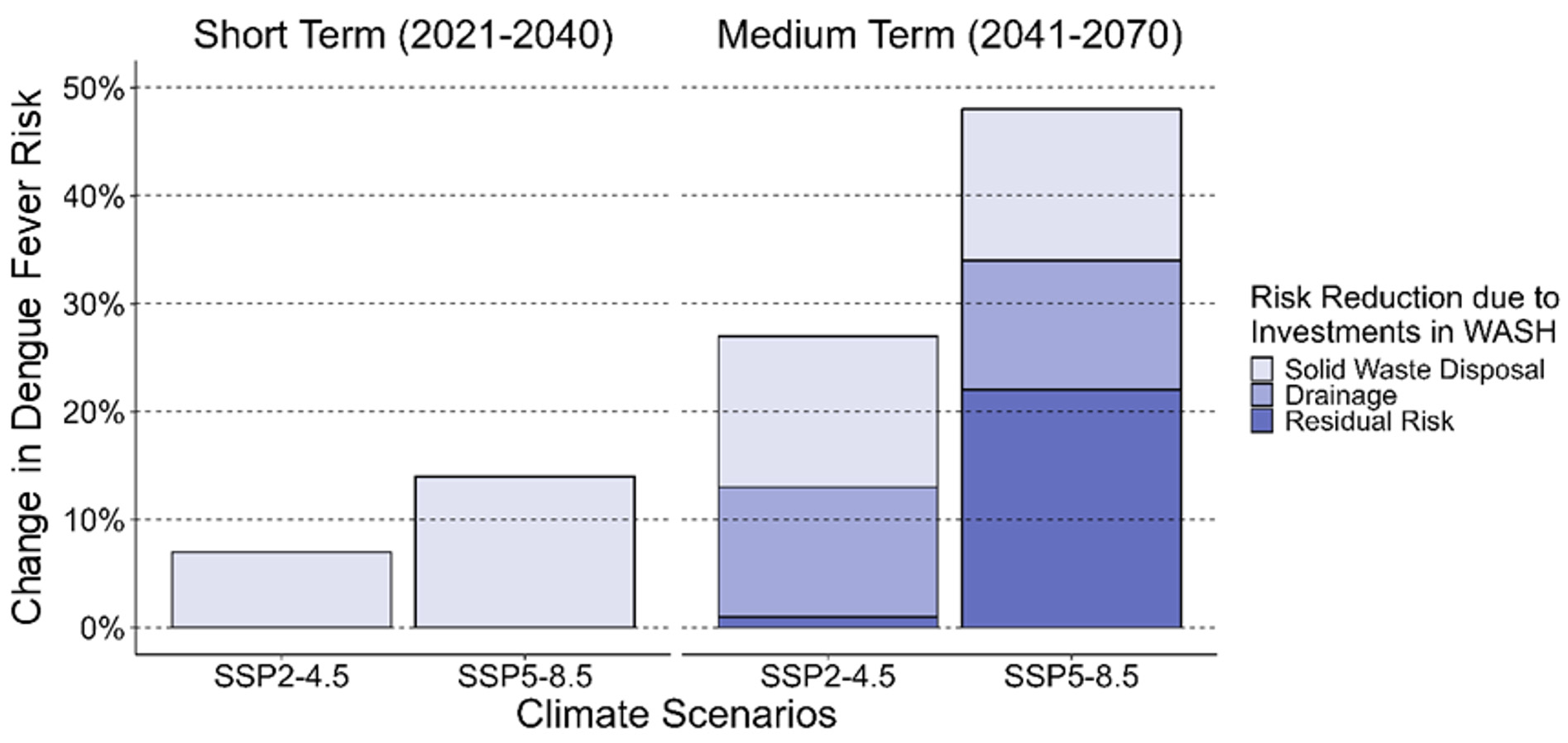
Note: Based on increases in mean temperature. These reductions are only illustrative as further improvements in WASH may have a greater impact on disease risk. Source: Deltares
As part of the ADB project, 20 mini piped water supply systems with household connections are planned for host communities in Cox's Bazar, a continuation of ADB support[1] on improving access of refugees and host communities to clean water supply. These systems reduce reliance on household water storage and lower exposure to mosquito vectors. The study estimates that increasing piped water coverage in Cox's Bazar to 11% from 1%-in line with national levels-could cut dengue fever risk by 5%. However, implementing permanent infrastructure in the camps may not be feasible.
Humanitarian and development partners should prioritize practical measures such as improving water storage practices, better drainage, and solid waste management to eliminate mosquito breeding sites. Combined with health and hygiene promotion and safer sanitation facilities, these measures offer a comprehensive approach to disease prevention.
Successful implementation of canal rehabilitation, piped water systems, and improved fecal sludge management can reduce dengue and malaria risks for both refugees and host communities while building resilience to climate change. Crucially, WASH systems must be designed to withstand extreme weather, incorporate future climate changes, and address the needs of women, children, and persons with disabilities to ensure inclusivity and sustainability.