
- Summers have been heating up for decades and they'll only get hotter if heat-trapping pollution continues - making future summers in Minneapolis feel more like current summers in Tulsa.
- With high levels of heat-trapping pollution, future summer high temperatures in 247 major U.S. cities would heat up by an average of 3.6°F by 2060 and 7.9°F by 2100.
- For many cities, summer temperatures in 2100 would be closer to current conditions in hotter locations hundreds of miles to the south.
- For 16 U.S. cities, there is no equivalent in North America to how hot they'd be in 2100. Their future summers are more similar to current conditions in Pakistan, the Middle East, and North Africa.
Summers heating up with climate change
Rising levels of carbon pollution have been causing summers to heat up for decades. The season has warmed since 1970 in 97% of 242 U.S. cities analyzed by Climate Central.
And summers will only become hotter as heat-trapping pollution continues - meaning that future summers in Minneapolis could feel more like current summers in Tulsa.
Mapping future climates in 247 U.S. cities
Climate Central analysis shows how much hotter 247 major U.S. cities could become if heat-trapping pollution - mainly from burning coal, oil, and gas - continues at high levels.
For each city, Climate Central used the latest climate model projections to calculate how summer high temperatures could change during each decade between 2030 and 2100.
Each city's projected future temperatures were then matched to cities that currently experience similar conditions. See Methodology for details.
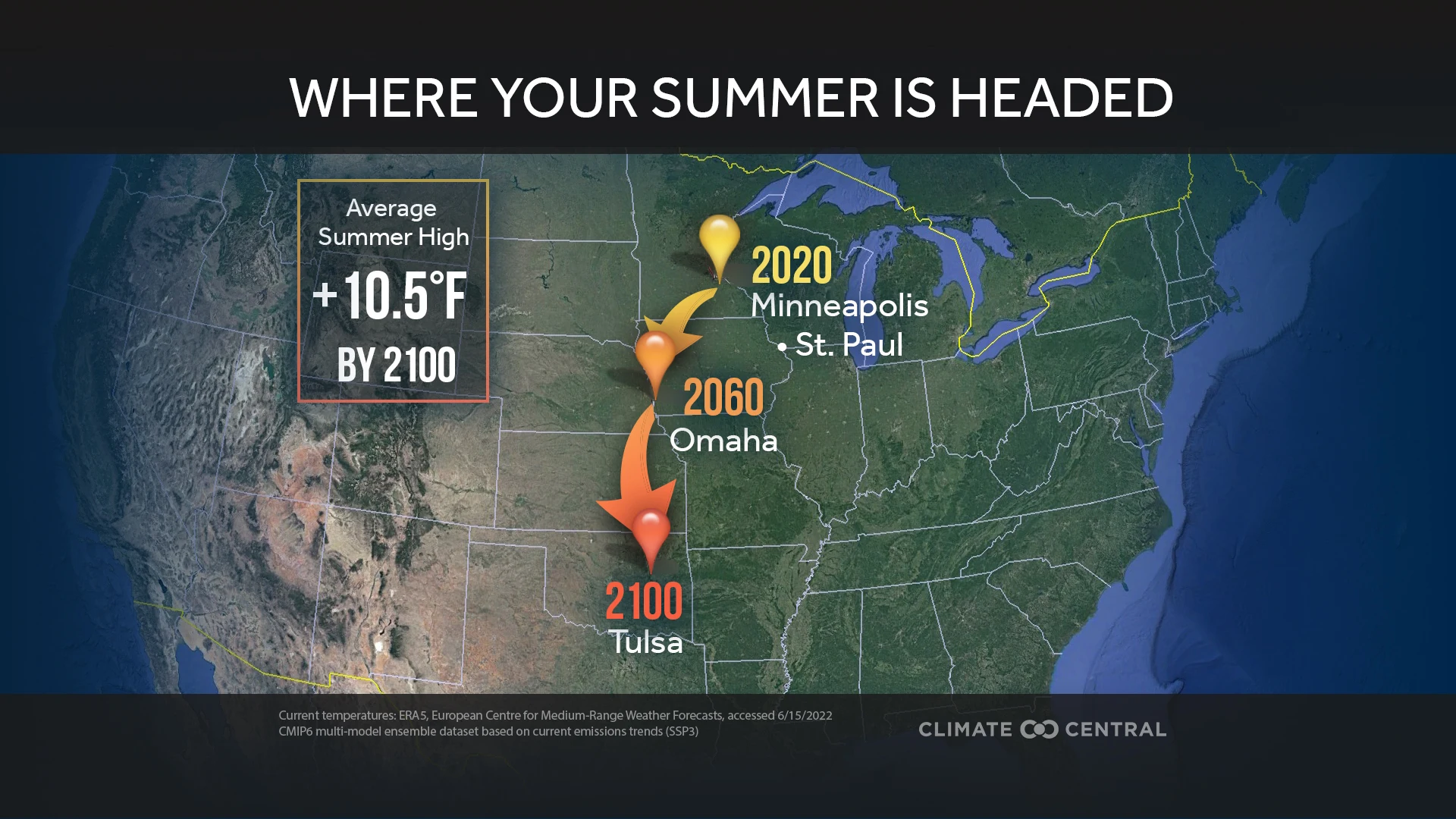
Where summers are headed by 2100
This analysis shows how future warming could transport a city's current climate to an entirely different part of the country - or the world - with reduced commitments to lower carbon pollution .
- On average, summer high temperatures across the 247 cities analyzed are projected to increase 3.6°F by 2060 and 7.9°F by 2100.
- By the end of this century, summers in the cities analyzed would shift to resemble hotter locations an average of 437 miles to the south.
- For 16 U.S. cities, there is no equivalent in North America to how hot they'd be in 2100. Their future summers are more similar to current conditions in Pakistan (e.g., Houston), the Middle East (e.g., Phoenix, Austin, and Las Vegas), and North Africa (e.g., Bryan, Texas).
- Mitchell, S.D. is projected to warm the most by 2100 (11.1°F), when it will feel more like Wichita Falls, Texas.
The five largest U.S. cities - with a combined population over 19 million - are projected to experience the following shifts by 2100:
- New York is projected to warm by 7.6 °F, with summers more like present-day Columbia, S.C.
- Los Angeles is projected to warm by 5.8 °F, with summers more like present-day Túxpam de Rodríguez Cano, Mexico.
- Chicago is projected to warm by 9.1 °F, with summers more like present-day Montgomery, Ala.
- Houston is projected to warm by 6.4 °F, with summers more like present-day Lahore, Pakistan.
- Phoenix is projected to warm by 7.2 °F, with summers more like present-day Al Mubarraz, Saudi Arabia.
Hotter summers are a health hazard
As summers get hotter, extreme heat occurs more often and becomes a growing health risk.
Exposure to extreme heat makes it difficult for our bodies to cool off, resulting in heat-related illnesses including heat cramps, heat exhaustion, and even fatal medical emergencies such as heat stroke.
This analysis only accounts for daytime summer temperatures and doesn't reflect the additional health risks that come with nighttime warming or humid heat.
Excessive heat is the leading cause of weather-related deaths in the U.S. In 2023, a record 2,325 people died from heat in the U.S. alone.
Climate change is already increasing exposure to dangerous extreme heat for billions of people across the globe.
Summer heat can also worsen air quality by trapping harmful pollutants close to the Earth's surface and fueling the formation of ground-level ozone. These pollutants can worsen respiratory health issues in people with asthma and other lung diseases.
Hotter summers can also strain local power grids as the demand for cooling rises. Meanwhile, weather-related power outages during heat season have increased 60% since the 2000s. When blackouts overlap with the need to cool homes, schools, and businesses, the risks compound for heat-sensitive populations, including children, older adults, pregnant people, and weather-exposed workers.