El Niño 2026: a closing window for anticipatory action in Latin America and the Caribbean
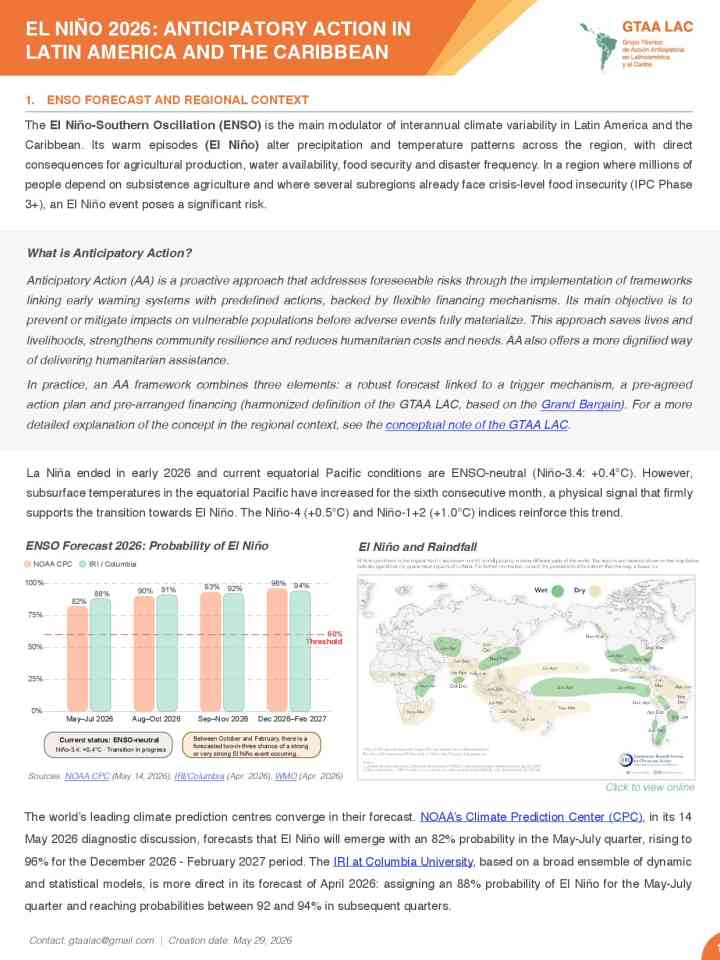
This briefing note presents the latest ENSO forecasts from NOAA, IRI/Columbia and WMO — which collectively assign between 82% and 96% probability of El Niño emerging between mid-2026 and early 2027 — and makes an urgent case for scaled-up anticipatory action across the region before impacts fully materialize. It maps projected subregional impacts across the Central American Dry Corridor, coastal Ecuador and northern Peru, Colombia and Venezuela, and the Andean altiplano, and documents the anticipatory action frameworks already activated or in development across 22 countries, with USD 37.8 million in pre-arranged financing. It also flags a critical compound risk: the Strait of Hormuz conflict has disrupted a third of global maritime fertilizer trade since February 2026, which, combined with El Niño, threatens to push 2.2 million additional people into acute hunger across the region.
The briefing finds that while the region has proven anticipatory action frameworks and coordination mechanisms in place — demonstrated by the March 2026 inter-agency activations in Guatemala, Honduras and El Salvador mobilizing USD 10.5 million from CERF to protect up to 145,000 people — the critical bottleneck is timely financing and political will, not technical capacity. The window for action is closing in weeks: financing to protect the Central American Primera season must be committed before June 2026, while preparations for Ecuador and Peru must begin before September, and South America's frameworks, though technically ready, remain underfunded relative to the scale of a moderate to strong event. Evidence from 16 WFP impact studies across 12 countries confirms that anticipatory action improves food consumption and reduces negative coping strategies by 28%, reinforcing the case for scaling up investment now rather than responding after impacts have materialized.
Explore further