
How a monster ocean heatwave could fuel a super El Niño
The chance of an El Niño event emerging by July is now over 80 percent, which will likely make 2026 one of the hottest years on record. At the same time, an exceptionally large 9,000-mile marine heatwave has been forming in the North Pacific since the end of 2025. These extreme warming events are now evolving together across the Pacific. Scientists are increasingly concerned that the warm water will fuel a “super” or “Godzilla” El Niño, potentially prolonging marine heatwaves, disrupting fisheries and ecosystems, and intensifying global climate impacts well into 2027.
Blob 3.0?
Marine heatwaves are periods when ocean waters become unusually warm for weeks, months, or even years compared to normal conditions for that region and season. They kick-off near the ocean surface but can extend deeper into the water column, and they are becoming more frequent and intense as the planet warms.
These extreme events occur in oceans around the world, from tropical waters to polar regions, but some of the largest and most persistent events have occurred in the Pacific Ocean, including the so-called “Blob 1.0” in the Northeast Pacific between 2013 and 2015, and its successor, “Blob 2.0” in 2019 and 2020. Both Blobs transformed marine ecosystems along the West Coast of North America, fueling harmful algal blooms, disrupting fisheries and the crab season, and contributing to one of the largest seabird mortality events ever recorded.
El Niños can be thought of as a kind of marine heatwave that occurs cyclically in the Pacific every 2-7 years or so. When the 3-month average sea surface temperatures in the equator are more than 0.5 degrees Celsius higher than normal, an El Niño has developed. Research has shown that anthropogenic climate change is impacting the frequency, intensity and location of El Niños.
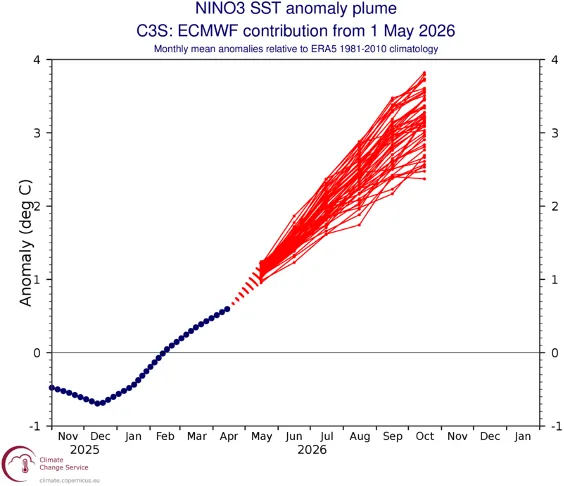
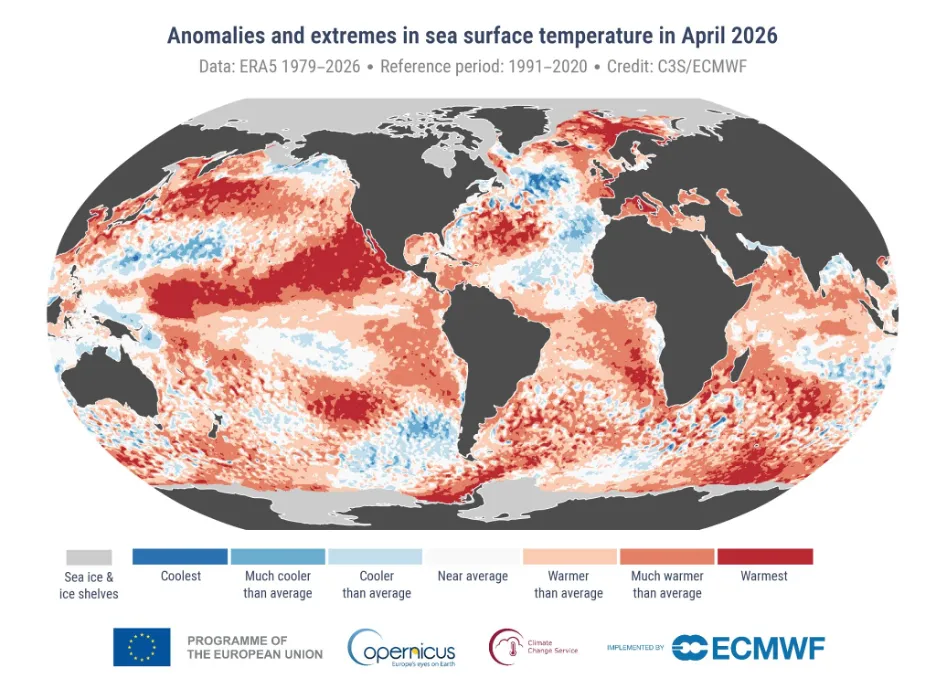
At the same time as the likelihood of an El Niño beginning this year has risen to over 80 percent between May-June and over 90 percent by end of the year, many scientists are focused on another area of the Pacific. There is another ocean heatwave stretching from Papua New Guinea all the way across the ocean to the Californian Coast, where temperatures have been 2 – 3 degrees Celsius warmer than normal for the past few months. These concurrent warm events are affecting a vast area of the Pacific unlike anything observed before.
Why does this matter? As ocean waters warm in the North Pacific with the marine heatwave, the reduction of the winds can also impact the equator, meaning that extreme event might be helping initiate the conditions necessary for an El Niño. And because the equatorial warming affects the North Pacific, the unprecedented 2026 El Niño might amplify the duration of the North Pacific marine heatwave, with serious consequences for people, wildlife, and Earth’s climate.
Unlike atmospheric heatwaves such as the one blistering Europe this May, the environmental impacts of marine heatwaves are harder to visualize, but they can profoundly affect marine ecosystems, from fisheries to oceanic oxygen levels and the ocean’s ability to absorb carbon dioxide.
Ecosystem and carbon impacts
The ocean’s biological carbon pump is a highway that carries the excess of carbon produced by photosynthesis at the surface down to the deep ocean. The exported carbon can be sequestered for hundreds to thousands of years, making the ocean a large carbon reservoir. This system depends on microscopic organisms like phytoplankton and zooplankton, ocean mixing, and the amount of sinking carbon all functioning like a well-oiled machine. But persistent ocean warming can disrupt every part of that system. Even small changes in temperature alter the chemistry, circulation, and biological functioning of the ocean.
Persistent warming can first reduce the upward transport of nutrients from deeper waters into the sunlit surface ocean. Normally, storms, mixing, and upwelling help replenish nutrients that phytoplankton need to grow, photosynthesize, and produce carbon (aka ocean primary productivity). But when surface waters become warmer and lighter, the ocean becomes more stratified, meaning the layers mix less efficiently. This stronger separation between surface and deeper waters can alter the chemical composition of the upper ocean, ultimately changing species composition, ocean productivity, and consequently the food web.
These changes do not affect all organisms equally. Some microbes and smaller opportunistic species, including toxic ones that produce harmful algal blooms, may benefit from warmer waters, while larger phytoplankton, zooplankton, fish, and seabirds may struggle to adapt. Many marine species survive within relatively narrow temperature ranges, so prolonged warming can also force organisms to move toward cooler waters or deeper layers of the ocean. Together, these shifts can reorganize food webs, change predator-prey interactions, and alter fisheries distributions over large regions.
This can result in “trophic mismatches,” where different parts of the food web respond at different speeds or times. For example, peak plankton blooms may no longer align with fish larvae feeding periods, reducing survival rates and affecting fisheries and marine predators higher in the food chain. During the 2013–2015 “Blob 1.0,” these unusually warm and stratified conditions were indeed associated with widespread harmful algal blooms and major ecosystem disruptions along the West Coast of the United States, including mass mortality of seabirds, and it contributed to a crash in the crab and fisheries industry.
But the biological response is not always uniform in space. A recent study in the equatorial Pacific shows that, while some regions experience reduced productivity and nutrient supply during El Niños, others can temporarily experience enhanced biological activity. Rather than responding as a single system, different parts of the Pacific can react in very different ways.
Why overlapping extremes matter
During the 2013-2015 “Blob,” the second year of extreme warming overlapped with the development of one of the strongest El Niño events on record, suggesting that interactions between large-scale marine heatwaves can reinforce and prolong heat across the Pacific. What makes 2026 unusual is that the current marine heatwave already covers an even larger area than the “Blob 1.0,” while El-Niño conditions are simultaneously emerging in the equator. Together, these overlapping warming patterns are raising concerns that the heat could persist or even intensify across the Pacific well into 2027.
If this happens, the consequences may extend far beyond a single warm year. Prolonged heat stress could further intensify ecosystem disruption, crash fisheries and crab seasons, expand harmful algal blooms, and weaken the ocean’s ability to absorb and store carbon dioxide. More broadly, this raises an unsettling possibility: That the Pacific Ocean may be entering a new era in which climate extremes increasingly overlap, reinforce one another, and persist for longer periods of time than previously observed.