
Climate change is likely to keep more labour in agriculture in the very regions where agricultural productivity suffers most, exacerbating the ‘food problem’ just as economies would benefit most from diversifying away from agriculture.
Reprinted by permission from VoxDev
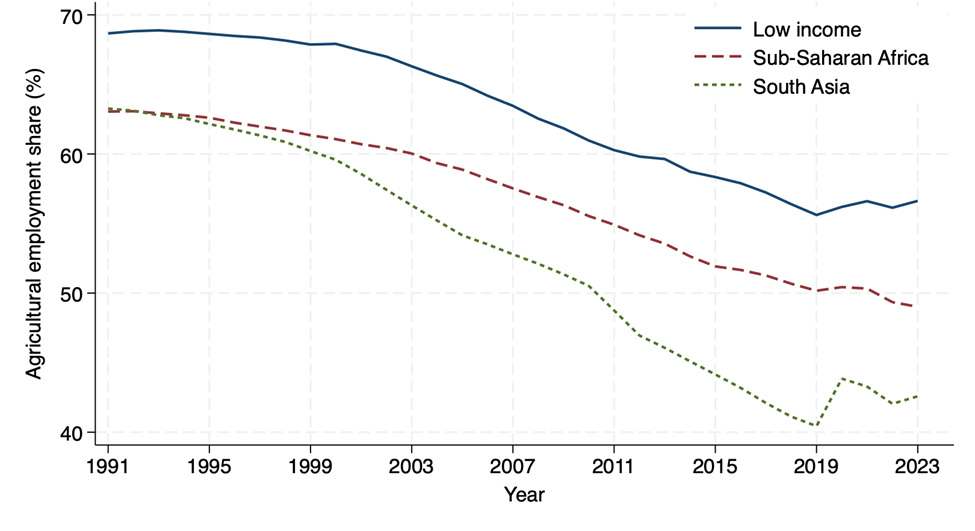
The global share of employment in agriculture has been falling steadily for decades, declining from 43.4% in 1991 to 26.2% in 2019 (World Bank, ILO). However, Figure 1 shows that the movement out of agriculture seems to have paused, and even reversed, in low-income countries over the past half-decade. Given that agriculture in these countries remains especially unproductive relative to other parts of the economy (Lagakos and Waugh 2013), this pause raises concerns about a potential risk to the conveyor belt of structural transformation out of agriculture that has served as an engine of development for nearly two centuries.
Figure 1: Agricultural employment shares over time
This apparent interruption of long-run trends in sectoral labour shares has coincided with a stagnation of agricultural productivity growth, with real agricultural output per worker in both sub-Saharan Africa and South Asia in 2023 registering below its 2019 levels (World Bank WDI). While a few years of data on agricultural output may just be a blip, a range of recent evidence (e.g. Hultgren et al. 2025) suggests that anticipated warming in coming decades is likely to pose a major long-run risk to global agriculture.
These concerning recent trends in agricultural productivity and specialisation relate to an emerging literature that examines how climate change may slow the movement of labour out of farming. The key intuition is straightforward. In countries where agricultural productivity is low, food is relatively expensive and households must devote a large share of their income to meeting subsistence needs. That consumption has to come from somewhere, so countries with unproductive farms – and limited ability to rely on imports – tend to have high labour shares in agriculture to produce enough food to meet demand. This dynamic is at the heart of what development economists call the ‘food problem’ (Gollin et al. 2007), and it becomes more severe in a warming world with growing risks to agricultural productivity.
The food problem in a climate-stressed, low-trade world
In my recent research (Nath 2025), I formalise this mechanism in a multi-sector model of trade and sectoral specialisation. The paper begins by using global micro-data to empirically estimate the effects of exposure to extreme temperatures on productivity in different sectors, which provides information on the potential value of sectoral reallocation for adaptation. The effects on manufacturing and services are modest: in a high emissions scenario, global manufacturing productivity is projected to decline by about 1.7%, with losses of 10-14% in the hardest hit countries.
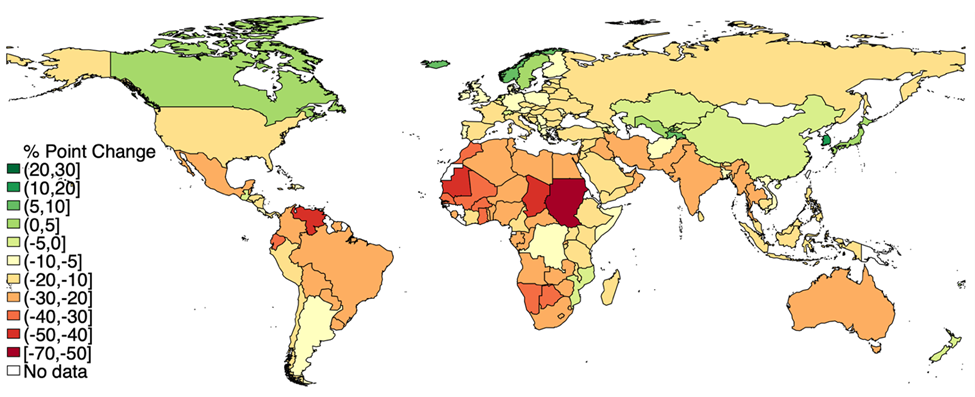
In contrast, previous work finds effects about ten times larger in agriculture, with projected losses approaching close to half of productivity in hot, low-income regions. Figure 2 shows the projected relative effects on agriculture vs. manufacturing in a high-emissions scenario considered in Nath (2025). This underscores the critical importance of sectoral specialisation for mediating climate damages – climate change is likely to be much more harmful if these economies stay specialised in the agricultural sector where damages are largest.
Figure 2: Relative impacts of global warming on agricultural vs manufacturing productivity (High Emissions Scenario)
Despite the disproportionate vulnerability of agriculture to warming, the quantitative model simulations in Nath (2025) suggest that climate change is likely to keep more labour in agriculture in the very regions where its productivity suffers most. By the late 21st century, agriculture’s share of the economy in the poorest quartile of countries projects to be about 2.8 percentage points higher than it would be without global warming. The mechanism mirrors the traditional ‘food problem’ logic in a climate context: when agricultural productivity declines, food prices rise, and because food demand is inelastic, the economy must allocate more labour to agriculture simply to keep people fed.
In principle, countries facing climate damages in agriculture could also meet demand by importing more food, but in practice the results suggest that this mechanism has weak effects in developing countries. In the model, trade adjustment reduces climate damages by only 1-2% relative to a scenario with autarky, largely because those countries most vulnerable to global warming are also those that are least open to trade in agriculture. In the data, the poorest quartile of countries import only 9% of their consumption, compared with 45% in the richest quartile. The model calibration in Nath (2025) rationalises this pattern with very high trade costs for agricultural goods in poor countries, which mean that even large relative price changes do little to stimulate food imports in the climate change counterfactual.
The paper highlights two especially important and overlooked adaptation margins. The first is trade costs, particularly those affecting agricultural imports in developing economies. When the model counterfactuals in Nath (2025) are re-evaluated in a benchmark scenario in which low-income countries face trade costs more typical of high-income places, predicted climate damages in poor countries fall by roughly half. While the underlying causes of the model-inferred trade costs cannot be fully decomposed into policy levers, the paper shows that about one-third of these hypothetical adaptation gains can be achieved by reducing the proportion of trade costs directly attributable to observable barriers such as tariffs, trade agreements, and regulatory/customs processing delays.
The second adaptation mechanism is economic growth. Because food is a necessity and preferences change with income, rising incomes naturally move labour out of agriculture. Growth also increases the capacity of firms and households to adapt within both agricultural and non-agricultural sectors – for example through irrigation and improved seeds in agriculture or with air conditioning for indoor workers. In the model, end-of-century climate damages in low-income countries are three to four times smaller under scenarios with faster baseline growth than in low-growth scenarios, reflecting both within-sector adaptation and the reallocation of workers away from the especially climate-vulnerable agricultural sector.
Across all these results, a consistent lesson emerges: in a warming world, the share of workers who remain in agriculture will be a key determinant of the economic and human costs of climate change. Policies that reduce trade costs or accelerate growth can meaningfully reduce the severity of these costs by easing the ‘food problem’ constraint that may bind meaningfully as the planet warms.
A growing body of research is examining how global warming interacts with structural transformation and trade
The findings in Nath (2025) contribute to a rapidly emerging body of work linking climate change, structural transformation, and international trade – research that increasingly points toward a common set of mechanisms.
Empirical evidence from India provides a clear illustration. Liu et al. (2023) exploit long-run variation in temperature trends across districts and show that each 1°C increase in mean decadal temperature reduces the non-agricultural employment share by 8.2%. The effects are strongest in remote areas with weak road networks – settings where households are more reliant on local food production and the food-problem mechanism is likely to bind most tightly. Relatedly, Adamopoulos (2025) shows that Ethiopia’s road expansion programme promoted structural transformation through a variety of mechanisms, underscoring the broader role of market integration in facilitating the movement of workers out of agriculture.
Structural models in several other papers reinforce these empirical patterns. For instance, Conte (2025) in Africa and Cruz (2024) in a global setting also find that warming is likely to raise agricultural employment shares in low-income regions, driven by the same food problem mechanism emphasised in Nath (2025). Both papers also highlight migration as an important partial substitute for trade-driven adaptation: mobility can reallocate some people away from the most exposed locations, though it cannot offset the impacts of warming on those who remain.
Several papers in the literature also focus specifically on trade as an adaptation mechanism. Gouel and Laborde (2021) show that trade adjustments can substantially mitigate climate damages by allowing agricultural production to shift toward regions less harmed by warming. More granular work by Porteous (2019) examines agricultural trade costs in Africa using local market-level data on crop production, storage, and regional price dispersion across 42 countries. The paper estimates that agricultural trade costs in Africa are about five times higher than in rich countries, and that reducing them to international benchmarks would lower staple grain prices by 46% and cut climate damages by 15% (Porteous 2025), consistent with the findings in Nath (2025).
Why are agricultural trade costs so high in low-income countries? Previous research points to a combination of regulatory and infrastructure constraints. Hummels and Schauer (2013) show that border and administrative delays impose tariff-equivalent costs of 2-3% per day on agricultural goods, and Tombe (2015) demonstrates that such delays can account for much of observed low agricultural trade shares in African countries. Porteous (2019) and Sotelo (2020) focus on transportation costs, using trucking surveys and patterns of price-dispersion to infer their importance. Consistent with these findings, Adamopoulos (2011) estimates that road transport costs are roughly 16 times higher in low-income countries than in rich ones.
Altogether, this work paints a consistent picture: as climate change puts increasing pressure on agricultural productivity, the ability of economies to adapt through trade and sectoral allocation is constrained by the structure and functioning of markets. High trade costs and weak infrastructure amplify the food problem, making it harder for workers to leave agriculture just as climate change makes doing so more urgent.
Policy implications: Productivity, trade, and growth
Across my research and the body of related work, three policy priorities stand out.
1. Strengthening agricultural productivity is essential.
Climate change exacerbates the food problem most in countries where yields are already low. Raising agricultural productivity – through improved technologies and production practices – reduces the agricultural share of the labour force and helps keep structural transformation on track.
2. Lowering trade costs can substantially reduce climate damages.
High internal and external trade costs limit the ability of low-income countries to rely on food imports when domestic production falters. Reducing transportation costs, regulatory frictions at the border, and tariff and non-tariff barriers could expand the scope for trade to contribute to climate change adaptation and ease the pressure on domestic labour to produce enough food.
3. Broad-based economic growth is itself a form of climate adaptation.
As incomes rise, economies naturally shift labour out of agriculture and improve their capacity to adapt within each sector. Faster growth therefore lowers long-run climate damages both by reducing productivity effects within sector and by reducing the concentration of labour in the most vulnerable agricultural sector.
Climate change is reshaping agriculture worldwide, but its consequences for development are most severe where productivity is low, trade is costly, and many workers remain tied to farming. The emerging evidence suggests that warming can slow – or even reverse – the movement of labour out of agriculture, exacerbating the ‘food problem’ just as economies would benefit most by diversifying away from agriculture. Policies that raise agricultural productivity, lower trade costs, and support broad-based growth therefore serve a dual purpose, promoting development in their own right and also serving as powerful tools for climate adaptation.