Public messaging for summer concurrent risks: Extreme heat, drought and wildfires
Source
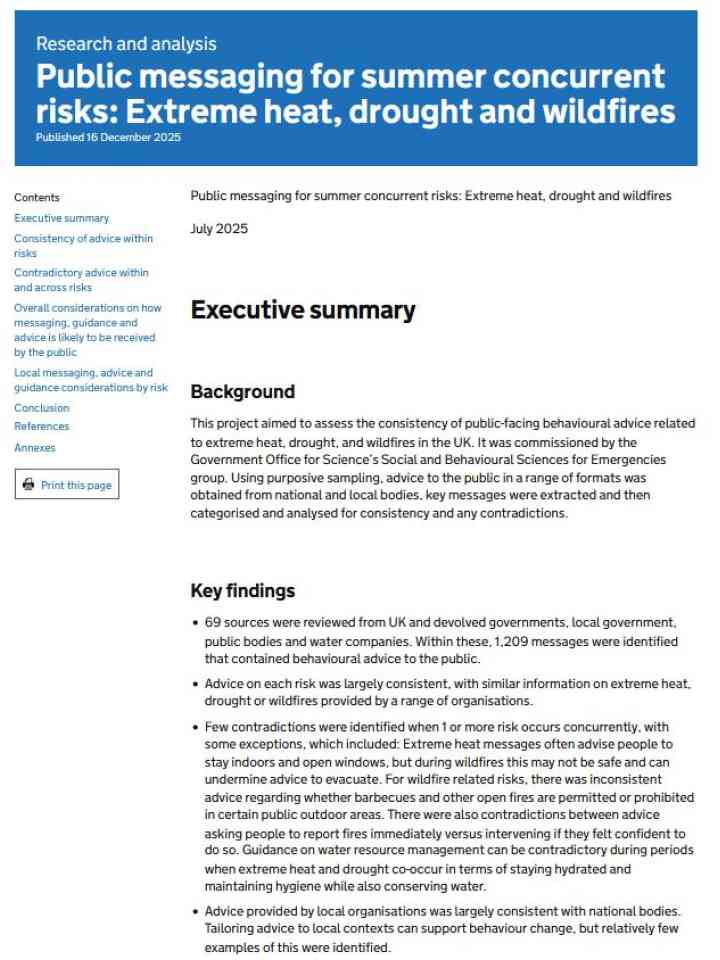
This publication aims to assess the consistency of public-facing behavioural advice related to extreme heat, drought, and wildfires in the UK. It was commissioned by the Government Office for Science’s Social and Behavioural Sciences for Emergencies group. Using purposive sampling, advice to the public in a range of formats was obtained from national and local bodies, key messages were extracted and then categorised and analysed for consistency and any contradictions.
Despite the relative consistency in behavioural advice for each individual risk and few contradictions across risks, our review identified several recommendations to improve messaging and support relevant behaviours.
- Prioritise, contextualise and sequence behavioural advice. When multiple actions are recommended, it would be preferrable to clearly prioritise behaviours based on urgency as well as health and environmental impact. Consistent, logically sequenced messaging can help people understand which actions to take first and in which contexts. Where possible, behavioural advice should be rooted in the local context.
- Enhance clarity and coherence of messaging. Distinguishing between different behavioural goals (e.g. health protection vs resource conservation) and avoiding overlapping instructions is preferable. Use consistent and directive language appropriate for target populations and clearly explain the rationale behind each behaviour to support informed decision-making. Where summarising advice for short-form communications, ensure that details most relevant to recommended behaviours remain and clarity is maintained. Use pictures or images where possible rather than long blocks of text.
- Coordinate cross-agency messaging and communication channels.Ideally develop integrated, multi-risk communication frameworks that align messages across organisations and risk; this could be supported by the development of guidance around how messages should be adapted and disseminated. This reduces duplication, ensures consistent use of terminology, and helps the public navigate advice from multiple authorities and channels.
- Ensure inclusive and resource-aware communication.Messaging should consider the needs and constraints of vulnerable populations and key groups of interest (such as children and pets). Ideally behavioural advice would be accompanied by information on how to access support (e.g. access to services, tools or resources) where socioeconomic and structural barriers exist.
- Improve signposting to alerts and information sources.Make sources and systems for monitoring warnings (e.g. rainfall gauges, river flow index, reservoir storage levels, heat-health alert, fire risk severity index, etc.) easy to understand and accessible and clearly signpost these sources. Employ a mixture of communication tools including alerts, social media posts, webpage updates to ensure high engagement with warning messages.
- Messaging should be pre-tested and evaluation with relevant groups. Changes to or new communication strategies should be based on feedback and observed behaviours.
Explore further
Themes
Disaster risk communication
Country and region
United Kingdom of Great Britain and Northern Ireland
Publication year
2025