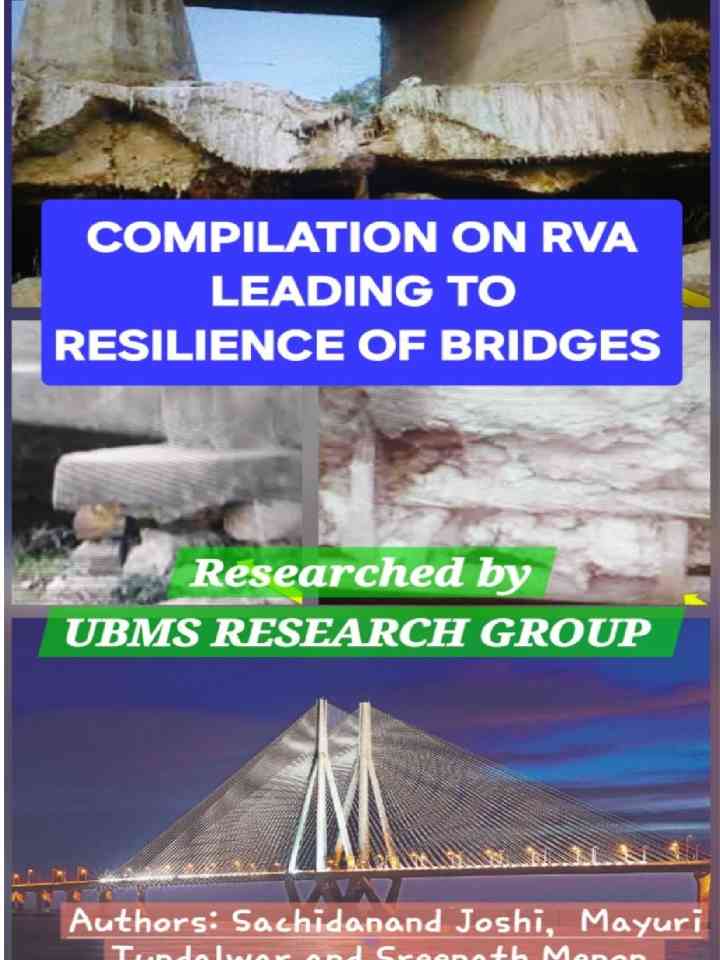
Compilation on RVA leading to resilience of bridges
This paper presents the results of RVA conducted to support informed decision-making, prioritization of interventions, and enhancement of long-term resilience of bridge infrastructure in Kolhapur District. Bridges in any region or community are essential components of the transportation network, enabling regional connectivity, supporting economic activities, and ensuring access for emergency and disaster response services. For research purposes we focus on Kolhapur District of India. The geographical setting, combined with a tropical monsoon climate, exposes bridge infrastructure to recurring natural hazards such as floods, landslides, and moderate seismic activity. Repeated flood events in past decades have demonstrated that bridges are frequently subjected to prolonged submergence, high hydraulic forces, debris impact, and foundation scour, leading not only to structural distress but also to significant loss of serviceability. Many bridges in the district are ageing and were constructed prior to the adoption of modern design, hydraulic, and seismic standards, further increasing their vulnerability under multi-hazard conditions. Past natural hazards occurrence in the district have shown that failure or disruption of few critical bridges can severely affect mobility, emergency response, and regional economic stability. In this context, conventional condition-based inspection practices alone are inadequate to capture the true level of vulnerability and resultant risk. A comprehensive Risk and Vulnerability Analysis is therefore necessary to integrate hazard exposure, bridge condition, functional importance, and potential consequences.
Explore further