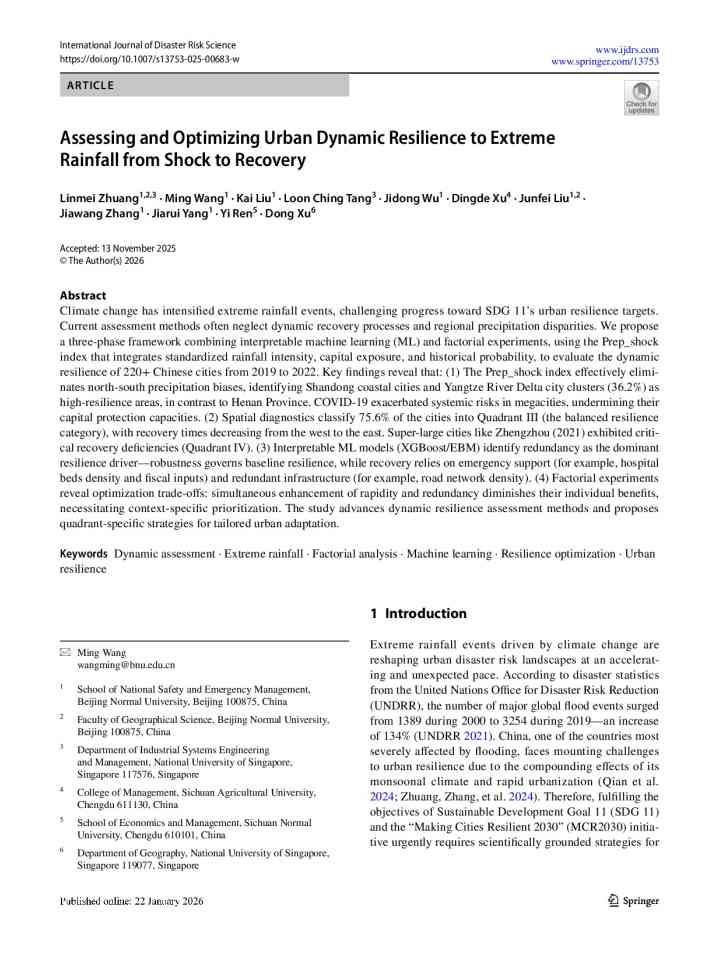
Assessing and optimizing urban dynamic resilience to extreme rainfall from shock to recovery
This publication presents a dynamic framework for assessing and improving urban resilience to extreme rainfall, focusing on more than 220 Chinese cities between 2019 and 2022. It introduces the Prep_shock index, which integrates standardized rainfall intensity, capital exposure, and historical probability, to normalize regional precipitation differences and more accurately measure shock severity. Using interpretable machine learning and factorial experiments, the study finds that coastal cities in eastern China tend to have higher resilience, while some inland areas show lower capacity to withstand and recover from extreme rainfall events. Results also show that megacities exhibited temporary resilience declines during the COVID-19 pandemic due to systemic stress. Key drivers of resilience include infrastructure redundancy and emergency support, with rapidity and redundancy offering trade-offs for optimization. The research advances methods for dynamic resilience assessment and suggests tailored, quadrant-specific adaptation strategies for urban planning and disaster management under climate change.
Explore further