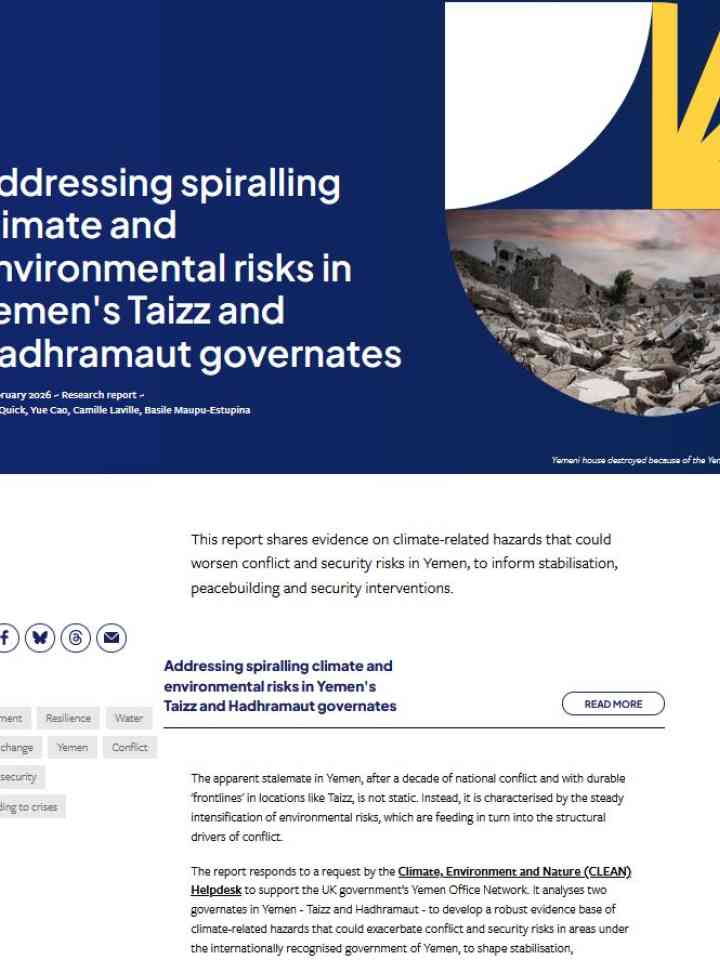
Addressing spiralling climate and environmental risks in Yemen's Taizz and Hadhramaut governates
This report shares evidence on climate-related hazards that could worsen conflict and security risks in Yemen, in order to inform stabilisation, peacebuilding, and security interventions. It responds to a request by the Climate, Environment and Nature (CLEAN) Helpdesk to support the UK government's Yemen Office Network, and analyses two governorates, Taizz and Hadhramaut, to develop a robust evidence base of climate-related hazards that could exacerbate conflict and security risks in areas under the internationally recognised government of Yemen. The central premise is that the apparent stalemate in Yemen, after a decade of national conflict and with durable "frontlines" in locations like Taizz, is not static but is characterised by the steady intensification of environmental risks, which feed in turn into the structural drivers of conflict. The evidence is intended to shape stabilisation, peacebuilding, and security interventions, including the possible creation of an Integrated Security Fund mechanism to support partners working at the climate–conflict–security nexus.
After introducing its scope, the report sets out a conceptual framework on the causes and extent of environmental risks in Yemen and how these interact with structural drivers of conflict, then summarises data and trends for Taizz and Hadhramaut, covering conflict and political dynamics alongside core environmental risks such as the overextraction of groundwater, the maladaptation of the agri-food sector, the degradation of water and soil resources, and the failure to mitigate extreme weather risks. It analyses the two-way interactions between environmental and conflict risks through three conflict pathways: the entrenchment of the conflict economy, the securitisation of natural resource governance, and the declining legitimacy of the internationally recognised government. The report then reviews how and where these pathways are addressed within existing climate and environmental programming in Yemen, identifying underaddressed dimensions and blind spots and drawing potential lessons for UK international climate finance. It concludes by bringing together key takeaways and considerations for future UK government engagement, focusing on how environment–conflict risks can be mainstreamed across different areas of the portfolio and, where appropriate, addressed through targeted initiatives.
Explore further