The 2023 South Lhonak Glacial Lake Outburst Flood: Insights, lessons and recommendations
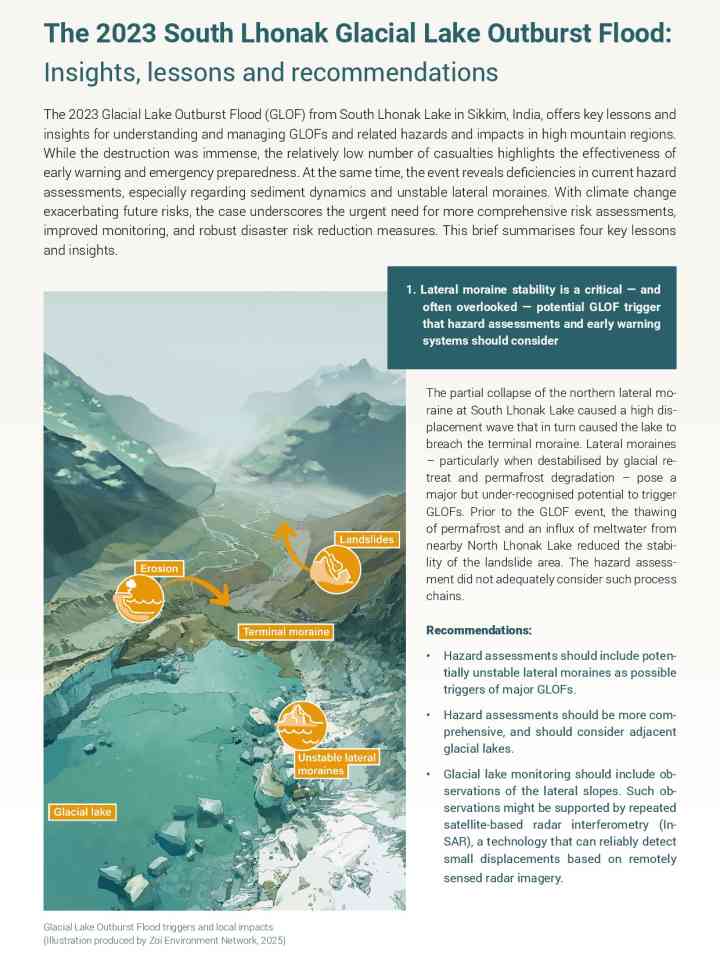
The publication examines the 2023 South Lhonak Glacial Lake Outburst Flood (GLOF) in Sikkim, India, using it as a case study to understand how cascading hazards unfold in high mountain regions. The event was triggered by the collapse of a lateral moraine, which generated a large displacement wave that breached the lake’s natural dam, releasing massive volumes of water downstream.
The flood caused widespread destruction across the Teesta Valley, including landslides, erosion, and the destruction of critical infrastructure such as a major hydropower dam. Despite this, the relatively low number of fatalities highlights the effectiveness of early warning systems and emergency response. The publication argues that current hazard assessments underestimate key risks, particularly sediment dynamics, lateral moraine instability, and cascading multi-hazard interactions. It stresses that climate change is increasing the likelihood and complexity of such events. The report ultimately calls for more comprehensive risk assessments, improved monitoring (including satellite technologies), stronger infrastructure design, and enhanced early warning and preparedness systems.
Explore further