
Playing for the planet: gamified learning and global health education
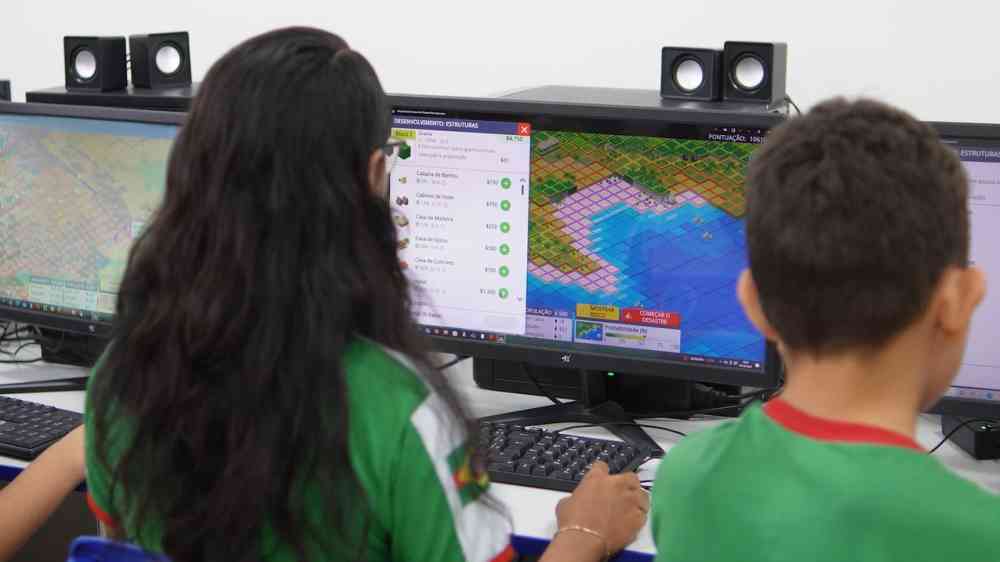
Schoolchildren playing the Stop Disasters game in Barcarena, Brazil, in the lead up to COP30 (October 2025).
Dr Michael J Dillon and Professor Laura Bowater emphasise the significance of gamification in global health education amidst increasingly complex challenges
Global health challenges are increasingly complex, interconnected and difficult to predict. Climate change, emerging infectious diseases, antimicrobial resistance and humanitarian crises do not occur in isolation; they are often linked (1) and interact across systems, borders and communities in ways that are difficult to capture through traditional teaching methods alone. For students entering healthcare and biomedical professions, understanding these challenges and visualising how they are interconnected requires more than memorising facts or recalling protocols. They must learn to interpret evolving situations, weigh competing priorities, and consider how decisions can have consequences across wider social, environmental, and healthcare systems. Increasingly, educators are turning to gamified and simulation-based learning to help students engage with this complexity in more active and meaningful ways.
Enhancing global health education through gamified learning
The inherent complexities that are part and parcel of global health education offer particularly fertile ground for this kind of learning. Serious games such as Stop Disasters!, (2) developed with the United Nations Office for Disaster Risk Reduction, place learners in the role of community planners, asking them to make decisions about housing, infrastructure, evacuation routes, and early warning systems before hazards strike. The lesson is not that disasters happen, but that risk is shaped – dialled up or dialled down – by human choices and material constraints: where communities build, how money is spent, which infrastructure is protected, and whose needs are prioritised before a crisis occurs.
More recent examples extend this logic into climate and environmental education. CoastCraft, a Minecraft Education resource, asks learners to manage coastal change and balance the needs of communities and the environment, with decisions shaping future scenarios in 2040 and 2060. (3) It is aimed at school-age students rather than university learners, but the underlying principle is highly relevant to global health students: students learn by seeing how environmental decisions, population needs, and long-term risk interact. By making these trade-offs visible, the game encourages students to think about climate adaptation not as a technical problem alone, but as a challenge shaped by environmental change, resource allocation, and population wellbeing that can be influenced by the decisions that key stakeholders make.
Outbreak simulations make a similar contribution in public health education. In Solve the Outbreak, learners take on the role of a disease detective, analysing clues and data to decide whether to quarantine, request further laboratory testing, or communicate with the public. (4) Outbreak Ready 2!: Thisland in Crisis goes further, placing humanitarian health practitioners in the role of managing an outbreak response in a setting affected by civil conflict, displacement, and an influenza outbreak. (5) These examples show how games can condense complex global health realities into structured learning experiences in which each decision has visible consequences.
How gamified learning supports better decision making
Within our own global health teaching portfolio, which includes an online MSc programme, we have begun integrating scenario-based activities and gamified approaches to encourage students to navigate uncertainty, consider competing priorities, and engage with the interconnected nature of global challenges. The emphasis is not on finding the ‘correct’ answer, but on understanding how decisions interact within complex systems.
What unites these approaches is not the technology or platform itself, but the kind of thinking they encourage. Global health problems rarely have simple or isolated solutions. Decisions made in one area can produce unintended consequences elsewhere, whether through migration, resource allocation, environmental change, or patterns of disease transmission. (6) Traditional teaching methods can struggle to capture these interdependencies, particularly when learning is reduced to static diagrams and didactic case studies.
By contrast, gamified learning environments allow students to experiment with systems dynamically. Learners can make decisions, observe downstream and interconnected consequences, and adapt their strategies in real time. They can test assumptions, reflect on outcomes and explore alternative approaches without real-world consequences. This is particularly valuable in subjects shaped by uncertainty, where there may be no single correct answer and every decision involves trade-offs. Students need opportunities to consider not only what they know, but how they use that knowledge when situations become complex.
In this sense, gamification is not about making global health ‘fun’; rather, it is about creating educational experiences that reflect the complexity, ambiguity, and interconnectedness of the real world. The educational value lies not in competition or entertainment, but in participation, reflection, and systems thinking.
Is this an authentic learning experience?
Well, if an authentic learning experience is considered as ‘classroom environments (face-to-face, online, distance and so on), with learning opportunities, with activities, and in relation to the nature of the ‘real world beyond the classroom, as well as in relation to student personal meaning making,’ (7) then yes, these approaches are authentic. They enable global health challenges to be brought to life in a safe learning environment where students can challenge their assumptions, test their hypotheses and understand the outcomes of their decision-making in ‘real’ time. As such, gamified learning has significant value and merit. Using this approach has other advantages. It also provides opportunities for students to bring their lived experiences and engage with their perspectives and viewpoints in an authentic yet safe way.
As global health challenges become increasingly interconnected, biomedical education must prepare students not only to understand scientific systems but also to navigate uncertainty, collaboration, and consequences. Gamified learning will not replace traditional teaching, nor should it. But when designed thoughtfully, it can help students move beyond memorising information towards understanding how complex systems behave, adapt, and interact by offering authentic learning experiences. In a world shaped by climate instability, emerging diseases, and global interdependence, those may be among the most important lessons we can teach.