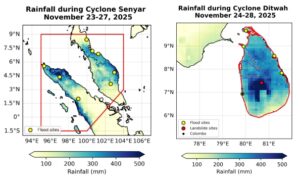
On 27 November, Cyclonic Storm Ditwah struck Sri Lanka with strong winds and very heavy rainfall, causing the worst flooding and landslides since the early 2000s (UN News, 2025). Cyclonic Storm Ditwah became the deadliest weather-related disaster since the 2004 tsunami. Meanwhile Indonesia, Malaysia and southern Thailand were experiencing persistent heavy rainfall, intensified by Cyclonic Storm Senyar that made landfall on Indonesia and Malaysia on 26 and 27 November.
In Sri Lanka, as of December 8, at least 635 fatalities, 192 missing and over 600,000 families displaced are reported; 2.1 million individuals have overall been affected (DMC, Sri Lanka, 2025). For Indonesia, at least 593 fatalities, 468 missing and 2,600 injured individuals as well as 600,000 displaced people have been reported by the IFRC as of December 2, while in Malaysia at least 37,000 people have been affected by the rains (OCHA, 2025).
In Sri Lanka, transport and energy infrastructure have been impaired across the country with at least 247km of major roads and 35 bridges damaged and over 277,000 buildings inundated (ECHO, 2025; DMC Sri Lanka, 2025; News.lk, 2025). Access to clean water remains a major concern (UN News, 2025). In Indonesia, at least 1.5 million people are affected in total, with Sumatra being the hardest-hit region (ECHO, 2025; CNN, 2025).
The influence of climate change on tropical cyclones is rather complex. However, while both regions were hit by tropical cyclones, the impacts mainly stem from the associated heavy rainfall rather than the high winds. Sea surface temperatures and two large modes of natural variability – the ongoing La Niña and the current negative phase of the Indian Ocean Dipole (IOD) potentially influence the heavy rainfall as well.
Scientists from Sri Lanka, Philippines, Malaysia, United Kingdom, United States, Sweden, Ireland and the Netherlands collaborated to assess to what extent human-induced climate change altered the likelihood and intensity of the heavy rainfall in the region. For the assessment of the role of climate change in the heavy rainfall, we study the heaviest 5-day rainfall periods over two domains; Sri Lanka and a region encompassing half of Sumatra and most of the Malaysian peninsula (fig 1), also in the context of La Niña and IOD. To put this in context we also analyse surrounding sea surface temperatures.