1. Home
  2. Knowledge Base | PreventionWeb
  3. Hazards
Mediterranean super-storms have been called ‘medicanes’ combining the words ‘Mediterranean’ with ‘hurricane’. Storm Daniel unleashed devastation across Bulgaria, Türkiye, Greece and Libya in 2023.

Thunderstorms are different from cyclones in the following ways:

  • Formation: Thunderstorms can form overland whereas cyclones form over warm ocean waters.
  • Scale: Thunderstorms are relatively small, localized weather events, typically spanning a few kilometers in diameter. Cyclones are much larger weather systems, typically covering hundreds to thousands of kilometers in diameter.
  • Features: Thunderstorms are characterized by the presence of lightning, thunder, heavy rain, strong winds, and sometimes hail. Cyclones are characterized by strong winds, heavy rainfall, storm surges.
  • Duration: Thunderstorms usually last from about 30 minutes to a few hours and cyclones can last for several days to over a week.
  • Impact: Thunderstorms can cause localized damage whereas cyclones can cause widespread and severe damage.

(Source: National Weather Service (NWS), American Meteorological Society (AMS), World Meteorological Organization (WMO), National Oceanic and Atmospheric Administration (NOAA))

This hazard category also covers hazards such as:

  • Hail: Hail is precipitation in the form of particles of ice (hailstones). These can be either transparent, or partly or completely opaque. They are usually spheroidal, conical or irregular in form, and generally 5−50 mm in diameter. The particles may fall from a cloud either separately or agglomerated in irregular lumps (WMO, 2017).
  • Lightning: Lightning is the luminous manifestation accompanying a sudden electrical discharge which takes place from or inside a cloud or, less often, from high structures on the ground or from mountains (WMO, 2017).
  • Derecho: Derechos are fast-moving bands of thunderstorms with destructive winds. The winds can be as strong as those found in hurricanes or even tornadoes. Unlike hurricanes and tornadoes, these winds follow straight lines (NOAA, 2019).
  • Strong wind: Wind is air motion relative to the Earth’s surface. Human health can be severely affected by windstorms

As an example of National Alerting Parameters, the United States Weather Service defines a thunderstorm as a severe thunderstorm when it produces hail one inch (2.54 cm) or larger in diameter and/or winds equal or exceed 58 mph (93 kmh) (NOAA, no date c).
Latest Thunderstorm additions in the Knowledge Base

Uploaded on
Case study
Location: Belize Dominican Republic Grenada Saint Vincent and the Grenadines
Case study on the development of a replicable digital monitoring and evaluation system to track post-disaster recovery across Caribbean countries.
  • Intra Africa, Caribbean and Pacific (ACP) Disaster Risk Reduction Programme (DRRP)
Case study
Location: Togo
This case study examines how Togo is establishing a connected national situation room, integrating disaster risk information, strengthening early warning and improving interoperability with ECOWAS and African Union systems.
  • Intra Africa, Caribbean and Pacific (ACP) Disaster Risk Reduction Programme (DRRP)
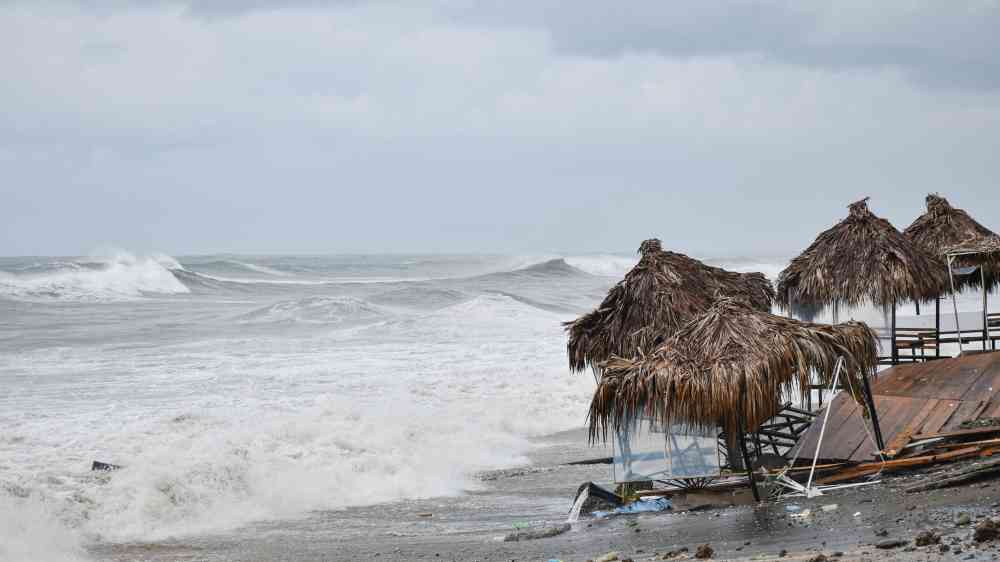
Dramatic waves crash on a Batumi beach with rustic huts under overcast skies.
Update
Cabo Verde: EW4LL roadmap validation after Tropical Storm Gonzalo

Days after Tropical Storm Gonzalo flooded parts of Sal, Cabo Verde, institutions and stakeholders from across the early warning chain came together in Praia on 29 September 2026 to validate the country’s national Early Warnings for All roadmap.

World Meteorological Organization (WMO)
Modelling storm-induced coastal exposure using hindcast wave data in a densely urbanised coastal area thumbnail
Documents and publications

This paper presents a high-resolution modelling approach for coastal exposure assessment, based on a 43-year wave hindcast dataset, applied to a densely urbanised stretch of coast along the eastern Ligurian Riviera (northwestern Italy).

Natural Hazards (Springer)
World Risk Report 2026 - focus: storms thumbnail
Documents and publications

The World Risk Report 2026 asks: why does the same storm turn into a disaster in one country while its consequences remain limited elsewhere?

Bündnis Entwicklung Hilft
Institute for International Law of Peace and Armed Conflict
Reimagining disaster risk assessment: The role of information equity in vulnerable communities thumbnail
Documents and publications

This study advances an equity-centered approach by centering informational equity as an underexamined dimension of disaster vulnerability. Findings show informational inequities emerge from systematic misalignments across the risk communication ecosystem.

International Journal of Disaster Risk Reduction (Elsevier)
Equatorial extreme convective storms are expanding and becoming more persistent thumbnail
Documents and publications

This study leverages the first long-term, sub-kilometer, sub-hourly observational network in equatorial Singapore to produce a high-resolution gridded rainfall reanalysis.

AGU Advances (Wiley)
Research briefs
UK and Ireland: Risk from rare tropical cyclones reaching Europe

The new results suggest that, particularly for the UK and Ireland, storms with unusual origins may deserve a place in assessments of future wind and rainfall risk—even if they remain far less common than the storms Europe experiences every winter.

Phys.org
Uploaded on