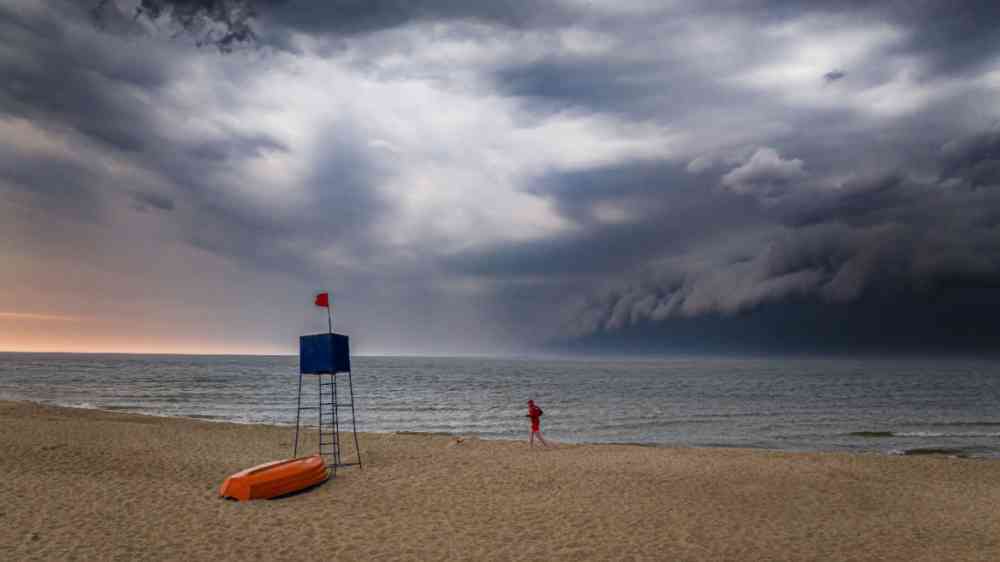
Thunderstorm
A thunderstorm is defined as one or more sudden electrical discharges, manifested by a flash of light (lightning) and a sharp or rumbling sound (thunder) (WMO).
Thunderstorms are associated with cumulonimbus clouds (WMO, 2017) and are most often accompanied by precipitation that, when it reaches the ground, is in the form of a shower of rain, snow, snow pellets, small hail or hail. Thunderstorms can cause tornadoes, strong winds, and flash flooding (Habitat for Humanity, 2021).
Thunderstorms are different from cyclones in the following ways:
- Formation: Thunderstorms can form overland whereas cyclones form over warm ocean waters.
- Scale: Thunderstorms are relatively small, localized weather events, typically spanning a few kilometers in diameter. Cyclones are much larger weather systems, typically covering hundreds to thousands of kilometers in diameter.
- Features: Thunderstorms are characterized by the presence of lightning, thunder, heavy rain, strong winds, and sometimes hail. Cyclones are characterized by strong winds, heavy rainfall, storm surges.
- Duration: Thunderstorms usually last from about 30 minutes to a few hours and cyclones can last for several days to over a week.
- Impact: Thunderstorms can cause localized damage whereas cyclones can cause widespread and severe damage.
(Source: National Weather Service (NWS), American Meteorological Society (AMS), World Meteorological Organization (WMO), National Oceanic and Atmospheric Administration (NOAA))
This hazard category also covers hazards such as:
- Hail: Hail is precipitation in the form of particles of ice (hailstones). These can be either transparent, or partly or completely opaque. They are usually spheroidal, conical or irregular in form, and generally 5−50 mm in diameter. The particles may fall from a cloud either separately or agglomerated in irregular lumps (WMO, 2017).
- Lightning: Lightning is the luminous manifestation accompanying a sudden electrical discharge which takes place from or inside a cloud or, less often, from high structures on the ground or from mountains (WMO, 2017).
- Derecho: Derechos are fast-moving bands of thunderstorms with destructive winds. The winds can be as strong as those found in hurricanes or even tornadoes. Unlike hurricanes and tornadoes, these winds follow straight lines (NOAA, 2019).
- Strong wind: Wind is air motion relative to the Earth’s surface. Human health can be severely affected by windstorms
As an example of National Alerting Parameters, the United States Weather Service defines a thunderstorm as a severe thunderstorm when it produces hail one inch (2.54 cm) or larger in diameter and/or winds equal or exceed 58 mph (93 kmh) (NOAA, no date c).