1. Home
  2. Knowledge Base | PreventionWeb
  3. Hazards

The World Meteorological Organization guidelines on the definition and monitoring of extreme weather and climate events advise the following (WMO, 2020):

  • Index: Daily values of Tmax, Tmin, and /or average temperature. Another index could be computed using temperature change in the 24 hours prior to the onset of the event.
  • Threshold: Determined based on historical values of the index.
  • Temporal: Station-level information on starting date, ending date, and duration of the event. Persistence of conditions for a cold wave are two days.
  • Spatial: Calculate the area affected, by providing the percentage of stations where the threshold was surpassed; locate the coordinates of the impacted stations and the centre with the highest/lowest values of the indices; and optional, but recommended if resources are available, to use a geographical information system (GIS) to calculate the area affected by the event, the magnitude, and severity.

This hazard category also includes Dzud which is a cold-season disaster in which anomalous climatic (i.e., heavy snow and severe cold) and/or land-surface (snow/ ice cover and lack of pasture) conditions lead to reduced accessibility and/or availability of forage/pastures, and ultimately to high livestock mortality during winter–spring. This page also contains content on Blizzard which is a severe snow storm characterised by poor visibility, usually occurring at high-latitude and in mountainous regions.

Vulnerability

Human health impacts from cold waves include mortality from ischaemic heart disease and cerebrovascular disease, both of which increase in cold weather.

Living in a cold house can affect health at any age, not just in old age, for a variety of reasons. Although the extra deaths in elderly people are caused mainly by cardiovascular and respiratory disease, far greater numbers have minor ailments that lead to a huge burden of disease, costs to the health system, and misery.

Compared with those who live in a warmer house, respiratory problems are roughly doubled in children, arthritis and rheumatism increase, and mental health can be impaired at any age. Adolescents who live in a cold house have a five-fold increased risk of multiple health problems (Dear and McMichael, 2011).

Risk reduction measures

To reduce impacts related to cold waves, countries have used national alerting parameters for cold wave warning or cold weather plans, which help prevent major avoidable effects on health (HIP, 2021).

Latest Cold Wave additions in the Knowledge Base

Uploaded on
The Jordanian municipality of Salt has become a leader in disaster resilience (Photo: UNISDR)
Update

Municipalities are taking the lead in Jordan to help build resilience to disasters, in the wake of recurrent winter storms that have seen heavy snow, rainfall and high winds cause power cuts, road closures and flooded homes.

United Nations Office for Disaster Risk Reduction - Regional Office for Arab States
Documents and publications

This community science position paper considers the disaster risk associated with extreme geohazards, such as earthquakes and tsunamis, landslides, extreme temperatures, volcanic eruptions, drought and floods, and addresses the challenges of disaster risk

Group on Earth Observations
European Science Foundation (ESF)
Geohazard Community of Practice
Documents and publications

Southasiadisasters.net issue no. 127, March 2015:

This issue focuses on the important theme of 'Understanding Drought in India'. India's over dependence on rainfed agriculture and the increasing variability of monsoons due to climate change underscore

All India Disaster Mitigation Institute
Update

The WMO Statement on the Status of the Global Climate in 2014 confirmed the continuation of the warming trend over the past few decades, with 14 of the 15 hottest years on record occurring this century. The report was released to coincide with World Meteorological Day 23 March which promotes the theme 'Climate Knowledge for Climate Action'...

World Meteorological Organization (WMO)
Policies and plans
Policy type
Local policies and plans

This plan serves as a blueprint for coordinating and implementing mitigation programs and projects. It provides a list of hazards that are of concern to the Town of Lincoln, mitigation goals, and related actions. Hazard mitigation planning is a process in

Lincoln, Rhode Island
Update

'Through this project, the World Bank (WB) is supporting Mongolia’s efforts to build resilience and identify gaps so that resource plans and programs can be better aligned with needs,' said James Anderson, WB Country Manager...

World Bank, the
© 2015 Münchener Rückversicherungs - Gesellschaft, Geo Risks Research, NatCatSERVICE – As at January 2015
Update

'Though tragic in each individual case, the fact that fewer people were killed in natural catastrophes last year is good news. And this development is not a mere coincidence. In many places, early warning systems functioned better, and the authorities consistently brought people to safety in the face of approaching weather catastrophes, for example before Cyclone Hudhud struck India’s east coast and Typhoon Hagupit hit the coast of the Philippines'...

Münchener Rückversicherungs-Gesellschaft (Munich Re)
Documents and publications

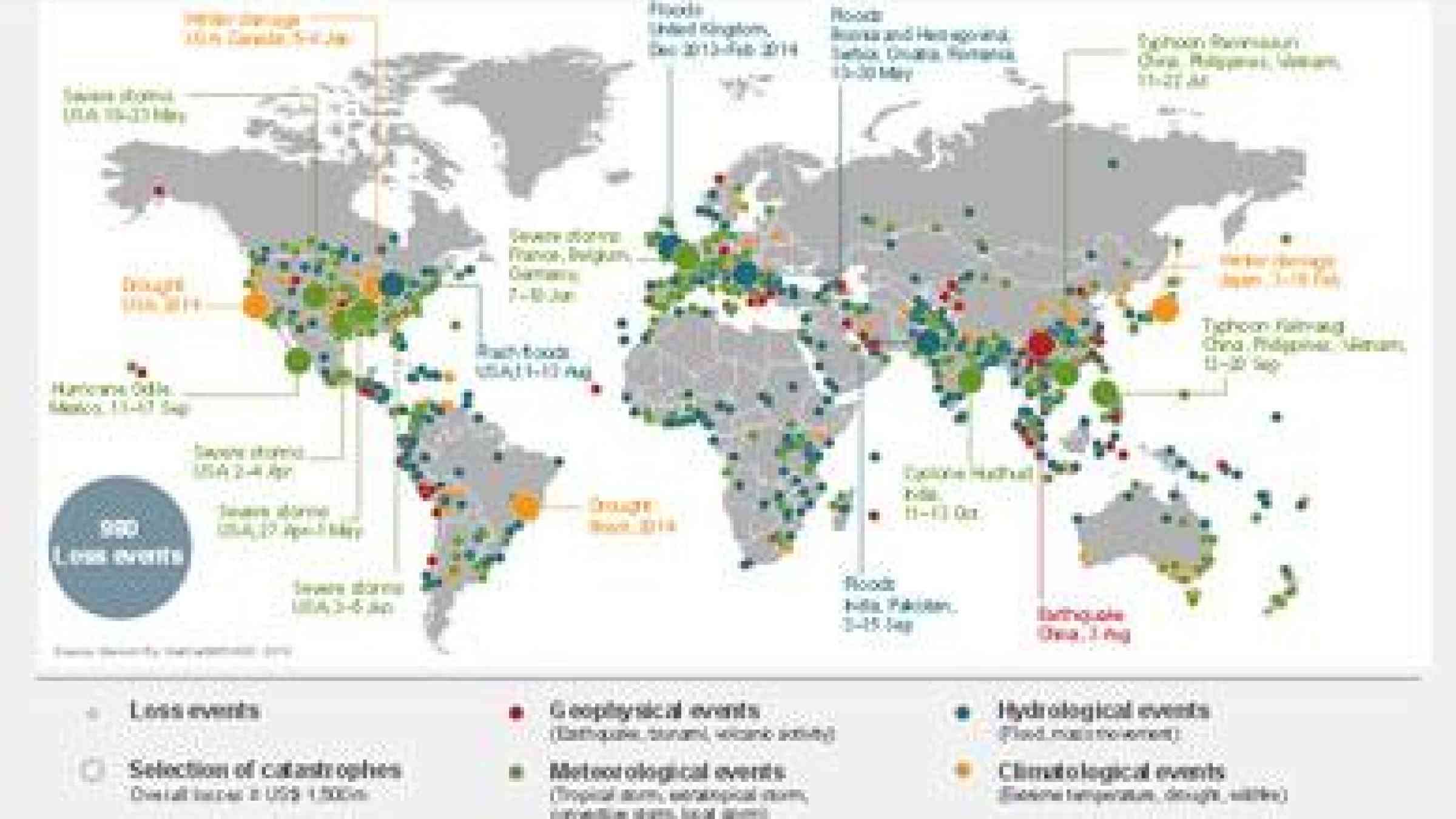
This map shows the worldwide distribution of natural disasters that occurred in 2014, according to Munich Re, NatCatSERVICE.

With more than 25,000 entries, NatCatSERVICE is one of the leading global databases for natural catastrophes. Every year between

Münchener Rückversicherungs-Gesellschaft (Munich Re)
Uploaded on