
Uncovering local realities: a spotlight on a disaster anthropologist

Villagers on Tanna Island, Vanuatu, perform traditional ceremonies in the shadow of Mt Yasur, an active volcano.
Small island developing states (SIDS) have especially high levels of exposure to hazards - including complex multi-hazard events such as hurricanes, storm surges and sea-level rise. Yet each island across archipelagos has unique social and cultural aspects that mean a one-size-fits-all disaster risk reduction strategy is not suitable across a country's island arcs. To specialise DRR strategies to individual islands, a closer look at the local realities of residents needs to be taken.
The field of disaster anthropology looks to understand how a physical hazard can result in a disaster, and how in turn disasters may lead to social transformations. As inherently intersectional work, disaster anthropologists merge different fields of study to ultimately provide recommendations and ways of practice that are rooted in the socio-cultural realities of an area - and will therefore be the most effective.
Maëlle Calandra, a disaster anthropologist and a research fellow at the French National Research Institute for Sustainable Development (IRD) in Paris, was interviewed by PreventionWeb to find out how her fieldwork has led to a highly comprehensive view of the disasters experienced on the island of Tongoa in Vanuatu.
Could you explain the link you are making between anthropology and disasters in your research? How did you end up working in this area of intersectional study?
It is more than just a link that I have established between anthropology and disasters, because I have been involved in disaster anthropology since my first research projects in Vanuatu in 2011. This field seeks to understand how physical phenomena become events that "cause" disasters. It is part of a continuum of several sub-fields, such as the anthropology of risk, or disaster studies, which focus more on the economic and social vulnerability of societies affected by a disaster than on the phenomenon itself. Since the late 1990s, the anthropology of disasters has made disasters its main subject of study, suggesting that we analyze how disasters may lead to social transformations.
From this perspective, as explained by anthropologist Sandrine Revet – a leading figure in this field in France – fieldwork (ethnography) should serve to "shed light on the practices, ways of doing things, forms of organization, and different interpretive frameworks that are put in place to deal with the event " (Revet 2009: 421). Furthermore, the anthropology of disasters invites us to think of disaster as a process, revealing its mechanisms, historical depth, and "root causes," as put by Suzanna Hoffman and Anthony Oliver-Smith (2002).
In the end, it seems to me that our discipline leads us to understand disasters beyond the destruction they cause. A reflective approach also allows us to move beyond the spectacular nature of the event and place the analysis outside the frame, embracing all points of view and meeting with a multitude of actors in order to gain the most comprehensive view possible of the disaster.
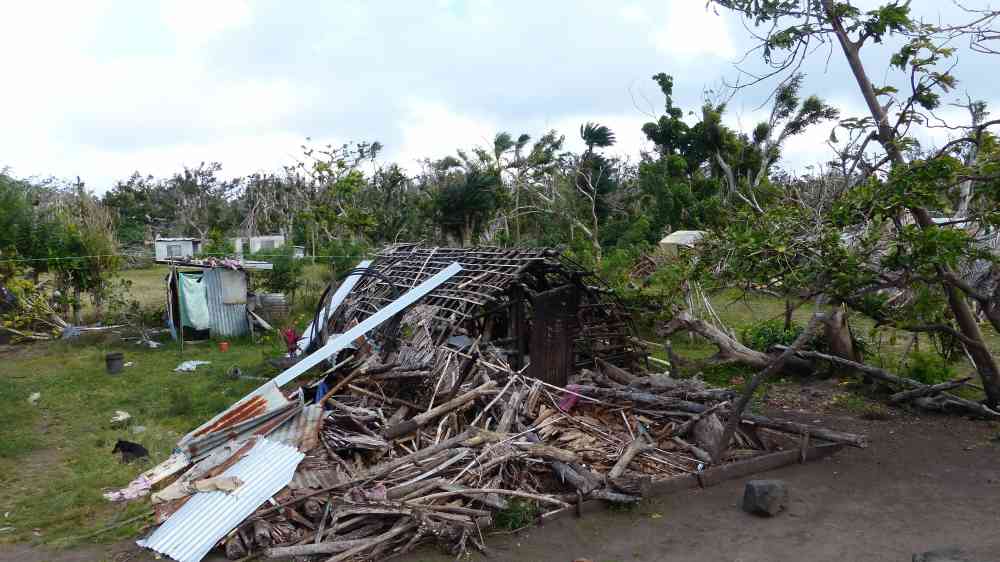
A destroyed house in the aftermath of Cyclone Pam, 2015, on Tongoa, Vanuatu
A lot of your work has focused on Vanuatu. Could you tell us a bit more about the risk profile of the archipelago?
The Vanuatu archipelago is located in the southern part of the South Pacific island arc, between the latitudes of 13°S and 22°S. Comprising of more than 80 islands, it is home to nearly 300,000 inhabitants. This country lies on the Pacific Ring of Fire, at the junction of the subduction zone between the Australian and Pacific plates. This geological position explains the high frequency of volcanic and seismic activity. The country has nine volcanoes, three of which are submarine. Several hundred earthquakes are recorded each year. In addition, between November and April, the archipelago is crossed by tropical depressions that can develop into cyclones. It is therefore possible that, on any given day, Vanuatu could experience a cyclone, an earthquake, and a volcanic eruption simultaneously.
These combined factors and the risks they entail (tsunamis, floods, landslides, mudslides, etc.) make Vanuatu one of the territories most exposed to so-called "natural" disasters, as evidenced by the World Risk Index ranking, which places it as the most dangerous country to live in. However, as my work has shown, the inhabitants of this country do not describe their environment as dangerous or unliveable, and disasters are rarely thought of as "natural." This is the aspect that my work initially focused on (Calandra 2019). Since 2021, I have been co-directing a research program on the volcanic eruption of Ambae between 2017 and 2018 - it turned out that for the inhabitants, the real disaster was not the eruption itself, as they had always lived with this threat , but rather the forced displacement organized by the government and the resettlement of the population to other islands in the country.
There is no such thing as a natural disaster. A hazard can only become a disaster once it impacts on society or community. A hazard is natural, disasters are not. Words matter. Describing disasters as natural suggests there is nothing humans can do to reduce disaster risk and mitigate their impact.
During your fieldwork in Vanuatu in 2015, Cyclone Pam led you to change your study focus. Could you explain what happened and how this shaped your research interests?
Indeed, Cyclone Pam was a significant event in the context of my research, because overnight, Tongoa, the island where I was conducting my ethnography, was devastated by powerful winds. I was already working on local conceptions of disasters based on my study of subsistence gardens. Cyclone Pam provided a counterpoint to what I had observed up to that point: the gardens that provided subsistence for families had been destroyed, and their food security was now compromised.
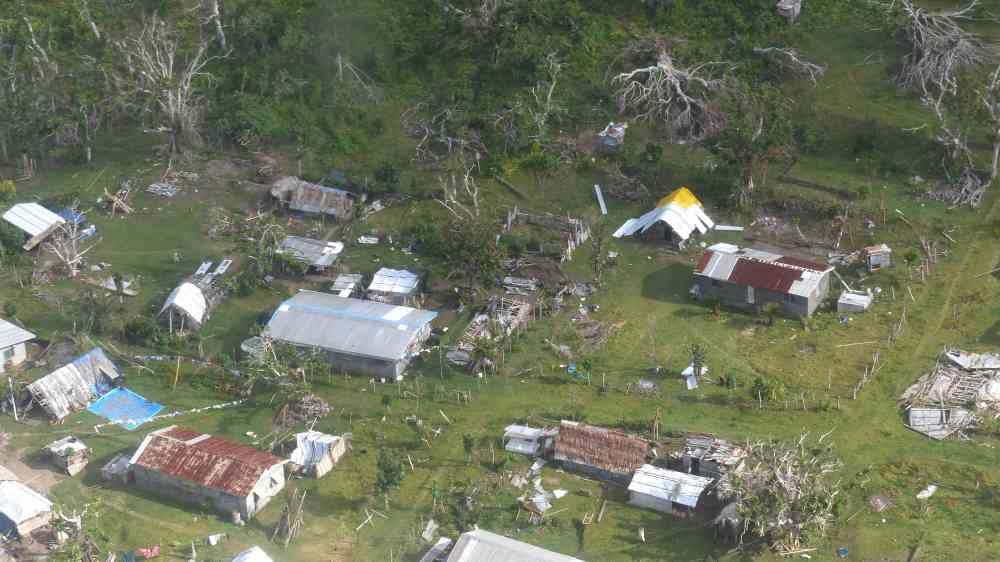
Aerial view of destroyed houses on Tongoa, Vanuatu, in the aftermath of Cyclone Pam, 2015
In addition, the scale of the phenomenon and its media coverage encouraged volunteers and humanitarian aid professionals from around the world to come to the island. They were tasked with rebuilding homes. However, this was the subject of controversy, which prompted me to shift the focus of my analysis from the disaster victims to those who govern crises. This led me to conclude that when humanitarian action in charge of reconstruction does not take sufficient account of the socio-cultural reality in which its project is taking place – due to the time frame of the intervention, the results expected by donors, pre-established reconstruction kits, etc. – it runs the risk of creating confusion within the beneficiary community, or even reinforcing its vulnerabilities (Calandra 2023).
What is the relation of the people of Vanuatu with their environment and how do they perceive and live with hazard risk, notably volcanic, in their daily lives? Have they developed knowledge systems that help them reduce their exposure?
Generally speaking, it can be said that over time and through the disasters that they have experienced, inhabitants have co-constructed specific vigilance strategies with their environments (vernacular architecture, resource management, transmission of local knowledge, etc.) that can be traced back through history. For example, in Tongoa, inhabitants have developed expertise based on precise visual and olfactory observations that enable them to anticipate and protect themselves from both cyclones and volcanic eruptions (Calandra 2025).
This knowledge is transmitted through oral histories and is re-circulated, or even updated, with each new destructive event. In my previous work on the islands of Tongoa and Tanna, each of which has a volcano, I showed that the inhabitants perceived these elements of their environment as ambivalent figures – sources of chaos, certainly – but also of life. Indeed, over time, the ashes enrich the soil, making it well-suited for growing the food crops on which families depend for their sustenance, and thus ash ultimately ensures even more abundant harvests in the long-term (Calandra 2013).
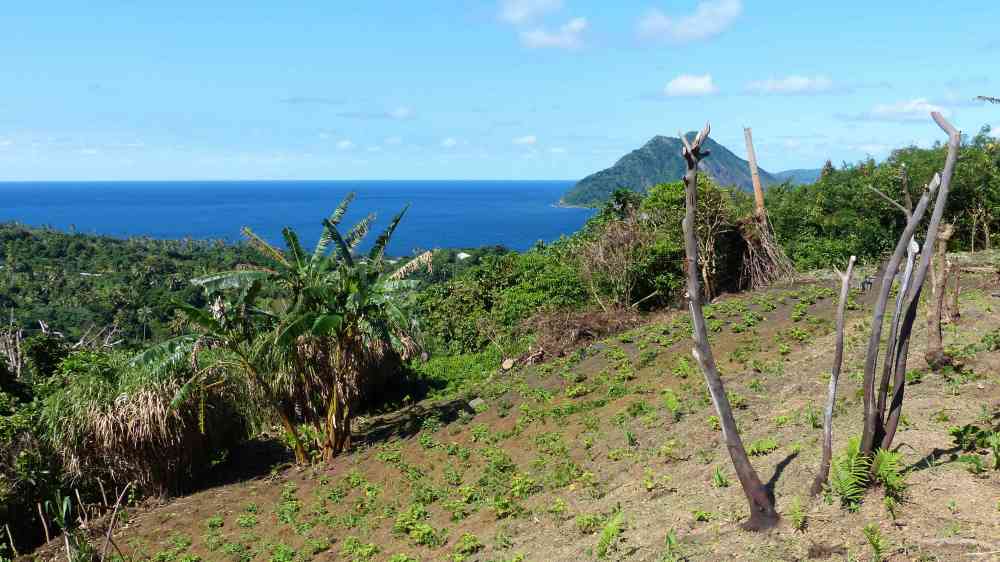
Hillside garden on Tongoa, Vanuatu
In terms of early warning systems, the local warning system is supplemented by the warning system developed by the authorities responsible for risk monitoring and prevention. In an archipelago such as Vanuatu, which is made up of more than 80 islands, it can be difficult for government agencies to relay information across the country. Social media plays a major role in relaying important information, keeping people informed, and communicating about increased volcanic activity on certain islands - or any other disasters that may have temporarily escaped the government's radar (Calandra 2022).
What advice would you give to young professionals interested in studying disaster anthropology?
I would tell them that they are entering an exciting field in which it is possible to observe and analyze a multitude of different aspects of the disasters they respond to. It is also a field which, through its tools and methods, helps us to take a step back from the world we live in and offers the possibility of taking a decentralized – or at least renewed – look at the disasters that regularly affect us. It seems to me that our work can shed more light on actions taken in the field and ultimately propose measures that are more firmly rooted in socio-cultural realities, or at least make sense to the intended audience.
This interview has been translated from French.

Maëlle Calandra is an anthropologist, she holds a PhD from EHESS, is a research fellow at IRD, and a member of the Migrations and Societies Research Unit (URMIS) in Paris. Her scholarship engages with current debates in the anthropology of disasters, the anthropology of human-environment relations, and migration studies. She works primarily on the island societies of the South Pacific, with a particular focus on rural Vanuatu. Her current research investigates the forced displacement of the inhabitants of Ambae Island following the 2018 volcanic eruption, within the framework of the ANR-funded project "Environmental Migrations and Volcanic Disasters in Vanuatu: A Multiple Perspective (EMVOLDIVA)". Since 2023, she co-leads the course "Anthropology of Disasters" at Sciences Po Paris. In November 2025, her work was recognized with the Research Prize of the French Red Cross Foundation.
Maëlle's book, titled 'Gardens, cyclones and disasters: an ethnography of disasters in Vanuatu' [Jardins, cyclones et catastrophes: ethnographier le désastre au Vanuatu] focuses on the issues discussed above.