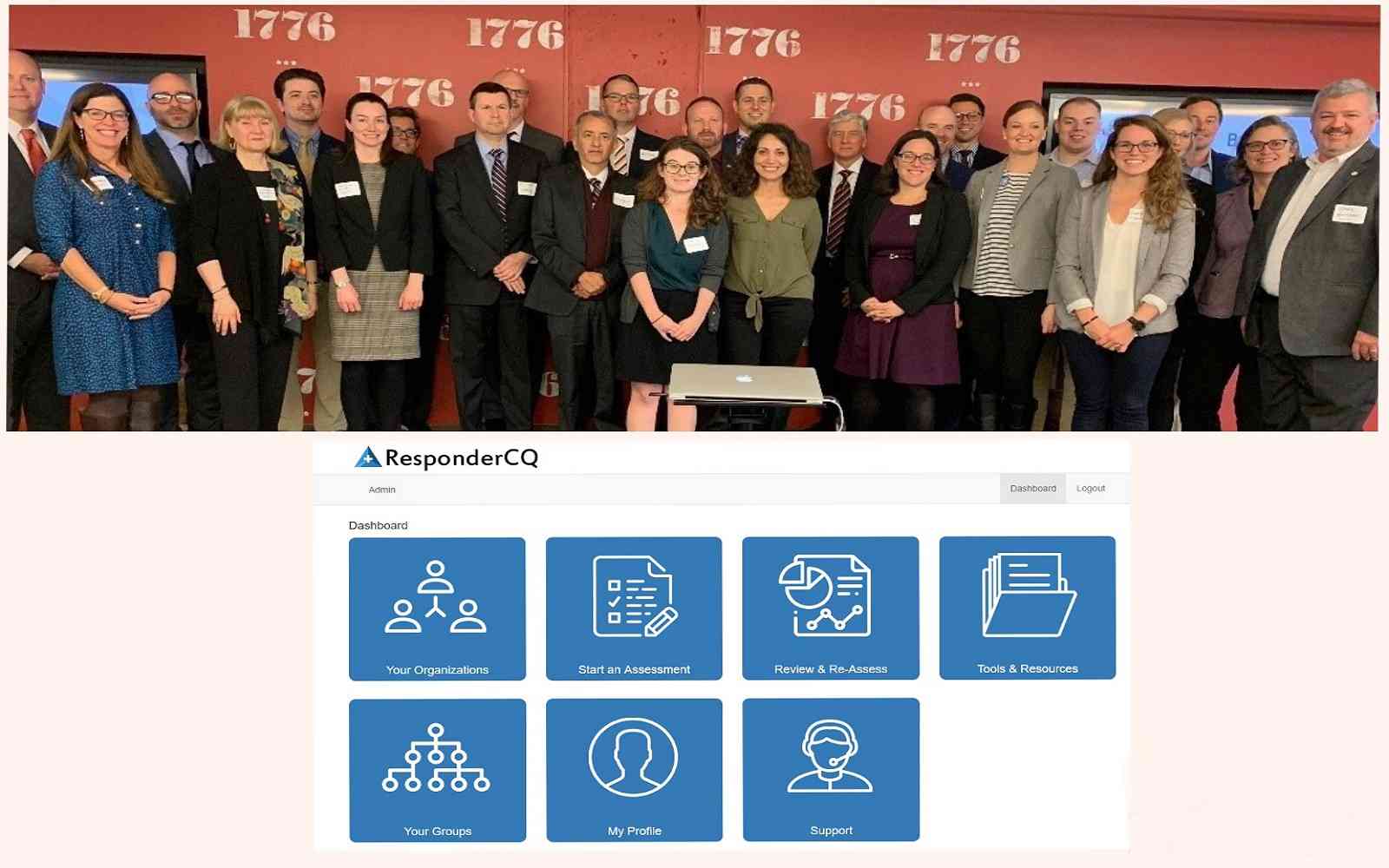
ResponderCQ: A Disaster Resilience Assessment and Data Management Service
ResponderCQ is an online disaster resilience and data management assessment service designed to facilitate rapid evaluation of core capabilities and facilitate capability improvement through an online toolkit for government, business and humanitarian organizations. The service is free for end users.
Description
The intention is to facilitate rapid disaster resilience assessments and sharing of data to enable harmonization of city and national level efforts that are designed to foster positive disaster resilient outcomes. Workshops (2018/2019) were/will be held as well as a Disaster Resilience Assessment Working Group in order to move forward in achieving disaster resilience with the technical assistance of the online platform. Cities will be able to complete assessments that relate to their needs, priorities, and risks.
The mission of the Disaster Resilience Assessment Working Group is to form a collaborative smart cities assessment approach that facilitates capability improvement and yields positive disaster resilient outcomes. To accomplish its mission, the Working Group will: Identify existing assessments and methodologies, develop cohesive approach and delivery strategy, organize existing assessments into an online assessment service at ResponderCQ.com, and conduct assessments of smart cities and present findings. ResponderCQ comes into play as the enabler of the assessment, data collection, monitoring and evaluation process. The goal output is a repeatable process that can be implemented in cities across the world.
The commitment helps us achieve our mission by assessing communities to figure out where they can become stronger in order to increase resilience and DRR outcomes. The ResponderCQ disaster resilience assessment service uses the Capability Quotient (CQ) to assess communities in order to gather a baseline or current capabilities. CQ is an assessment indicates the readiness posture and relative responsiveness of personnel and assets to perform a mission. This commitment reinforces priorities of the Sendai Framework and helps make cities resilient across the globe. Additionally, this commitment hopes to further unite growing resilient cities so they can share assessments, resources, and best practices.
Our commitment is to execute the Disaster Resilience Assessment Working Group findings with the goal of implementing a repeatable process to assess, measure, monitor, evaluate, and increase disaster resilience outcomes across the world. Lessons learned and findings reports will be published in 2019.
Did the Sendai Framework change or contribute to changes in your activities/organization? If so, how?
Yes, since the SF recognizes the importance of resilience and makes calls to action for countries to invest in DRR for resilience, We decided to include DRR perspectives in our research, development, and assessments. Our activities target resilient cities worldwide as test beds for implementation. Greater justification exists in our initiatives when aligned with the Sendai Framework. Our work is being implemented in cities that are members of the 100RC project/UNISDR. Furthermore, Priority 1 specifically calls for strengthening the capacity to apply methodologies and models to do pre-disaster and periodic risk assessments. In turn, Priority 2 underlines that the assessments should include technical, financial & administrative capabilities.
What led you to make this commitment/initiative?
What was your position before making this Voluntary Commitment / prior to the Sendai Framework?
The alignment of our work and activities with DRR initiatives made this commitment seem like a natural fit. Collaborating with other groups globally will allow even further dialogue, ideas, and potential relationships to form with other members.
Deliverables and Progress report
Deliverables
Deliverables are the end-products of the initiative/commitment, which can include issuance of publications or knowledge products, outcomes of workshops, training programs, videos, links, photographs, etc.
This deliverable followed the first Disaster Resilience Assessment Workshop, hosted in Washington, D.C. The report includes a workshop summary, considerations for ongoing and future research, and a working group action plan. This report was published in December 2018.
Attached is a flyer that details an overview of the workshop. (A report is available upon request). This report will follow the second workshop to be hosted in April 2019 (Washington, D.C.).
Attached is a flyer that details an overview of the workshop. (A report is available upon request). This report will follow the third workshop to be hosted in April 2019 (Wellington, New Zealand).
Organizations and focal points
Implementing Organization(s)
Focal points
Partners