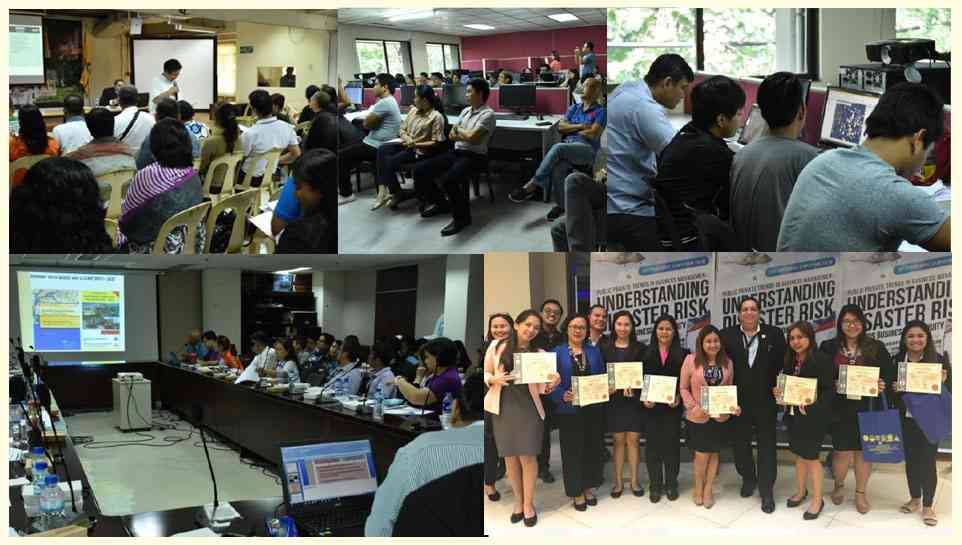
Programs, projects, research and other DRR activities by the Disaster Risk Management Unit (DRM Unit) of PSBA Manila
The DRM Unit is committed to provide support for formal DRM education for local and international citizens by addressing the root cause of vulnerability to disasters in order to uphold people’s right to life and property.
Description
In 2003, the Disaster Risk Management Unit (DRM Unit) was founded under the Graduate School Research Center of the Philippine School of Business Administration Manila (PSBA-Manila). Our mission is to enable men and women to achieve their leadership and frontline role in the field of DRM in changing climate, especially focusing on Business Continuity/Contingency; and to raise awareness, knowledge dissemination, and mainstreaming DRM, Climate Change Adaptation, and Sustainable Development in every aspect of the community from local to national levels.
The DRM Unit plans to achieve the above by achieving the following objectives:
- Develop and support a formal education program on DRM for current and future community leaders, planners, and experts directly and indirectly involved in decision making.
- Support and improve existing DRM Unit programs, projects, and research activities, particularly on climate-related disaster challenges on sustainable development.
- Organize Local and International Seminars, Symposia, Workshops, Training Programs, and similar activities predominantly on business continuity/contingency planning in changing climate towards sustainable development.
- Offer short certificate courses for leaders, advocates, and professionals involved in DRM, Climate Change Adaptation (CCA), and achieving Sustainable Development Goals (SDGs) of their respective communities.
- Create face-to-face and online venues for peer-to-peer knowledge sharing, participatory process, and open dialogue of local leaders, advocates, and professionals involved in DRM, CCA, and SDGs.
Presently, the DRM Unit has research fellows from local and international partners who research significant DRM topics and share their expertise and knowledge on DRM in changing climate at various international symposiums and colloquiums co-organized by PSBA-Manila.
The DRM Unit has a total of 42 personnel as part of its research fellowship program and internal support staff as of April 2018. The organization’s departments are staffed by qualified and capable people whose expertise covers a broad range of topics related to DRM with a focus on Business Continuity.
Did the Sendai Framework change or contribute to changes in your activities/organization? If so, how?
The Sendai Framework for Disaster Risk Reduction stated the importance of promoting the incorporation of disaster risk knowledge, including disaster prevention, mitigation, preparedness, response, recovery and rehabilitation in education at all levels, as well as in professional education and training. There is also a call for long-term, multi-hazard and solution-driven research in DRM to address gaps, obstacles, interdependencies and social, economic, educational and environmental challenges and disaster risks. The DRM Unit contributes to this and other aspects of the Framework.
What led you to make this commitment/initiative?
What was your position before making this Voluntary Commitment / prior to the Sendai Framework?
We are motivated to provide support for formal DRM education to uphold the Republic Act 10121 of the Philippine Government, which mandates to “Uphold people’s right to life and property… by addressing the root cause of vulnerability to disasters…”, and the lack of a formal DRM education in the country is a huge gap causing vulnerability of its citizens to disasters. This aligns with the Sendai Framework of 2015-2030, citing the need for DRM to be incorporated in public and private institutions, including academia.
Deliverables and Progress report
Deliverables
Deliverables are the end-products of the initiative/commitment, which can include issuance of publications or knowledge products, outcomes of workshops, training programs, videos, links, photographs, etc.
Our specific tool is strategic model:
- Strategic Model: Conceptualization and Implementation of a Total Disaster Risk Management: Cherry Hills Tragedy, Antipolo City
DRM tool:
- Estimation of Economic Damages Caused by Disasters: Event Impact Rapid Assessment and Disaster Scaling (EIRADS) Calculator
PSBA-Manila has an E-learning System at psbaelearning.psba.edu which acts as a portal for information sharing from the School.
In addition to offering the School's main educational programs, the e-Learning Portal also offers certificate courses for Disaster Risk Reduction (DRR) and Climate Change Adaptation (CCA)-related programs, such as Geographic Information Systems.
The E-learning System uses third-party off-site hosting, ensuring 24/7 availability from all around the globe even on the onset of a disaster.
The Geographic Information Systems Research and Development Hub (GIS-RDH) of the DRM Unit seeks to acquire a respectful status within the Philippines as a credible research center specialized in DRM. The center aims to establish a geospatially-centered research environment and providing world-class knowledge and expertise for disaster research. The center serves as a synergetic avenue for the pursuit of excellence in research, education, and services in geographic information technologies.
Our programs include:
- The MBA-DRM Program
- Joint Venture with UP PLANADES for Lahore College for Women University, Pakistan
- Joint Venture with the Quezon City Government and UP PLANADES, Philippines
- Collaborating with Asian Institute of Technology, Thailand
- Partnership with the National Health Emergency Preparedness & Response Network, Pakistan
For more information on the MBA-DRM Research Fellowship, DBA Research Fellowship and International Partner Schools' Research Fellowship, please follow the link below.
Organizations and focal points
Implementing Organization(s)
Focal points
Partners