
Mining Hazards
Mining hazards may cause major environmental and health impacts such as pollution of water bodies, degradation of forest resources, depletion of soil nutrients, destruction of wildlife habitat, and threats to human health. (adapted from UNDP and UN Environment, 2018).
Primary reference(s)
UNDP and UN Environment, 2018. Managing Mining for Sustainable Development: A sourcebook. United Nations Development Programme (UNDP). Accessed 6 February 2025
Annotations
Additional scientific description
Over recent decades, mining has generated considerable wealth, reduced poverty in developing countries, and improved quality of life through the provision of natural resources. Although mining has considerable benefits, this industry can have harmful impacts on people, society, and the environment (Donelly, 2018). The most common mining hazards include but are not limited to ground collapse, subsidence, fault reactivation and fissures, mine water rebound, acid mine water drainage, mine gas emissions, and combustion. Other notable hazards are mining-induced landslides, mining-induced seismicity, waste, dereliction, and contamination. Although potentially foreseeable, mining hazards cannot necessarily be forecast or predicted in terms of their timing, location, duration, magnitude, and extent. Mining hazards can occur in isolation or as groups of hazards occurring simultaneously (Donelly, 2018).
Artisanal and small-scale mining (ASM) has experienced substantial growth in recent years, largely due to the increasing value of mineral prices and additional sources of income, particularly in Africa and Latin America. Despite being low in productivity, ASM is an important source of minerals and metals and accounts for approximately 20% of the global gold supply and 20% of the global diamond supply. In 2017, 40.5 million people were estimated to have been involved in this sector. The most recent estimates are for about 9 million ASM operators in Africa and about 54 million people whose livelihoods depend on the sector (IGF, 2017). However, The Africa Minerals Development Centre considers this a 'conservative estimate', citing an important lack of data on ASM, as the activity is often informal and mostly operates illegally in several African countries. The Latin America ASM sector has strict regulations on informal operators and the use of certain substances but has limited capacity to implement these regulations. It is particularly difficult to control informal mining where there are large numbers of miners, such as in Colombia, where about 87% of 4134 Colombian gold mining operations are illegal and 95% of all the gold mines have no environmental permit (IGF, 2017). Perceptions of ASM activity vary from country to country. Stakeholders often tend to vilify artisanal and small-scale mining because of its informal nature and hazardous characteristics, with significant health and safety risks as well as susceptibility to social conflict and human rights violations (Barreto, 2011).
Mining hazards may occur during the exploitation of the mine and differ depending on what is mined and how. For example, underground coal mining may cause subsidence, landslides, fissures, and even hazard chains, seriously damaging the ecological environment (Ma et al., 2022). Gold mining often involves the use of chemicals dangerous for the health of the workers, their community and the surrounding environment, for example through the migration of pollutants into the air, the soil and the water (Liu et al., 2021; Wongsasuluk et al., 2021; Gerson et al., 2022).
During mining, the use of hazardous substances in mining puts the health of miners and their communities at risk - they are exposed, for example, to mercury, zinc vapour, cyanide, or other acids. This is a particular concern in artisanal gold mining, where mercury is frequently deployed and cyanide use is growing. Other health concerns include inhaling dust and fine particles from blasting and drilling processes causing respiratory diseases such as silicosis or pneumoconiosis in men and women, and in the children who often accompany their parents a lack of ear protection to filter noise from equipment such as drills or crushers can cause temporary or permanent hearing loss and speech interference (ILO, 2014).
Concrete actions started in 2018 with a focus on formalisation, establishing gold-buying schemes, capacity building at the national level on mercury-free technologies, awareness raising and knowledge sharing (UNEP, 2019).
Metrics and numeric limits
Not available.
Key relevant UN convention / multilateral treaty
There is no treaty on environmental pollution from mining activities, but several conventions regulate work in mines:
• Occupational safety and health in the mining (coal and other mining) sector (ILO, 2014).
• Hours of Work (Coal Mines) Convention (No. 31) in 1931 to the Safety and Health in Mines Convention (No. 176), which was adopted in 1995 (ILO, 2014).
The ILO’s International Classification of Radiographs of Pneumoconioses and Guidelines (OSH 22) is an internationally recognised tool for recording systematically radiographic abnormalities in the chest provoked by the inhalation of
ILO International labour standards
• Occupational Safety and Health Convention (No. C155) and Recommendation (No. R164), 1981
• Promotional Framework for Occupational Safety and Health Convention (No. C187) and Recommendation (No. R197), 2006
• Occupational Health Services Convention (No. C161) and Recommendation (No. R171), 1985
• Safety and Health in Mines Convention (No. C176) and Recommendation (No. R183), 1995
• C124 - Medical Examination of Young Persons (Underground Work) Convention, 1965
• R125 - Conditions of Employment of Young Persons (Underground Work) Recommendation, 1965 (No
ILO Codes of practice
• 2006 - Safety and health in underground coal mines
• 1991 - Safety and health in opencast mines
• 1986 - Safety and health in coal mines
• 1974 - Prevention of accidents due to explosions underground in coal mines
• 1965 - Guide to the prevention and suppression of dust in mining, tunnelling and quarrying
• 1959 - Prevention of accidents due to electricity underground in coal mines
• 1959 - Prevention of accidents due to fires underground in coal mines
• 1949 - Model code of safety regulations for underground work in coal mines
Drivers
The major multi-hazards related to mines include ground collapse and subsidence, sinkholes, mine flooding, water pollution, toxic gas leaks, and explosion risks. Natural hazards such as earthquakes (Senses & Kumral, 2023) and floods (Mason et al., 2013) can exacerbate mining hazards. These multi-hazards can occur sequentially or simultaneously, further amplifying the risks (Wu et al., 2022).
Lack of governance and inappropriate practices may increase the risk of accidents, in particular, at artisanal mining sites (Adu-Baffour et al., 2021).
Impacts
Mining activities release dust in the surrounding environment, with impacts on the health of surrounding communities (Entwistle et al., 2019) and the environment (Yu & Zahidi, 2023). Underground coal mining releases potentially harmful gases during accidents (Zykov & Filatov, 2018).
Occupational hazards are a major consequence of mining activities. Although only accounting for 1% of the global workforce, mining is responsible for about 8% of fatal accidents at work. No reliable data exist on injuries, but they are significant, as is the number of workers affected by such disabling occupational diseases as pneumoconiosis, hearing loss and the effects of vibration (ILO, 2015). Mineworkers face a constantly changing combination of workplace circumstances. Some work in an atmosphere without natural light or ventilation, creating voids in the earth by removing material and trying to ensure that there will be no immediate reaction from the surrounding strata. Despite the efforts in many countries, injury and disease among the world’s mineworkers means that, in most countries, mining remains the most hazardous occupation when the number of people exposed to risk is taken into account (ILO, 2015). In some countries, many more people are employed in small-scale, often informal, mining than in the formal mining sector. Many of these jobs are precarious and far from conforming to international and national labour standards. Accident rates in small-scale mines are routinely six or seven times higher than in larger operations, even in industrialised countries. A special problem is the employment of children (IGF, 2017).
Once the activities end and the mine is abandoned, the release of pollutants may continue for several years (Demkova et al., 2017). Abandoned underground mines (for coal or stones); may lead to collapse, manifesting at surface from shallow depressions to sinkhole-like structures. This type of damage can lead to financial loss for anyone involved in the ownership or management of property in former mining areas, including householders, developers and local government (British Geological Survey, 2025).
Multi-hazard context
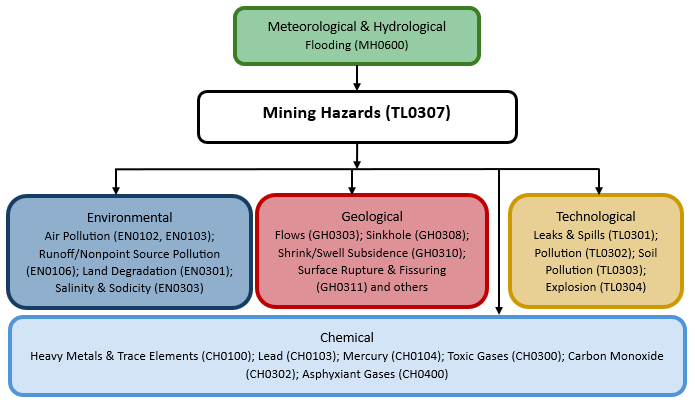
The figure below summarises common interactions between mining hazards and other hazards. This information should be used with caution and not be solely relied upon in Disaster Risk Management, particularly as some interactions may not have been included. Note that hazardous events occurring together or locally in space or time may not necessarily cause, amplify, or be otherwise related to each other. Specific examples of multi-hazard context can be found in the ‘Hazard drivers’ and ‘Impacts’ sections above.
Multi-hazard diagram
Risk Management
Risk generated by extreme events also needs to be incorporated in planning and management into pre-development, development and construction, mining and processing operations and post-mining phases. Whilst mining and mineral professionals have experience with risk management and managing workplace health and safety, changes to patterns of extreme weather events and future climate impacts are unpredictable. Responding to these challenges requires planning and preparation for events that many people have never experienced before.
To prevent mining hazards from occurring, monitoring and site inspections are recommended prior to, during, immediately after and long after mineral production ceases and a mine is abandoned (Donelly, 2018). Governance needs to be improved and regulations enforced. The Global Environment Facility has developed the Global Opportunities for Long-term Development of ASGM Sector (GEF GOLD) which is an important funding body for projects on ASM and hazardous substances. In 2016, the Global Opportunities for Long-term Development (GEF GOLD) was launched to support the phasing out of mercury use in artisanal and small-scale gold mining and reduce environmental health and safety risks in the sector. The United Nations Industrial Development Organization (UNIDO) is one of the main organisations in charge of implementing the project which is targeted at Burkina Faso, Colombia, Guyana, Indonesia, Kenya, Mongolia, Peru and the Philippines (GEF, 2017).
Monitoring
The section and the table below offer an overview of monitoring mining hazards. This information can be used for forecasting within a national early warning system (EWS). Since EWS capacities and processes differ across countries, the most current and specific information regarding EWS should be obtained from the appropriate national or regional agency/authority responsible for disaster management.
| Which institution(s) produce(s) Disaster Risk Data/Information? |
|
| How is the Hazard Observed/Monitored/Forecast? |
|
References
Adu-Baffour, F., Daum, T., Regina Birner, R., 2021. Governance challenges of small-scale gold mining in Ghana: Insights from a process net-map study. Land Use Policy, 102. DOI: 0.1016/j.landusepol.2020.105271. Accessed 6 February 2025.
Barreto, L., 2011. Analysis for stakeholders on formalization in the artisanal and small-scale gold mining sector based on experiences in Latin America, Africa, and Asia. Accessed 6 February 2025.
British Geological Survey, 2015. Mining hazard (not including coal). Accessed 6 February 2025.
Demková, L., Jezný, T., Bobuľská, L., 2017. Assessment of Soil Heavy Metal Pollution in a Former Mining Area – Before and After the End of Mining Activities. Soil & Water Res., 12 (4): 229–236. doi: 10.17221/107/2016-SWR. Accessed 6 February 2025.
Donnelly, L., 2018. Mining Hazards. In: Bobrowsky, P.T. and B. Marker, (eds.). Encyclopaedia of Engineering Geology. Encyclopaedia of Earth Science Series. Springer.
Entwistle, J.A., Hursthouse, A.S., Marinho Reis, P.A. et al. , 2019. Metalliferous Mine Dust: Human Health Impacts and the Potential Determinants of Disease in Mining Communities. Curr Pollution Rep 5, 67–83. DOI:10.1007/s40726-019-00108-5. Accessed 6 February 2025.
Global Environment Facility (GEF), 2017. Global Opportunities for Long-term Development of ASGM Sector - GEF GOLD. Global Environment Facility (GEF). Accessed 6 February 2025.
Gerson, J.R., Szponar, N., Zambrano, A.A. et al., 2022. Amazon forests capture high levels of atmospheric mercury pollution from artisanal gold mining. Nat Commun 13, 559 (2022). DOI: 10.1038/s41467-022-27997-3. Accessed 6 February 2025.
Intergovernmental Forum on Mining, Minerals, Metals and Sustainable Development (IGF), 2017. Global Trends in Artisanal and Small-Scale Mining (ASM): A review of key numbers and issues. Intergovernmental Forum on Mining, Minerals, Metals and Sustainable Development (IGF). Accessed 6 February 2025.
International Labour Organization (ILO), 2014. Occupational safety and health in the mining (coal and other mining) sector. International Labour Organization (ILO). Accessed 6 February 2025.
ILO, 2015. Mining: a hazardous work. International Labour Organization (ILO). Accessed 6 February 2025.
Li H., Zhang Y., and Yang W, 2023. Gas explosion early warning method in coal mines by intelligent mining system and multivariate data analysis. DOI: 10.1371/journal.pone.0293814. Accessed 6 February 2025.
Liu, R. P., Xu, Y. N., Rui, H. C., El-Wardany, R. M., Dong, Y., 2021. Migration and speciation transformation mechanisms of mercury in undercurrent zones of the Tongguan gold mining area, Shaanxi Loess Plateau and impact on the environment,
China Geology, 4 (2), 311-328, DOI: 10.31035/cg2021030. Accessed 6 February 2025.
Ma, S., Qiu, H., Yang, D., et al., 2023. Surface multi-hazard effect of underground coal mining. Landslides 20, 39–52. DOI: 10.1007/s10346-022-01961-0. Accessed 6 February 2025..
Mason, L. M., Unger, C., Lederwasch, A. J., Razian, H., Wynne, L. E., Giurco, D., 2013. Adapting to climate risks and extreme weather: a guide for mining and minerals industry professionals. National Climate Change Adaptation Research Facility, University of Technology, Sydney. Accessed 6 February 2025.
Mine Safety and Health Administration (MSHA), No date. Proximity Detection/Collision Warning. Accessed 6 February 2025.
Senses, S., Kumral, M., 2023. Embedding extreme events to mine project planning: Implications on cost, time, and disclosure standards, Resources Policy, 86, Part A, 104162, DOI: 10.1016/j.resourpol.2023.104162. Accessed 6 February 2025.
Song Y., Wang E., Yang H., Liu C., Di Y., Li B., and Chen D, 2024. Comprehensive early warning of rockburst hazards based on unsupervised learning. Physics of Fluids 36, 076628. DOI: 10.1063/5.0221722. Accessed 6 February 2025.
United Nations Environment Programme (UNEP), 2019. Global Mercury Assessment 2018, United Nations Environment Programme (UNEP). Accessed 6 February 2025
Wongsasuluk, P., Tun, A.Z., Chotpantarat, S. et al., 2021. Related health risk assessment of exposure to arsenic and some heavy metals in gold mines in Banmauk Township, Myanmar. Sci Rep 11, 22843. DOI: 10.1038/s41598-021-02171-9. Accessed 6 February 2025.
Wu M. Hu N., Ye Y., Wang Q., and Wang X, 2022. Multi-hazard risk characterization and collaborative control oriented to space in non-coal underground mines. Scientific reports. 12., 16452(2022). DOI: 10.1038/s41598-022-20437-8. Accessed 6 February 2025.
Yu, H., Zahidi, I., 2023. Environmental hazards posed by mine dust, and monitoring method of mine dust pollution using remote sensing technologies: An overview. Science of The Total Environment, 864, 161135. DOI: 10.1016/j.scitotenv.2022.161135. Accessed 6 February 2025.
Zykov, V. S., Filatov, Y. M., 2018. Hazardous manifestation of gas-dynamic phenomena in the faces of coal mines. IOP Conf. Ser.: Earth Environ. Sci. 206 012047DOI 10.1088/1755-1315/206/1/012047. Accessed 6 February 2025.