Explosion
Explosion-related technological incidents can be defined as accidental or intentional rapid energetic events that result in the actual or potential exposure of responders and/or members of the public to a chemical hazard (adapted from WHO, no date).
Primary reference(s)
WHO, no date. Health Topics – Chemical Incidents World Health Organization (WHO). Accessed 13 February 2025.
Annotations
Additional scientific description
The effects of explosions can be devastating in terms of lives lost, injuries, damage to property and the environment, and to business continuity. Working with flammable liquids, dusts, gases and solids can be hazardous because of the risk of explosion and potentially a subsequent fire (HSE, no date). Explosion effects can include blast waves, fragment and debris throw, cratering and ground shock (USNRC, 2013).
Explosions can result from accidents at hazardous installations (such as chemical plants) and accidents while hazardous substances are in transport (such as by tankers or lorries). Notable examples of industrial explosions include those at the Piper Alpha oil platform in the North Sea in 1986 (Cullen, 1990), the ammonium nitrate (c.f. HIP CH0902) explosion in Beirut Lebanon in 2020 (Al-Hajj et al., 2021; El Sayed, 2020), the AZF fertiliser factory in Toulouse, France in 2001 (French Ministry of Sustainable Development, 2013) and the Buncefield oil storage depot in 2005 (HSE, 2011). Fires and explosions are frequently grouped together but an explosion can happen without a fire.
Explosion-related technological incidents can suddenly and overtly release hazardous chemicals (e.g. toxic gases (CH0300), persistent organic pollutants (CH0500), strong acids and bases (CH0901)) into the environment. The factors leading up to an incident can include poor maintenance of manufacturing and storage equipment, lack of regulation and/or poor enforcement of safety regulations, road traffic accidents, human error, natural events such as heavy rain, earthquakes, hurricanes, floods, and terrorism (WHO, no date).
Most explosion-related technological incidents occur at the interfaces between the transport, storage, processing, use, and disposal of hazardous chemicals, where these systems are more vulnerable to failure, error or manipulation. Exposure levels generally differ for the different people involved in a chemical incident (WHO, no date):
- Employees and other on-site persons: usually more than one exposure pathway, often inhalation (breathing) of smoke and vapours and skin contact from splashing and clean-up of chemicals.
- Emergency services: usually close to the emergency and involved in rescue, containment of chemicals, managing the impact of the explosion and extinguishing fires; primary and secondary contamination of fire officers, ambulance officers, and other emergency staff; secondary contamination of medical staff and other hospital patients of incomplete decontamination of causalities.
- Public: exposure via air, water, food, soil etc.
Metrics and numeric limits
Vary with compounds. FEMA has published, in their Risk Management Series, a Primer for Design of Commercial Buildings to Mitigate Terrorist Attacks for providing protection to people and buildings (FEMA, 2003).
Key relevant UN convention / multilateral treaty
No globally agreed treaty identified.
Regional Directive: Europe example: Directive 2012/18/EU of the European Parliament and of the Council of 4 July 2012 on the control of major-accident hazards involving dangerous substances, amending and subsequently repealing Council Directive 96/82/EC Text with EEA relevance, Applies to European Commission Member States (European Parliament and Council, 2012). In Europe, the catastrophic accident in the Italian town of Seveso in 1976 prompted the adoption of legislation on the prevention and control of such accidents. The so-called Seveso-Directive
Drivers
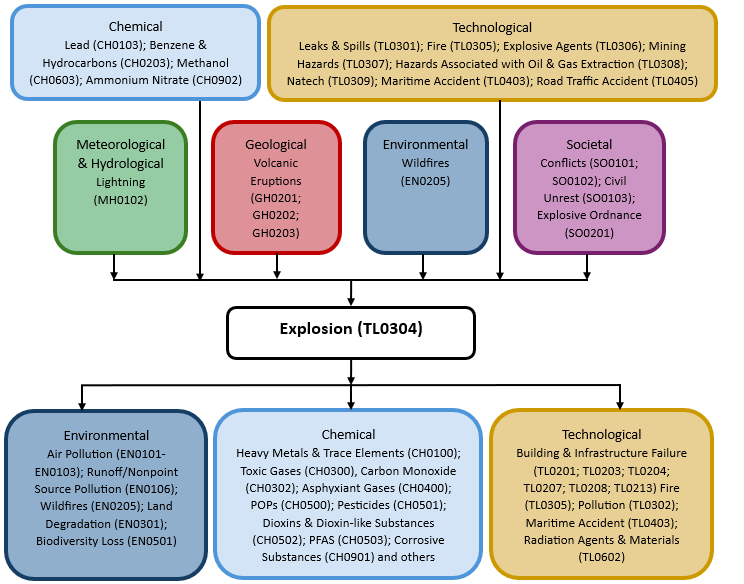
Explosions can result from natural hazards such as wildfires, lightning, volcanic eruptions or when critical infrastructures are damaged after an earthquake. They may also be caused by technological accidents such as fires, incidents in oil and gas extractions facilities, explosive agents, or inadequate storage of chemicals such as ammonium nitrate. Explosions may also occur during conflicts or criminal intent.
Impacts
Explosions affect the environment, through the release of toxic chemicals, and can damage or destroy buildings and infrastructure.
Damage and injury due to primary explosion effects are predominantly immediate with the potential of increasing damage in the long term (Finlay et al., 2012). Potential injuries can include lethal lung injury, brain traumata, hearing loss or violent displacement of the body (Finlay et al., 2012). Potential damages to the built environment can include the entire range from no or minor damage to complete collapse
Some individuals and sub-populations are at increased risk because they are more susceptible to the adverse effects of a given exposure. Among the potential causes of enhanced susceptibility are inherent genetic variability; age; gender; pre-existing disease (e.g., diabetes, asthma, chronic obstructive pulmonary disease); inadequate diet; occupational, environmental or lifestyle factors (e.g., smoking); and stress and inadequate access to health care (WHO, no date).
In most cases the mechanisms and health outcomes of exposure are unknown. Symptoms may present differently depending upon the explosion, any products of combustion, and chemicals and other materials involved in the explosion. In general, adverse health outcomes to toxic chemical exposure include:
- Effects that are local or arise at the site of contact with the products of combustion and chemicals, such as bronchoconstriction from respiratory irritants, or irritation of the skin and eyes by gases, liquids and solids.
- Effects that are systemic or affect organ systems remote from the site of absorption, such as depression of the central nervous system from inhalation of solvents, or necrosis of the liver from the inhalation of carbon tetrachloride.
- Effects on mental health arising from real or perceived releases, which depend on the psychosocial stress associated with an incident.
The time elapsing between exposure and the onset of symptoms can vary. Some effects, for example, eye and respiratory irritation or central nervous system depression, can occur rapidly, within minutes or hours of exposure (acute effects). Other effects, for example, congenital malformations or cancers, may take months or years to appear (delayed effects). The duration of the symptoms can also vary, from short- term, to long- term or chronic. Chemical incidents (especially acts of terrorism) may also cause fear and anxiety in populations (WHO, no date).
Multi-hazard context
The figure below summarises common interactions between explosions and other hazards. This information should be used with caution and not be solely relied upon in Disaster Risk Management, particularly as some interactions may not have been included. Note that hazardous events occurring together or locally in space or time may not necessarily cause, amplify, or be otherwise related to each other. Specific examples of multi-hazard context can be found in the ‘Hazard drivers’ and ‘Impacts’ sections above.
Multi-hazard diagram
Risk Management
Risk management measures can be grouped under the categories: prevention and control, preparedness and response (WHO, no date).
Prevention and control: Being aware of explosive- related hazards: locating chemical sites away from centres of population; registration of all chemicals in commercial establishments with a hazard inventory to ensure rapid identification of the released chemical; regular evaluation of plans and their implementation; inspection/monitoring and enforcement of safety measures; reducing the amounts of chemicals stored; appropriate labelling of all chemicals (using the Globally Harmonized System of Classification and Labelling of Chemicals (GHS – UNECE no date); appropriate segregation of incompatible chemicals; rapid notification of the chemical incident emergency services in the event of a chemical release; regular surveillance and standardised reporting of incidents, including the small, commonly occurring incidents; measures to decontaminate land or water already contaminated by waste disposal; measures to prevent or contain any fire-fighting water run-off; and construction of drainage ditches or holding tanks to contain liquid chemicals.
In any chemical incident, there are a number of essential steps to go through as part of the chemical incident plan, including control of precursors for manufacturing high explosives. In approximate chronological order, these are: alerting the health care services; best outcome assessment of actions and management options; environmental monitoring; public information and public warnings; advice on protection; sheltering or evacuation; other interventions to protect public health; and organising registers and samples.
Preparedness: Careful planning and thorough preparedness are prerequisites for an effective response to chemical incidents. Public authorities, at all levels, and the management staff of installations where hazardous chemicals are produced, stored etc. should establish emergency preparedness plans, and conduct response drills. All responsible parties should ensure that manpower equipment, and financial and other resources necessary to carry out emergency plans are readily available for immediate activation in the event, or imminent threat of an accident. In addition, all personnel involved in the emergency response process should be adequately educated and trained.
Response: Depending on the level of potential exposure, risk zones are usually established around an incident:
- The hot zone is the area where first responders must use protective equipment to prevent primary contamination (National CBRN Centre, 2016).
- The warm zone, which surrounds the hot zone, is the area where appropriate PPE must be worn to prevent secondary contamination.
- The cold zone is the uncontaminated area between the inner cordon and the outer cordon where it has been assessed that there is no immediate threat to life.
- The decontamination line separates the warm zone from the cold zone.
- A vulnerable zone (in effect a potential hot zone) can be declared, which is the area likely to be contaminated if the emergency response action is not successful. The population within the vulnerable zone includes the resident population as well as the working population (in the plant and in the area), and other populations in the area at certain times, such as motorists, tourists and visitors to entertainment facilities.
Consider contacting the nearest Poisons Centre in case advice on diagnoses and treatment of chemical poisonings is needed. Also consider setting up a public health team which, in the case of an explosion- related chemical incident, will provide accident and emergency departments with information about the nature of the chemicals(s), any precautions to be taken, and information about secondary contamination and how to decontaminate casualties, staff and equipment. Further details and guidance can be found in the WHO manual on the public health management of chemical incidents (WHO, 2009).
Designed to help manage the recovery phase of a chemical incident where contamination has affected food production systems, inhabited areas and water environments, further information can be found in the UK recovery handbook for chemical incidents (PHE, 2020).
The WHO works closely with countries and partners to monitor and report on their emergency preparedness capacities for all hazards, including chemical incidents. Surveillance of diseases of possible chemical aetiology is a daily element in the WHO outbreak alert and response activities (WHO, no date). The WHO also convenes regional meetings to strengthen the global network of poison centres and thus facilitate emergency responses to chemical incidents. Guidance and training materials to strengthen preparedness for chemical incidents and emergencies have been developed in collaboration with the Organisation for Economic Co-operation and Development, the Inter-Organization Programme for the Sound Management of Chemicals, and relevant organisations in the United Nations system (WHO, no date). Additional resources include the WHO human health risk assessment toolkit for chemical hazards (WHO, ILO & UNEP, 2011) and the guidance document on evaluating and expressing uncertainty in hazard characterisation (WHO & IPCS, 2018).
Monitoring
The section and the table below offer an overview of monitoring explosion. This information can be used for forecasting within a national early warning system (EWS). Since EWS capacities and processes differ across countries, the most current and specific information regarding EWS should be obtained from the appropriate national or regional agency/authority responsible for disaster management.
| Which institution(s) produce(s) Disaster Risk Data/Information? | Private companies managing industrial facilities (production and/or storage),; Military Command,; Firefighting agencies,; Disaster Risk Management Agencies |
How is the Hazard Observed/Monitored/Forecast? | Explosion early warning systems are used in various settings, including industrial facilities, military zones, urban environments, and disaster-prone areas. For example, the Explosion Early Warning System (EWS) used in the oil and gas industry is equipped with sensors such as gas, flow, and temperature sensors. It aims to effectively identify potential hazard zones and provide early warnings to nearby workers and industrial safety monitoring teams. Through real-time monitoring and data analysis, the system optimises safety protocols and prevents casualties and asset damage caused by gas leaks. This approach enhances worker safety in modern industrial environments and contributes to the protection of critical energy resources (Padmaa et al, 2024). |
References
Al-Hajj, S., Dhaini, H. R., Mondello S., Kaafarani H., Kobeissy F., DePalma R. G., 2021. Beirut Ammonium Nitrate Blast: Analysis, Review, and Recommendations. Frontiers in Public Health 9. 10.3389/fpubh.2021.657996. Accessed 19 February 2025.
Cullen, W.D., 1990. The Public Inquiry into the Piper Alpha Disaster. Accessed 13 February 2025.
El Sayed M. J. 2020. Beirut Ammonium Nitrate Explosion: A Man-Made Disaster in Times of the COVID-19 Pandemic. Accessed 18 February 2025.
European Commission, 2020. The Seveso Directive - Technological Disaster Risk Reduction. Accessed 13 February 2025.
European Parliament and Council, 2012. Directive 2012/18/EU of the European Parliament and of the Council of 4 July 2012 on the control of major-accident hazards involving dangerous substances, amending and subsequently repealing Council Directive 96/82/EC Text with EEA relevance. Accessed 13 February 2025.
FEMA, 2003. Risk Management Series. Primer for Design of Commercial Buildings to Mitigate Terrorist Attacks. Providing protection to people and buildings. Federal Emergency Management Agency (FEMA). Accessed 18 May 2025.
Finlay SE, Earby M, Baker DJ, Murray VS. Explosions and human health: the long-term effects of blast injury. Prehosp Disaster Med. 2012 Aug;27(4):385-91. doi: 10.1017/S1049023X12000891. Epub 2012 Jul 17. PMID: 22800859. Accessed 18 May 2025.
French Ministry of Sustainable Development, 2013. Explosion in the AZF fertilizer plant, September 21st, 2001 Toulouse, France. Accessed 14 February 2025.
Health and Safety Executive (HSE), no date. Fire and Explosion. Health and Safety Executive (HSE). Accessed 13 February 2025.
Health and Safety Executive (HSE), 2011. Buncefield: Why did it happen? The underlying causes of the explosion and fire at the Buncefield oil storage depot, Hemel Hempstead, Hertfordshire on 11 December 2005. Health and Safety Executive (HSE). Accessed 13 February 2025.
National Chemical, Biological, Radiological and Nuclear Centre (National CBRN Centre), 2016. Responding to a CBRN(e) Event: joint operating principles for the emergency services. First edition September 2016. Accessed 14 February 2025.
Padmaa M., Dharanika S., Harani M., Nivetha T., and Poovizhi N., 2024. Explosion Risk Detection System for the Oil and Gas Industries. Journal of Emerging Technologies and Innovative Research (JETIR), Volume 11, Issue 5. 2024 May. Accessed 4 February 2025.
Public Health England (PHE), 2020. UK Recovery Handbook for Chemical Incidents (2020). Public Health England (PHE). Accessed 13 February 2025.
PreventionWeb. Hazard Information Profiles (HIPs) online reference. Accessed 18 February 2025.
United Nations Economic Commission for Europe (UNECE), no date. Globally Harmonized System of Classification and Labelling of Chemicals (GHS). Accessed 18 February 2025.
United States Nuclear Regulatory Commission (USNRC), 2013. Characterizing Explosive Effects on Underground Structures. United States Nuclear Regulatory Commission (USNRC). Accessed 19 May 2025.
World Health Organization (WHO), 2009. WHO Manual: The Public Health Management of Chemical Incidents. World Health Organization (WHO). Accessed 13 February 2025.
World Health Organization (WHO), no date. Chemical incidents. World Health Organization (WHO). Accessed 13 February 2025.
World Health Organization (WHO) and International Programme on Chemical Safety (IPCS), 2018. Guidance document on evaluating and expressing uncertainty in hazard characterization, 2nd ed. World Health Organization (WHO) and International Programme on Chemical Safety (IPCS). Accessed 13 February 2025.
World Health Organization (WHO), International Labour Organization (ILO) and United Nations Environment Programme (UNEP), 2011. World Health Organization Human Health Risk Assessment Toolkit: Chemical Hazards. Harmonization Project Document No. 8. Accessed 13 February 2025.