
Soil Pollution
Soil pollution refers to the presence of a chemical or substance out of place and/or present in a soil at higher-than-normal concentration that has adverse effects on any non-targeted organism (Rodríguez-Eugenio et al., 2018).
Primary reference(s)
Rodríguez-Eugenio, N., M. McLaughlin and D. Pennock, 2018. Soil Pollution: A Hidden Reality. Food and Agriculture Organization of the United Nations. Accessed 5 February 2025.
Annotations
Additional scientific description
Soil plays a key role in food production and food quality, in climate regulation and in the provision of raw materials and other resources. Notwithstanding the enormous scientific progress made to date, protection and monitoring of soil conditions at national and global levels still face complicated challenges impeding effective on-the-ground policy design and decision- making (FAO, 2018).
Human activities over thousands of years have left a legacy of polluted soils worldwide. Much of it is local soil contamination which occurs commonly in connection to past and present mineral extraction, industrial activities, waste management and disposal, and includes remnants of hazardous materials such as obsolete pesticides. Countless chemical agents, some of them highly persistent, are found at various levels in the ground and can enter groundwater and surface water, locally produced food, and can even become airborne (gases, vapours, dusts, particulates). Soil pollution and its adverse health effects have been documented in many cases, but the magnitude of the overall impact on human health is not known. This is in contrast to air or water pollution, for which reliable estimates of their impacts have been available for two decades (FAO, 2018).
Soil pollution has been identified as one of the main soil threats affecting global soils and the ecosystem services that they provide (FAO and ITPS, 2015). Soil pollution poses a serious risk to human health through direct contact (dermal exposure, inhalation of polluted soil particles, intentional ingestion of polluted soil) or indirectly, by consuming plants or animals that have accumulated significant amounts of soil contaminants (FAO, 2018). For example, in an area of Japan where soil has been contaminated with cadmium from zinc/lead mines, Itai-itai disease used to be widespread and is still seen in women over 50 years of age. Itai-itai disease is characterised by osteomalacia, osteoporosis, painful bone fractures and kidney dysfunction (WHO, 2019). Health risks associated with the widespread soil pollution by radionuclides released during the Chernobyl disaster in 1986 are an enduring memory for many people (Rodríguez-Eugenio et al., 2018).
Recent research has expanded our understanding of emerging soil contaminants, particularly microplastics and per- and polyfluoroalkyl substances (PFAS). These persistent pollutants present unique challenges due to their resistance to degradation and complex mobility patterns through soil matrices. Studies indicate that microplastics can alter soil structure, water retention capacity, and microbial communities (Han et al, 2024), while PFAS contamination has been linked to reduced soil fertility and potential bioaccumulation in food crops (Lasters et al, 2024). The interaction between these emerging contaminants and traditional soil pollutants creates complex mixtures with potentially synergistic toxic effects that current risk assessment frameworks may not adequately address
Despite efforts in many regions of the world to estimate the extent of soil pollution, the lack of harmonised and comprehensive data at the national, regional and global level limits the mobilisation of economic resources to minimise soil pollution and to achieve public and private commitment to combating soil pollution. There is a need to translate sound scientific evidence into concrete actions to prevent, control and remediate soil pollution (FAO, 2018).
Remediation of polluted soils is essential, and research continues to develop novel, science-based remediation methods. Increasingly, expensive physical remediation methods such as chemical inactivation or sequestration in landfills are being replaced by science-based biological methods such as enhanced microbial degradation or phytoremediation (Rodríguez-Eugenio et al., 2018). The maintenance of soil health and the prevention and reduction of soil pollution are possible through promoting sustainable soil management practices, environmentally friendly industrial processes, reduction of waste generation, recycling and reuse of goods, and sustainable waste storage (FAO, 2018).
The risks to human health posed by contaminated soils are assessed by comparing a representative soil concentration with chemical specific assessment criteria indicative of 'safe' levels of exposure. There is no international standard for deriving these criteria. For example, Jennings (2013) compared the range of American standards with standards used elsewhere around the world. A total of 5949 guidance values for 57 elements were identified across the US regulatory authorities and assessment criteria values were seen to have been published in at least 71 other United Nations member states.
Metrics and numeric limits
While no globally harmonized metrics exist, several widely used quantitative frameworks could be referenced. For instance, many jurisdictions employ soil screening values (SSVs) or environmental quality standards (EQS) that establish concentration thresholds for common contaminants.
- The Dutch Intervention Values establish remediation triggers at concentrations where soil functionality is seriously impaired (RIVM/NIPHE, 2001).
- The United States EPA's Regional Screening Levels (RSLs) provide risk-based concentration thresholds for residential and industrial land uses. (USEPA, 2024)
- The European Commission' Risk Assessment Guidance Document provides a framework for calculating predicted no-effect concentrations (PNECs) for soil ecosystems. (European Commission, 2003)
These frameworks typically consider factors including background concentrations, exposure pathways, target protection levels, and contaminant bioavailability.
Key relevant UN convention / multilateral treaty
United Nations (2015) Sustainable Development Goals (United Nations, 2015). The prevention of soil pollution could reduce soil degradation, increase food security, contribute substantially to the adaptation and mitigation of climate change, and contribute to the avoidance of conflict and migration. Therefore, by taking immediate actions against soil pollution, contributions to the achievement of almost all the Sustainable Development Goals (SDGs) are possible, with a significant impact on SDGs 1, 2, 3, 6, 9, 11, 12, 13, 14, 15 and 17 (FAO, 2018).
Basel Convention on the Control of Transboundary Movements of Hazardous Wastes and their Disposal (1989). At the time of writing, there were 187 parties to the Basel Convention (Basel Convention, 2011). At its fourteenth meeting, the Conference of the Parties to the Basel Convention adopted decision BC-14/12 by which it amended Annexes II, VIII and IX to the Convention with the objectives of enhancing the control of the transboundary movements of plastic waste and clarifying the scope of the Convention as it applies to such waste.
Rotterdam Convention on the Prior Informed Consent Procedure for Certain Hazardous Chemicals and Pesticides in International Trade (1998). The Convention promotes shared responsibility between exporting and importing countries in protecting human health and the environment from the harmful effects of such chemicals and provides for the exchange of information about potentially hazardous chemicals that may be exported and imported.
Stockholm Convention on Persistent Organic Pollutants (2001). The Convention is a global treaty to protect human health and the environment from chemicals that remain intact in the environment for long periods, become widely distributed geographically, accumulate in the fatty tissue of humans and wildlife, and have harmful impacts on human health or on the environment.
Minamata Convention on Mercury (UNEP, 2013). The Convention is a global treaty to protect human health and the environment from the adverse effects of mercury, which includes a ban on new mercury mines, the phase-out of existing ones, the phase- out and phase down of mercury use in a number of products and processes, control measures on emissions to air and on releases to land and water, and the regulation of the informal sector of artisanal and small-scale gold mining. The Convention also addresses interim storage of mercury and its disposal once it becomes waste, sites contaminated by
Drivers
Soils may be polluted following industrial accidents; overuse of pesticides and conflict may also occur. Soil can also be polluted during volcanic eruptions or by space debris. Different chemicals may be included in soil pollution.
Long-term interactions between soil pollutants and environmental systems create persistent and evolving risk scenarios. Contaminants like heavy metals and persistent organic pollutants can remain bioavailable in soils for decades or centuries, gradually migrating through watersheds and entering food chains. These slow- developing but significant interactions highlight the need for multigenerational monitoring and adaptive management strategies that account for changing environmental conditions over extended timeframes.
Impacts
Contaminated soil in areas exposed to landslides and flood risks can remobilize contaminants through physical (erosion) chemical (leaching) processes and issues such as dumping of waste. When a landslide occurs, contaminated soil may be displaced and flow into rivers or lakes, potentially spreading pollution. Soil and water contamination can also impact agriculture and ecosystems (Grimmer, 2024).
Multi-hazard context
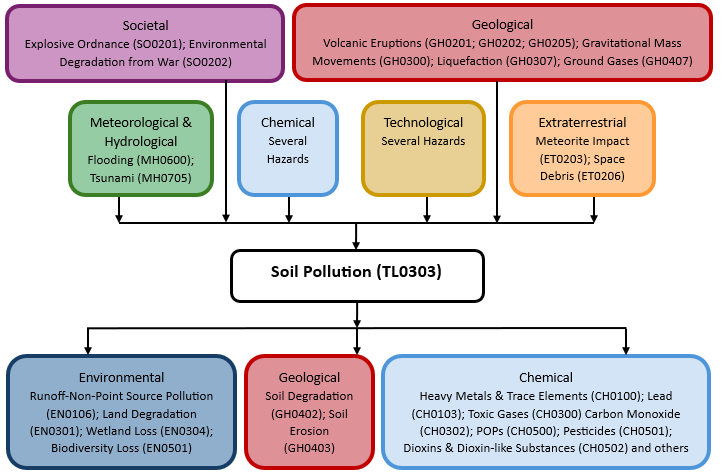
The figure below summarises common interactions between soil pollution and other hazards. This information should be used with caution and not be solely relied upon in Disaster Risk Management, particularly as some interactions may not have been included. Note that hazardous events occurring together or locally in space or time may not necessarily cause, amplify, or be otherwise related to each other. Specific examples of multi-hazard context can be found in the ‘Hazard drivers’ and ‘Impacts’ sections above.
Multi-hazard diagram
Risk Management
The Basel Convention promotes the environmentally sound management of hazardous waste to prevent soil contamination. Key activities include a household waste partnership and technical guidelines on managing hazardous waste like mercury and POPs. The Rotterdam Convention ensures the safe use of hazardous pesticides and chemicals by facilitating information exchange and enabling informed decisions on imports and exports. The Stockholm Convention aims to eliminate or reduce persistent organic pollutants (POPs) due to their toxicity and long-term environmental impact. Efforts include inventory development, phase-out strategies, best practices guidance, and technical assistance for national action plans (FAO&UNEP, 2021).
Key drivers for the assessment of contaminated land in the UK, primarily in the context of urban development, include remediation of contamination identified as impacting on groundwater quality or ecology and remediating brownfield sites for a change of land use and in particular development for housing. To this local management, using soil guidance values and land quality management is essential (European Commission, no date). As examples of local risk assessment and management, the sites of the 2000 Olympic Games in Sydney and the 2012 Olympic Games in London (Mead et al., 2013) successfully remediated contaminated land sites. However, further remediation could be required for any future land-use change involving more sensitive end-use, such as redevelopment for domestic gardens.
A number of assessment models and tools are available via CLARINET, the Concerted Action of the European Commission’s Environment and Climate Research and Development Programme, which provides access to technical recommendations based on the concept of Risk Based Land Management for decision-making (EUGRIS, 2008). Also, in the European context, NICOLE is a European forum for the dissemination and exchange of good practice, practical and scientific knowledge and ideas to manage contaminated land in a sustainable and collaborative way.
The outcome document of the Global Symposium on Soil Pollution ‘Be the Solution to Soil Pollution’ (FAO, 2018) recommends an active and effective implementation of the Voluntary Guidelines for Sustainable Soil Management, which were developed through an inclusive process and endorsed by the 155th session of the FAO Council (Rome, 5 December 2016) (FAO, 2017). Their implementation is important in order to progress with the accomplishment of several of the sustainable soil management objectives, such as: to ensure that the availability and flows of nutrients are appropriate to maintain or improve soil fertility and productivity, and to reduce their losses to the environment; to reduce soil salinisation, sodification and alkalinisation; to ensure that water is efficiently infiltrated and stored to meet the requirements of plants and ensure the drainage of any excess; to ensure that contaminants are below toxic levels, i.e., those which would cause harm to plants, animals, humans and the environment; to guarantee that soil biodiversity provides a full range of biological functions; and to undertake soil management (FAO, 2018).
Monitoring
No information Available
References
Basel Convention on the Control of Transboundary Movements of Hazardous Wastes and their Disposal, 1989. Accessed 13 February 2025.
EUGRIS, 2008. The Contaminated Land Rehabilitation Network for Environmental Technologies in Europe (CLARINET). Accessed 13 February 2025.
European Commission, no date. Extractive Waste. Accessed 5 February 2025.
Food and Agriculture Organization of the United Nations (FAO), 2017. Voluntary Guidelines for the Sustainable Soil Management. Food and Agriculture Organization of the United Nations (FAO). Accessed 5 February 2025.
Food and Agriculture Organization of the United Nations (FAO), 2018. Be The Solution To Soil Pollution. Global Symposium on Soil Pollution: Outcome Document. 2-4 MAY 2018, Rome, Italy. Food and Agriculture Organization of the United Nations (FAO). Accessed 5 February 2025.
Food and Agriculture Organization of the United Nations and Intergovernmental Technical Panel on Soils (FAO and ITPS), 2015. Status of the World’s Soil Resources - Main Report. Food and Agriculture Organization of the United Nations (FAO) and Intergovernmental Technical Panel on Soils (ITPS). Accessed 5 February 2025.
Food and Agriculture Organization of the United Nations and United Nations Environment Programme (FAO and UNEP), 2021. Global assessment of soil pollution: Report. Rome. DOI: 10.4060/cb4894en. Accessed 5 February 2025.
Grimmer A. Approaching the Multi-Hazard of Contaminated Sites at Risk of Landslides and Floods in Switzerland. Accessed 5 February 2025.
Han L., Chen L., Feng Y., et al. 2024. Microplastics alter soil structure and microbial community composition, Environment International. Volume 185, 108508, ISSN 0160-4120, DOI: 10.1016/j.envint.2024.108508. Accessed 20 May 2025
Jennings, A.A., 2013. Analysis of worldwide regulatory guidance values for the most commonly regulated elemental surface soil contamination. Journal of Environmental Management, 118:72-95.
Lasters R, Groffen T., Eens M., & Bervoets L. 2024. Per- and polyfluoroalkyl substances (PFAS) in homegrown crops: Accumulation and human risk assessment, Chemosphere. Volume 364. 143208. ISSN 0045-6535. DOI: 10.1016/j.chemosphere.2024.143208. Accessed 20 May 2025
Mead, I., I. Apted and S. Sharif, 2013. Delivering London 2012: Contaminated soil treatment at the Olympic Park. Proceedings of the Institution of Civil Engineers - Geotechnical Engineering. 166:8-17.
RIVM/NIPHE, 2001. RIVM report 711701 023 Technical evaluation of the Intervention Values for Soil/sediment and Groundwater: Human and ecotoxicological risk assessment and derivation of risk limits for soil, aquatic sediment and groundwater. Rijksinstituut Voor Volksgezondheid en Milieu (RIVM) National Institute of Public Health and the Environment (NIPHE). Accessed 20 May 2025
Rodríguez-Eugenio, N., M. McLaughlin and D. Pennock, 2018. Soil Pollution: A Hidden Reality. Food and Agriculture Organization of the United Nations. Accessed 5 February 2025.
Rotterdam Convention on the Prior Informed Consent Procedure for Certain Hazardous Chemicals and Pesticides in International Trade, 1998. Accessed 5 February 2025.
Stockholm Convention on Persistent Organic Pollutants (POPs), 2001. Text of the Convention and its subsequent amendments. Accessed 5 February 2025.
United Nations Environment Programme (UNEP), 2013. Minamata Convention on Mercury. United Nations Environment Programme (UNEP). Accessed 5 February 2025.
United Nations, 2015. Sustainable Development Goals. Accessed 5 February 2025.
United States Environmental Protection Agency (USEPA), 2024. Regional Screening Levels for Chemical Contaminants at Superfund Sites. United States Environment Protection Agency (USEPA). Accessed 20 May 2025.
World Health Organization (WHO), 2019. Preventing Disease Through Healthy Environments. Exposure to Cadmium: A major public health concern. World Health Organization (WHO). Accessed 5 February 2025.