
Pollution
Pollution is the presence of substances and heat in environmental media (air, water, land) whose nature, location, or quantity produces undesirable environmental effects; and the activities that generates pollutants. (UN data, no date).
Primary reference(s)
UN data, no date. Pollution. Environment Glossary / United Nations Statistics Division. Accessed 22 May 2025.
Annotations
Additional scientific description
Pollution today is pervasive and persistent. While the world has achieved significant economic growth over the past few decades, it has been accompanied by large amounts of pollution, with significant impacts on human health and ecosystems and the ways in which some of the major Earth system processes, such as the climate, are functioning. Though some forms of pollution have been reduced as technologies and management strategies have advanced, approximately 19 million premature deaths are estimated to occur annually as a result of the way societies use natural resources and impact the environment to support production and consumption. If consumption and production patterns continue as they are, the linear economic model of 'take-make-dispose' will seriously burden an already polluted planet, affecting current and future generations (UNEP, 2017).
Global pollution is rising due to rapid economic growth, population increases, and insufficient environmental management. This poses serious health risks for people and ecosystems, particularly in low- and middle-income countries. Contributing to these challenges, the global economy relies on deeply intertwined supply chains, sustained by more than 100 billion tons of raw materials entering the system each year. Intensive material consumption depletes natural resources and causes negative environmental impacts at every stage of the product lifecycle. Global waste is expected to increase to 3.4 billion tons by 2050 (World Bank, 2025).
Pollution of all types hinders development outcomes. Exposure to air pollution, water pollution, and hazardous chemicals and wastes like mercury, lead and persistent organic pollutants (POPs) causes debilitating and fatal illnesses, creates harmful living conditions, and destroys ecosystems. Pollution undermines sustainable economic growth, exacerbates poverty and inequality in both urban and rural areas, and significantly contributes to climate change. Poor people, who cannot afford to protect themselves from the negative impacts of pollution, end up suffering the most (World Bank 2025). Pollution can have a disproportionate and negative effect on the poor, the disadvantaged and the vulnerable. Pollution constitutes a significant impediment to achieving health, well-being, prosperity and the sustainable development goal of 'leaving no one behind' (UNEP, 2017).
Pollution is the largest environmental cause of disease and premature death. It is estimated to be several times more deaths than from AIDS, tuberculosis, and malaria combined. Global health crises, such as the COVID-19 pandemic, are reminders of the strong linkages between environment and health and of the need to address such linkages systematically. (World Bank, 2025).
Our food, air and water expose us to a complex mixture of chemicals and materials (UNEP, no date a) (see Chemical HIPS CH0100, CH0200. CH0300, CH0500, CH0501, CH0902). These chemicals have a wide range of effects on health. In 2012, the World Health Organization (WHO) estimated that 23% of all deaths worldwide, amounting to 12.6 million people, were due to environmental causes; with 90% occurring in low- to middle-income countries. In the same year, the burden of disease from environmental factors related directly to pollution in terms of death, illness and disability was estimated at 345 million Disability Adjusted Life Years. More recently, a study indicated that pollution is currently the largest environmental cause of disease and death, responsible for an estimated 9 million premature deaths globally in 2015 (Landrigan et al., 2017). With the world population growing, the numbers of vulnerable groups exposed to pollutants will increase unless urgent pollution abatement policies are implemented, and actions taken at the local level (UNEP, 2017).
There is a critical need for system-wide transformations to prevent, reduce and control pollution, toward greater resource efficiency and equity, circularity and sustainable consumption and production, and improved ecosystem resilience to support cleaner and more sustainable development (UNEP, 2017).
Emerging pollutants such as PFAS, endocrine-disrupting compounds, and nanomaterials, are increasingly detected in water, air, and soil but remain under-regulated (UNEP, 2017). These can have chronic effects even at low concentrations.
Metrics and numeric limits
A range of metrics are available for the different sources of pollution hazards and include
- WHO sets global air quality guidelines (AQGs) based on the latest scientific evidence and health research to protect human health from the adverse effects of air pollution. These guidelines are designed to provide guidance for policymakers and governments in setting targets and implementing measures to reduce air pollution. The (AQG) serve as a global target for national, regional and city governments to work towards improving their citizen's health by reducing air pollution (WHO, 2021).
- WHO produces international norms on water quality and human health in the form of guidelines that are used as the basis for regulation and standard setting world-wide. The Guidelines for drinking-water quality (GDWQ) promote the protection of public health by advocating for the development of locally relevant standards and regulations (health- based targets), adoption of preventive risk management approaches covering catchment to consumer (Water Safety Plans) and independent surveillance to ensure that Water Safety Plans are being implemented and effective and that national standards are being met (WHO, 2022)
- WHO has published guidance on chemicals and health (WHO., no date a). More than 160 million chemicals are known to humans. About 40, 000 to 60, 000 of them can be found in commerce; 6000 of these account for more than 99% of the total volume of chemicals in commerce globally. In 2017, the chemical industry was the second largest manufacturing industry in the world and the trend is going upwards - chemicals sales are projected to almost double from 2017 to 2030. Chemicals, whether of natural origin or produced by human activities, are part of our environment. Manufactured chemicals include industrial and agricultural products such as pesticides, petroleum products and processed metals. Some chemicals are manufactured for specific uses, while others are unwanted by-products, including wastes, or products of combustion such as toxic gases and particles from industrial emissions and the burning of fuel. Levels of exposure and resulting health impacts are determined by social as well as biological factors. Men, women and children are exposed to different kinds and levels of chemicals and are exposed with different frequency. In addition, men, women and children vary in their physiological susceptibility to health effects from exposure to hazardous chemicals. (WHO, 2024)
- WHO/ILO partnership focuses on promoting safe and healthy workplaces by managing the risks associated with hazardous chemicals. This is achieved through various tools and initiatives, including the International Chemical Safety Cards (ICSCs), which provide essential safety and health information on chemicals (ILO/WHO, 2025). The International Chemical Safety Cards (ICSCs) are data sheets intended to provide essential safety and health information on chemicals in a clear and concise way. The primary aim of the Cards is to promote the safe use of chemicals in the workplace. The main target users are workers and those responsible for occupational safety and health. The ICSCs project is a common undertaking between the International Labour Organization (ILO) and the World Health Organization (WHO), with the cooperation of the European Commission.
Key relevant UN convention / multilateral treaty
The Basel Convention on the Control of Transboundary Movements of Hazardous Wastes and their Disposal (1989). At the time of writing, there were 187 parties to the Basel Convention. At its 14th meeting, the Conference of the Parties to the Basel Convention adopted decision BC-14/12 by which it amended Annexes II, VIII and IX to the Convention with the aim of enhancing the control of transboundary movements of plastic waste and clarifying the scope of the Convention as it applies to such waste. (Basel Convention on the Control of Transboundary Movements of Hazardous Wastes and their Disposal
The Rotterdam Convention on the Prior Informed Consent Procedure for Certain Hazardous Chemicals and Pesticides in International Trade (1998). The Convention promotes shared responsibility between exporting and importing countries in protecting human health and the environment from the harmful effects of such chemicals and provides for the exchange of information about potentially hazardous chemicals that may be exported and imported. (Rotterdam Convention on the Prior Informed Consent Procedure for Certain Hazardous Chemicals and Pesticides in International Trade, 1998)
The Stockholm
The Stockholm Convention on Persistent Organic Pollutants (2001). The Convention is a global treaty to protect human health and the environment from chemicals that remain intact in the environment for long periods, become widely distributed geographically, accumulate in the fatty tissue of humans and wildlife, and have harmful impacts on human health or on the environment.
The Minamata Convention on Mercury (UNEP, 2013). The convention was signed in 2013 and ratified in 2017 and draws attention to a global and ubiquitous metal that, while naturally occurring, has broad uses in everyday objects and is released to the atmosphere, soil and water from a variety of sources. Controlling the anthropogenic releases of mercury throughout its lifecycle has been a key factor in shaping the obligations under the Convention (UNEP, 2024 a).
The Global Framework on Chemicals – For a planet free of harm from chemicals and waste' was formally established at the fifth International Conference on Chemicals Management (ICCM5) in Bonn, Germany, held on September 25-29, 2023. The Bonn Declaration, a political statement developed through extensive informal consultations, was also adopted during ICCM5. The Global Framework presents a comprehensive plan with 5 strategic objectives and 28 targets to guide countries and stakeholders in jointly addressing the lifecycle of chemicals, including products and waste. The Global Framework is multi
Drivers
Pollution is one of the great existential challenges of the Anthropocene epoch (Landrigan et al., 2017). Pollution, especially pollution caused by industrial emissions, vehicle exhausts, and toxic chemicals, has increased sharply in the past 500 years, and the greatest increases today are seen in low-income and middle-income countries (Landrigan et al., 2017). Pollution contributes to long-term ecosystem degradation, loss of biodiversity, and climate amplification. Black carbon, a short-lived climate pollutant, worsens glacial melt. Persistent pollutants can lead to endocrine disruption and immune suppression, affecting disease susceptibility over time (UNEP, 2023). These hazard drivers also cause indirect hazard linkages such as floods spreading industrial contaminants (Euripidou and Murray, 2004) and particulate pollution from wildfires exacerbating respiratory epidemics (Finlay et al, 2012).
Many organisations including the United Nations Environment Programme (UNEP), in partnership with other United Nations organisations, member states, scientists and communities at all levels have developed programmes addressing air pollution, water contamination, marine pollution, chemicals, plastics waste and space debris.
Impacts
Air pollution: Killing an estimated 7 million people per year, air pollution is currently the biggest environmental health risk. Airborne pollutants are responsible for about one- third of deaths from stroke, chronic respiratory disease, and lung cancer, as well as one- quarter of deaths from heart attack (WHO, no date b). Air pollution also strongly influences climate and is generated from various sources, from cookstoves and kerosene lamps to coal-fired power plants, vehicle emissions, industrial furnaces, wildfires, and sand and dust storms. The problem is most acute in urban areas, particularly in Africa and Asia. In low- and middle-income countries, 98% of cities with more than 100,000 inhabitants fail to meet the WHO air quality guidelines. Addressing air pollution can bring significant benefits to economies, human health, and the climate. This underlies global efforts by UNEP to tackle air pollution by supporting cleaner fuels and vehicles, inspiring individuals and city leaders to act, strengthening laws and institutions, and developing affordable technologies to monitor air quality (UNEP, 2024 b).
Water contamination: UNEP states that once water is contaminated, it is difficult, costly, and often impossible to remove the pollutants (UNEP, 2016). Currently, 80% of global wastewater goes untreated, and is contaminated by a wide range sub- stances, from human waste to highly toxic industrial discharges. The type and amount of pollutants in freshwater determines its suitability for human uses such as drinking, bathing, and agriculture (UNEP, 2025 a). Pollution of freshwater ecosystems can also impact the habitat and quality of life of fish and other wildlife. This can include pathogens (largely from human and animal waste), organic matter (including nutrients from agricultural run-off such as nitrogen or phosphorus), chemical pollution (from irrigation, domestic wastewater and runoff of mines into rivers) and salinity. Plastics, and chemicals of emerging concern such as certain pharmaceutical products, are issues for which their extent and impacts on freshwater are largely unknown. A 2016 preliminary assessment of water quality in rivers in Latin America, Africa and Asia. A snapshot of the World’s Water Quality estimated that severe pathogenic pollution affects around one- third of all rivers, severe organic pollution around one- seventh of all rivers, and severe and moderate salinity pollution around one-tenth of all rivers in these regions (UNEP, 2016),
Marine pollution: Decades of relentless use of plastics across our economies has led to a seemingly unstoppable flow of plastics into the environment including out into the deep oceans. Largely a result of unsustainable production and consumption patterns and inadequate waste management, the challenge of plastics and other materials (UNEP, 2021). Sewage and waste water, persistent organic pollutants (including pesticides), heavy metals, oils, nutrients and sediments - whether from rivers or discharged directly into coastal waters – can have significant impacts on human health and coastal ecosystems. The result is more carcinogens in seafood, more closed beaches, more red tides, and more beached carcasses of seabirds, fish and even marine mammals. One billion people in developing countries depend on fish as their primary source of protein, making them vulnerable to the chemicals they carry. Over the next two decades, this landmark agreement led to similar regional agreements in other Regional Seas (UNEP, 2021).
Chemicals, plastics and waste: As the world’s population approaches 8 billion, the need for sound management of chemicals and waste is increasing. UNEP promotes joint approaches to the environment and health that demonstrate the economic, environmental and health advantages of sound chemical management for all concerned to stimulate policies and investment to reduce chemical risks to health and the environment (UNEP, 2025 b). Municipal solid waste generation is predicted to grow from 2.1 billion tonnes in 2023 to 3.8 billion tonnes by 2050. By 2025, the world’s cities will produce more than three times the amount produced in 2009. Countries continue to address challenges linked to air, soil and water pollution and exposure to toxic chemicals under the auspices of multilateral environmental agreements (UNEP, 2025 b). An important chemical- generating pollution is plastic. The presence of plastic in the environment, in particular in marine sediments, can be seen as a stratigraphic indicator of the Anthropocene era (Zalasiewicz et al., 2016). Plastic pollution has mostly been studied in marine ecosystems (Eriksen et al., 2014), including seabirds, but freshwater ecosystems (Blettler et al., 2018) and soil ecosystems are also affected. The accumulation of plastic, especially micro- and nano-plastics is a threat to human health (UNEP, 2021)
Multi-hazard context
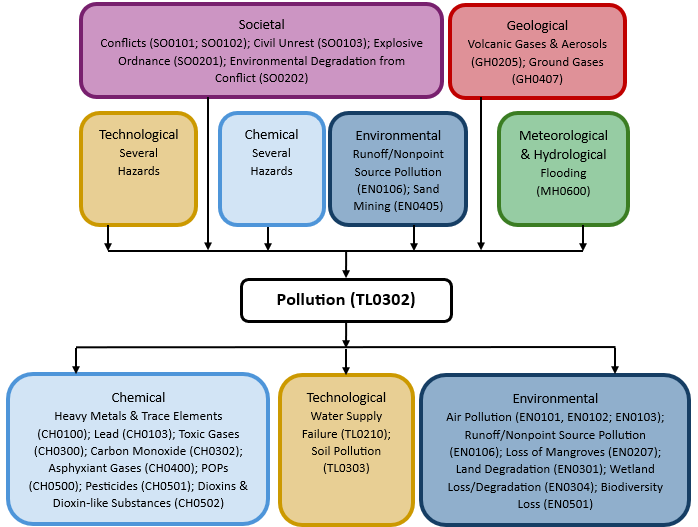
The figure below summarises common interactions between pollution and other hazards. This information should be used with caution and not be solely relied upon in Disaster Risk Management, particularly as some interactions may not have been included. Note that hazardous events occurring together or locally in space or time may not necessarily cause, amplify, or be otherwise related to each other. Specific examples of multi-hazard context can be found in the ‘Hazard drivers’ and ‘Impacts’ sections above.
Multi-hazard diagram
Risk Management
Mechanisms for pollution/contamination prevention and control are essential and may include: local, national and global policies, strategies and legislation; planning and coordination (at all levels – national, subnational, local, including regional and transboundary); financial and human resources with a trained multidisciplinary workforce capacity; information and knowledge management for risk assessments, early warning and surveillance and technical guidance and support; mechanisms for risk communication; infrastructure support to include environmental and health services; and facilities for monitoring and evaluating drivers, impacts, outcomes and controls and reporting to local, national and international partners and organisations.
The WHO works closely with countries and partners to monitor and report on their emergency preparedness capacities for all hazards, including for chemical incidents relating to pollution and contamination. Surveillance of diseases of possible chemical aetiology is a daily element in the WHO’s outbreak alert and response activities (WHO, 2020). Other health-related resources include the WHO Health Emergency and Disaster Risk Management Framework (WHO, 2019).
#BeatPollution is a UNEP campaign to stop the pervasive impact of pollution on people and the planet's health. The campaign drives rapid, large-scale and coordinated action for a cleaner, healthier and more sustainable future. Campaign activities show the impact of pollution on climate, nature and biodiversity, and health, and offer a platform to inspire thriving circular economies and enable the transition to a pollution-free planet (UNEP, 2025 c).
Monitoring
Different mechanisms are available for some pollutants. As examples,. for air pollution WHO recommends a variety of air quality monitoring methods, including both automatic and non-automatic approaches (WHO, no date b) and for drinking water extensive guidance is available (WHO, 2022)
References
Basel Convention on the Control of Transboundary Movements of Hazardous Wastes and their Disposal, 1989. Accessed 13 February 2025.
Blettler, M.C.M., Abrial, E., Khan, F.R., Sivri, N. and Espinola, L.A., 2018. Freshwater plastic pollution: recognizing research biases and identifying knowledge gaps. Water Research, 143, pp.416–424. Accessed 22 May 2025.
Eriksen, M., Lebreton, L.C.M., Carson, H.S., Thiel, M., Moore, C.J., Borerro, J.C., Galgani, F., Ryan, P.G. and Reisser, J., 2014. Plastic pollution in the world’s oceans: more than 5 trillion plastic pieces weighing over 250,000 tons afloat at sea. PLOS ONE. DOI: 10.1371/journal.pone.0111913. Accessed 22 May 2025.
Euripidou, E. and Murray, V., 2004. Public health impacts of floods and chemical contamination. Journal of Public Health, 26(4), pp.376–383. Accessed 22 May 2025.
Finlay, S.E., Moffat, A., Gazzard, R., Baker, D. and Murray, V., 2012. Health impacts of wildfires. PLOS Currents Disasters, 4:e4f959951cce2c. Accessed 22 May 2025.
International Labour Organization (ILO) and World Health Organization (WHO), 2025. ILO-WHO International Chemical Safety Cards (ICSCs). Accessed 22 May 2025.
Landrigan, P.J., Fuller, R., Acosta, N.J.R., et al., 2017. The Lancet Commission on pollution and health. The Lancet, 391, pp.462–512.
Rotterdam Convention on the Prior Informed Consent Procedure for Certain Hazardous Chemicals and Pesticides in International Trade, 1998. Accessed 13 February 2025.
Stockholm Convention on Persistent Organic Pollutants (POPs), 2001. Text of the Convention and its subsequent amendments. Accessed 13 February 2025.
United Nations Environment Programme (UNEP), 2016. A Snapshot of the World’s Water Quality: Towards a global assessment. Nairobi, Kenya: UNEP. Accessed 22 May 2025.
UNEP, 2017. Towards a Pollution-Free Planet: Background Report. Nairobi, Kenya: UNEP. Accessed 22 May 2025.
UNEP, 2021. From Pollution to Solution: A global assessment of marine litter and plastic pollution. Nairobi: UNEP. Accessed 22 May 2025.
UNEP, 2023. Global Framework on Chemicals. Accessed 22 May 2025.
UNEP, 2024a. Minamata Convention on Mercury: Text and annexes. Accessed 22 May 2025.
UNEP, 2024b. Why does air matter? Accessed 22 May 2025.
UNEP, 2025a. About water. Accessed 22 May 2025.
UNEP, 2025b. Why do chemicals and waste matter? Accessed 22 May 2025.
UNEP, 2025c. Towards a pollution free planet. Accessed 22 May 2025.
World Health Organization (WHO), 2019. Health Emergency and Disaster Risk Management Framework. Accessed 13 February 2025.
WHO, no date a. Guidance on chemicals and health. Accessed 22 May 2025.
WHO, no date b. Air pollution. Accessed 22 May 2025.
WHO, 2021. What are the WHO Air Quality Guidelines? Accessed 22 May 2025.
WHO, 2022. Guidelines for drinking-water quality: Fourth edition incorporating the first and second addenda. Accessed 22 May 2025.
WHO, 2024. Chapter 5: Chemicals. In: Compendium of WHO and other UN guidance in health and environment, 2024 update. Geneva: WHO. Accessed 22 May 2025.
World Bank, 2025. Pollution. Accessed 21 May 2025.
Zalasiewicz, J., Waters, C.N., Ivar do Sul, J.A. et al., 2016. The geological cycle of plastics and their use as a stratigraphic indicator of the Anthropocene. Anthropocene, 13, pp.4–17. Accessed 22 May 2025.