
Leaks and Spills
A leak or a spill is an incident involving the uncontrolled release of a toxic substance, potentially resulting in harm to public health and the environment. Chemical incidents can occur as a result of natural events, or as a result of accidental or intentional events. These incidents can be sudden and acute or have a slow onset when there is a ‘silent’ release of a chemical. Leaks and spills can range from small releases to full-scale major emergencies (adapted from WHO, no date).
Primary reference(s)
WHO, no date. Chemical incidents. World Health Organization (WHO). Accessed 14 February 2025
Annotations
Additional scientific description
Different hazardous chemicals may be released during leaks and spills, including but not limited to gases (CH0300, CH0400), heavy metals (CH0100), pesticides (CH0501), persistent organic pollutants (CH0500), dioxins (CH0502), and hydrocarbons (CH0203). Three notable examples of technological incidents involving a chemical leak and/or spill are the Seveso chemical leak, the Bhopal chemical leak and the Exxon Valdez oil spill.
Seveso chemical leak: At approximately 12:37 on Saturday 10 July 1976, a bursting disc on a chemical reactor ruptured at the Icmesa chemical company, Seveso, Italy. Maintenance staff heard a whistling sound, and a cloud of vapour was seen from a vent on the roof. A dense white cloud, of considerable altitude drifted offsite. Among the substances in the white cloud was a small deposit of 2,3,7,8-tetrachlorodibenzo-p-dioxin), a highly toxic material. The release lasted for twenty minutes. Over the next few days, there was confusion due to the lack of communication between the company and the authorities in dealing with this type of situation. The nearby town of Seveso, located 15 miles from Milan, had 17,000 inhabit- ants. No human deaths were attributed to TCDD but many people fell ill. Thousands of animals in the contaminated area died and many thousands more were slaughtered to prevent TCDD from entering the food chain (HSE, no date).
Bhopal chemical leak: On 3 December 1984, more than 40 tons of methyl isocyanate gas leaked from a pesticide plant in Bhopal, India. The gas drifted over the densely populated neighbourhoods around the plant killing thousands of people im- mediately. The leak also had long-term effects on health, with estimates of over 15,000 people dying prematurely in the years following the leak. This event highlighted the need for enforceable international standards for environmental safety, preventative strategies to avoid similar accidents and industrial disaster preparedness (Broughton, 2005).
Exxon Valdez oil spill: On 24 March 1989, the oil tanker Exxon Valdez ran aground on a charted rock, Bligh Reef, in Alaska's northern Prince William Sound. More than 11 million litres of crude oil spilt, eventually polluting over 30,000 km2 of coastal and offshore waters (Peterson et al., 2003).
Technological incidents such as chemical spills and leaks can be sudden and acute, when hazardous chemicals are 'overtly' released into the environment. Some chemical leaks and spillages may also result in fires, explosions and contamination of land. The factors leading up to an incident include poor maintenance of manufacturing and storage equipment, lack of regulation and/or poor enforcement of safety regulations, road traffic accidents, human error, natural events such as heavy rain, earthquakes, hurricanes, floods, and terrorism (WHO, no date).
Chemical spills and leaks are one of the issues addressed by the Food and Agriculture Organization of the United Nations (FAO). They report that spills and leaks from containers are a major problem in the storage and transport of pesticides (cf. CH0501). The main cause of these spills and leaks is rough handling which dents drums, weakens or splits seams and weakens closures (lids, caps, stoppers). Leaks also result from corrosion of the container, which may be accelerated by mechanical damage (dents may rupture drum linings). Corrosion may start internally, with the pesticide itself or its breakdown products being the primary cause. Alternatively, corrosion may begin externally, due to rusting in damp storage conditions or contamination from chemicals leaking from nearby containers. Rodents may damage paper, board or fibre containers. Termites may attack paper and card. Pesticides should be repacked in containers made of the same materials as the original containers because some chemicals are not compatible with different materials (FAO, no date).
Most chemical spill-related technological incidents occur at the interfaces between the transport, storage, processing, use, and disposal of hazardous chemicals, where these systems are more vulnerable to failure, error or manipulation. Exposure levels will in general be quite different for different people involved in a chemical incident (WHO, no date):
- Employees and other on-site persons: usually more than one exposure pathway, often inhalation (breathing) of smoke and vapours and skin contact from splashing and clean-up of chemicals.
- Emergency services: usually close to the emergency and involved in rescue, containment of chemicals, managing the impact of chemical spills; primary and secondary contamination of fire officers, ambulance officers and other emergency staff; secondary contamination of medical staff and other hospital patients of incomplete decontamination of casualties.
- Public: exposure via air, water, food, soil etc.
Metrics and numeric limits
Chemical spills and leaks are subject to various regulatory thresholds and measurement criteria depending on the substance and jurisdiction. For water contamination, metrics include Maximum Contaminant Levels (MCLs) established by environmental protection agencies. For example, the US EPA sets the MCL for benzene in drinking water at 0.005 mg/L.
Additionally, the Strategic Approach to International Chemicals Management (SAICM) provides an important policy framework that supports the prevention and management of chemical leaks and spills (UNEP, 2020).
Key relevant UN convention / multilateral treaty
While a single global treaty specific to chemical leaks and spills doesn't exist, several international frameworks contain relevant provisions:
• Basel Convention on the Control of Transboundary Movements of Hazardous Wastes and their Disposal (1989). At the time of writing, there were 187 parties to the Basel Convention. At its 14th meeting, the Conference of the Parties to the Basel Convention adopted decision BC-14/12 by which it amended Annexes II, VIII and IX to the Convention with the aim of enhancing the control of transboundary movements of plastic waste and clarifying the scope of
Regional Directive: Europe example: Directive 2012/18/EU of the European Parliament and of the Council of 4 July 2012 on the control of major-accident hazards involving dangerous substances, amending and subsequently repealing Council Directive 96/82/EC Text with EEA relevance, Applies to European Commission Member States (European Parliament and Council, 2012). In Europe, the catastrophic accident in the Italian town of Seveso in 1976 prompted the adoption of legislation on the prevention and control of such accidents. The so-called Seveso-Directive (Directive 82/501/EEC) was later amended in
Drivers
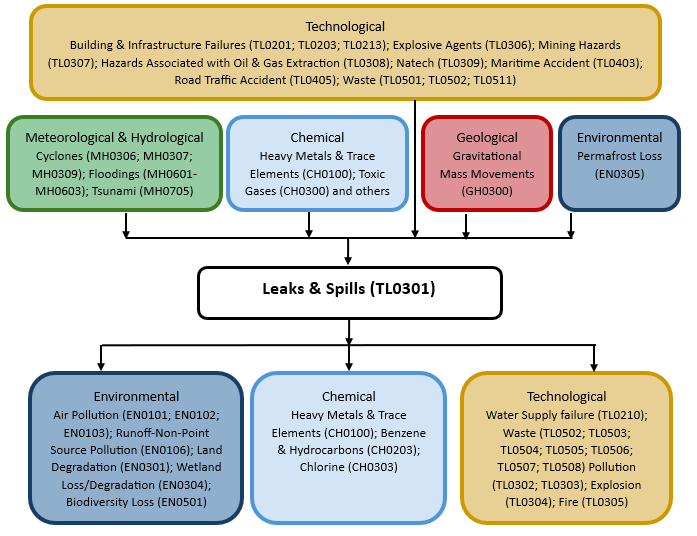
Leaks and spills can occur due to natural hazards, industrial accidents, or infrastructure failures, and they often create cascading risks. Several hazardous chemicals can be released during leaks and spills incidents, leading to different impacts.
Impacts
These incidents can trigger or worsen multiple hazards. They generally affect environmental health, human health or both. Air, water and soil pollution leading to environmental degradation and biodiversity loss are often observed. Damages to health vary depending on the chemical release but include skin damage, eye damage, respiratory issues, sometimes leading to death, either immediately after the event, or sometime later
Multi-hazard context
The figure below summarises common interactions between leaks & spills and other hazards. This information should be used with caution and not be solely relied upon in Disaster Risk Management, particularly as some interactions may not have been included. Note that hazardous events occurring together or locally in space or time may not necessarily cause, amplify, or be otherwise related to each other. Specific examples of multi-hazard context can be found in the ‘Hazard drivers’ and ‘Impacts’ sections above.
Multi-hazard diagram
Risk Management
Risk management measures can be grouped under the categories: prevention and control, preparedness and response.
Prevention and control: Being aware of chemical incident- related hazards: locating chemical sites away from centres of population; registration of all chemicals in commercial establishments with a hazard inventory to ensure rapid identification of the released chemical; regular evaluation of plans and their implementation; inspection/monitoring, and enforcement of safety measures; reducing the amounts of chemicals stored; appropriate labelling of all chemicals; conducting response drills; rapid notification of the chemical incident emergency services in the event of a chemical release; regular surveillance and standardised reporting of incidents, including the small, commonly occurring incidents; measures to decontaminate land or water already contaminated by waste disposal; measures to prevent or contain any fire-fighting water run-off; and construction of drainage ditches or holding tanks to contain liquid chemicals (WHO, no date; UNEP/OCHA, 2023).
In any chemical incident, there are a number of essential steps to go through as part of the chemical incident plan. These steps include alerting the emergency services; assessment of actions and management options; environmental monitoring; public information and public warnings; advice on protection; sheltering or evacuation; other interventions to protect public health; and organising registers and samples as required (WHO, no date; National CBRN Centre, 2016; UNEP/OCHA, 2023).
Preparedness: Careful planning and thorough preparedness are prerequisites for an effective response to chemical incidents. Public authorities, at all levels, and the management staff of installations where hazardous chemicals are produced, stored etc. should establish emergency preparedness plans. All responsible parties should ensure that manpower, equipment, and financial and other resources necessary to carry out emergency plans are readily available for immediate activation in the event, or imminent threat of an accident. In addition, all personnel involved in the emergency response process should be adequately educated and trained (WHO, no date; National CBRN Centre, 2016; UNEP/OCHA, 2023).
Response: Depending on the type of contaminant and if an acute or a chronic contamination incident and the level of potential exposure from chemical leaks and spills consider, if appropriate, setting up risk zones. These are usually established around an incident:
- The hot zone is the area where first responders must use protective equipment to prevent primary contamination and is the area with actual or potential contamination and the highest potential for exposure.
- The warm zone, which surrounds the hot zone, is the area where appropriate personal protective equipment must be worn to prevent secondary contamination. The warm zone is an area uncontaminated by the initial release of a substance, which becomes contaminated by the movement of people or vehicles. The warm zone will be extended to include the area of decontamination activity. These areas cannot be guaranteed as free from contamination.
- The cold zone is the uncontaminated area between the inner cordon and the outer cordon where it has been assessed that there is no immediate threat to life.
- The decontamination line separates the warm zone from the cold zone, which is the area free from contamination (National CBRN Centre, 2016).
Consider contacting the nearest Poisons Centre in case advice on diagnoses and treatment of chemical poisonings is needed. Also consider setting up a public health team which, in the case of a spill-related chemical incident, will provide accident and emergency departments with information about the nature of the chemicals(s), any precautions to be taken, and information about secondary contamination and how to decontaminate casualties, staff and equipment. Further details and guidance can be found in the WHO manual on the public health management of chemical incidents (WHO, 2009).
Designed to help manage the recovery phase of a chemical incident where contamination has affected food production systems, inhabited areas and water environments, further information can be found in the UK recovery handbook for chemical incidents (PHE, 2020).
Community-based monitoring programs represent an important complementary approach to institutional and technological monitoring systems. Local communities often detect early warning signs of leaks through observations of environmental changes like unusual odours, water discolouration, or vegetation stress. Establishing formal mechanisms for community reporting, combined with training on basic observation protocols, can create valuable distributed monitoring networks. These approaches are particularly important in regions with limited institutional capacity or remote areas where technological monitoring coverage may be incomplete.
Guidance on risk communication strategies during a chemical leak and spill incidents should be effective, transparent, and timely communication is essential for reducing public exposure, maintaining trust, and facilitating cooperation with protective measures. Risk communication should be tailored to different stakeholder groups, address scientific uncertainties honestly, and incorporate cultural factors affecting risk perception. The WHO's Emergency Risk Communication guidelines provide valuable frameworks to help authorities manage the critical information dimensions of chemical leak and spill events (WHO, 2017)
The World Health Organization (WHO) works closely with countries and partners to monitor and report on their emergency preparedness capacities for all hazards, including chemical incidents. Surveillance of diseases of possible chemical aetiology is a daily element in the WHO outbreak alert and response activities (WHO, no date). The WHO also convenes regional meetings to strengthen the global network of poison centres and thus facilitate emergency responses to chemical incidents. Guidance and training materials to strengthen preparedness for chemical incidents and emergencies have been developed in collaboration with the Organisation for Economic Co-operation and Development, the Inter-Organization Programme for the Sound Management of Chemicals, and relevant organisations in the United Nations system (WHO, no date). Additional resources include the WHO human health risk assessment toolkit for chemical hazards (WHO, ILO and UNEP, 2011) and the guidance document on evaluating and expressing uncertainty in hazard characterisation (WHO and IPCS, 2018).
Monitoring
The section and the table below offer an overview of monitoring arsenic. This information can be used for forecasting within a national early warning system (EWS). Since EWS capacities and processes differ across countries, the most current and specific information regarding EWS should be obtained from the appropriate national or regional agency/authority responsible for disaster management.
| Which institution(s) produce(s) Disaster Risk Data/Information? | Private companies managing industrial facilities (production and/or storage); Environmental protection agencies |
| How is the Hazard Observed/Monitored/Forecast? | Monitoring systems use sensors, satellite data, AI, or remote sensing technologies to identify leaks in pipelines, industrial sites, or natural environments before they cause significant damage. For example, marine oil spills can be detected using synthetic aperture radar (SAR) images captured by the European Sentinel-1 satellite. A trained deep learning model identifies oil slicks in the SAR images, which are then segmented into binary masks to analyse their extent and characteristics. Finally, the system simulates the trajectory of the oil spill based on wind and ocean currents to predict its movement (Yang et al, 2024). |
References
Basel Convention on the Control of Transboundary Movements of Hazardous Wastes and their Disposal, 1989. Accessed 13 February 2025.
Broughton, E., 2005. The Bhopal disaster and its aftermath: a review. Environmental Health, 4:6. 10.1186/1476-069X-4-6.
European Commission, 2020. The Seveso Directive - Technological Disaster Risk Reduction. Accessed 14 February 2025.
European Parliament and Council, 2012. Directive 2012/18/EU of the European Parliament and of the Council of 4 July 2012 on the control of major-accident hazards involving dangerous substances, amending and subsequently repealing Council Directive 96/82/EC Text with EEA relevance. Accessed 14 February 2025.
Food and Agriculture Organization of the United Nations (FAO), no date. Spills, leaks and disposal of containers and chemicals. Food and Agriculture Organization of the United Nations (FAO). Accessed 14 February 2025.
Health and Safety Executive (HSE), no date. Icmesa chemical company, Seveso, Italy. 10th July 1976. Health and Safety Executive (HSE). Accessed 14 February 2025.
National CBRN Centre, 2016. Responding to a CBRN(e) Event: joint operating principles for the emergency services. First edition September 2016. Accessed 14 February 2025.
Peterson, C.H., S.D. Rice, J.W. Short, D. Esler, J.L. Bodkin, B.E. Ballachey and D.B. Irons, 2003. Long-term ecosystem response to the Exxon Valdez oil spill. Science, 302:2082-2086.
Public Health England (PHE), 2020. UK Recovery Handbook for Chemical Incidents, 2020. Public Health England (PHE). Accessed 14 February 2025
Rotterdam Convention on the Prior Informed Consent Procedure for Certain Hazardous Chemicals and Pesticides in International Trade, 1998. Accessed 13 February 2025.
Stockholm Convention on Persistent Organic Pollutions (POPs), 2001. Text of the Convention and its subsequent amendments. Accessed 13 February 2025.
United Nations Environment Programme (UNEP), 2020. The Strategic Approach to International Chemicals Management (SAICM). United Nations Environment Programme (UNEP). Accessed 18 May 2025
United Nations Environment Programme and United Nations Office for the Coordination of Humanitarian Affairs (UNEP/OCHA), 2023. Environmental Emergencies Guidelines: Prepare. Respond. Recovery. Voluntary guidelines for the provision and receipt of international humanitarian assistance for environmental emergencies through the United Nations Environment Programme/ United Nations Office for the Coordination of Humanitarian Affairs 2nd Edition UN Environment Programme (UNEP) and Office for the Coordination of Humanitarian Affairs (OCHA). Accessed 19 May 2025
World Health Organization (WHO), 2009. WHO Manual: The Public Health Management of Chemical Incidents. World Health Organization (WHO). Accessed 14 February 2025.
World Health Organization (WHO), 2017. Communicating risk in public health emergencies: a WHO guideline for emergency risk communication (ERC) policy and practice ISBN 978-92-4-155020-8. World Health Organization (WHO). Accessed 18 May 2025
World Health Organization (WHO), no date. Chemical incidents. World Health Organization (WHO). Accessed 14 February 2025.
World Health Organization and International Programme on Chemical Safety (WHO and IPCS), 2018. Guidance document on evaluating and expressing uncertainty in hazard characterization, 2nd ed. World Health Organization (WHO) and International Programme on Chemical Safety (IPCS). Accessed 14 February 2025.
World Health Organization, International Labour Organization and United Nations Environment Programme (WHO, ILO and UNEP), 2011. World Health Organization Human Health Risk Assessment Toolkit: Chemical Hazards. Harmonization Project Document No. 8. Accessed 14 February 2025.
Yang Y.J., Singha S., and Goldman R., 2024. A near real-time automated oil spill detection and early warning system using Sentinel-1 SAR imagery for the Southeastern Mediterranean Sea. International Journal of Remote Sensing, Volume 45, 2024. DOI:10.1080/01431161.2024.2321468. Accessed 5 February 2025