
Dam Failure
Dam failure is the uncontrolled release of water due to structural collapse, foundation instability, or overtopping, posing risks on people and property downstream (ICOLD, 2023, mentioned in Moreno-Rodenas et al., 2025).
Primary reference(s)
Moreno-Rodenas, A;, Mantilla-Jones, J. D., Valero, D., 2025. Age, climate and economic disparities drive the current state of global dam safety. Nature Water 3, 284-295 Age, climate and economic disparities drive the current state of global dam safety | Nature Water Accessed 15 March 2025.
Annotations
Additional scientific description
A dam failure is a catastrophic incident characterized by:
- an uncontrolled release of impounded water;
- and/or by a total loss of integrity of the dam structure, its foundation, or abutments.
The term "dam" refers to any man-made barrier capable of impounding water, wastewater, or liquid-borne materials for storage or water control. A dam is considered to be 25 feet (7.62m) or more in height from either the natural stream bed or, if not across a stream channel, from the lowest elevation of the outer limit of the barrier to the maximum water storage elevation or has a storage capacity of 50 acre-feet (61,625m3) or more. A large dam is a dam with a height of 15 metres or greater from lowest foundation to crest or a dam between 5 metres and 15 metres impounding more than 3 million cubic metres (ICOLD, 2019). This definition is commonly adopted worldwide.
Dams are commonly categorised by a wide range of factors such as composition, height, and reservoir volume. Dams are typically constructed of earth, rock, concrete or tailings (chaff) from mining operations. As a function of upstream topography, even a small dam can impound or detain many millions of litres of water (acre-feet of millions of gallons (FEMA, 2017). The collapse or movement leading to a break in the dam could produce life-threatening flood situations due to the high velocities and large volumes of water involved. In the event of a dam failure, the potential energy of water stored behind the dam can cause significant damage to property and livelihoods, as well as injuries and loss of life for people downstream of the dam (FEMA, 2017).
The hazard potential classification system categorizes dam failure risks into three levels: LOW, SIGNIFICANT, and HIGH, with increasing adverse consequences (FEMA, 2004). Each level encompasses the consequences of the lower levels. The frameworks underscore that any dam failure, regardless of size, could endanger downstream life and property. They emphasize the unpredictability of such events and the potential for unexpected hazards, necessitating proactive risk management measures to mitigate risks effectively. (FEMA, 2017; ICOLD, 2023):
- The consequences of a low hazard potential dam failure should result in no probable loss of human life and low economic and/or environment losses.
- The consequences of a significant hazard potential dam failure should result in no probable loss of human life but can cause economic loss, environmental damage, disruption of lifeline facilities, or can impact other concerns.
- The consequences of a high hazard potential dam failure will probably cause loss of human life.
Three summary examples of dam failures follow:
- Brumadinho dam disaster Brazil 2019. On 25 January 2019, Córrego do Feijão's tailing dam at Brumadinho city breached, leading to at least 12 million cubic metres of tailing spread into Paraopeba River and the surrounding area, leaving more than 270 people dead and many missing, with major environmental impacts on the downstream catchment (Cambridge and Shaw, 2019; Thompson et al., 2020). This was the fifth tailings dam disaster to have occurred in the same region in an 18-year period and is considered the worst documented tailings dam failure to have occurred in the past 30 to 40 years. The failure at Brumadinho showed geotechnical similarities to that at Fundao in 2015, with the characteristic of all foundation zones predisposing the facility to an increased risk of basal liquefaction under increasing stress. Upstream construction, as well as management commitment to quality control and inspection and monitoring during operation, in addition to liquefaction and poor governance are potentially considered for the failure of the Brumadinho dam (Thompson et al., 2020).
- Ajka Red Sludge Reservoir. On 4 October 2010. The retaining wall of a caustic waste reservoir at the Ajka alumina plant near Kolontar, Hungary, collapsed releasing more than one million cubic metres of highly alkaline sludge containing toxic metals. The waste material flooded several nearby villages, resulting in 10 fatalities, 123 injured people, damage to buildings, and significant ecological and environmental impacts. Reports concluded that a check on the reservoirs stability and statics had not been performed by the relevant authorities (Ujaczki et al., 2015).
- Malpasset Dam, Fréjus, France. On December 2, 1959, the Malpasset arch dam in southeast France suddenly failed, flooding the valley down to the sea, causing huge destruction and more than 400 casualties. Built from 1952 to 1954 for water supply and irrigation, filling of the reservoir was delayed five years and the failure occurred following a flash flood of the river the dam was closing. Post failure studies and expertise during a trial revealed poor field investigations on a micaschist rock foundation crisscrossed by faults, and poor management of construction of the structure. The failure was ascribed to uplift, moving a rock dihedron defined by a conspicuous fault and a tear along foliation (Duffaut & Larouzée, 2019).
A review of failure mode analysis and implications for current and future resilience of flood protection infrastructure in the United States has been undertaken (Primary and Secondary Causes of Dam Failure in the US, no date). Dam failures are classified by date, location, dam type, primary and secondary root causes, cost in year of incident, damage type, and fatalities. The International Commission on Large Dams (ICOLD) is an international non-governmental organisation dedicated to sharing professional information and knowledge of the design, construction, maintenance, and impact of large dams. ICOLD has 100 member national committees and over 10,000 individual members, (ICOLD, no date). ICOLD has created a World Register of Dams. This is a global database on dams, established based on the national inventories sent by member countries of ICOLD. The register is continuously updated and includes information on more than 55,000 dams. In addition to the dam register, ICOLD has developed a technical dictionary. Between 2000 and 2009, more than 200 notable dam failures happened worldwide (Jonkman & Vrijling, 2008).
Metrics and numeric limits
Many more works have supplemented the inventory since that time, including ICOLD Bulletin No. 194 "Tailings Dam Safety" (ICOLD 2023).
It identifies accidents and events by dam type and age and by cause of accident. It increases the designer's awareness of the range of unforeseen factors with, to some extent, their likelihood, and the sequences of events that can lead to disaster.
Key relevant UN convention / multilateral treaty
The Convention on the Protection and Use of Transboundary Watercourses and International Lakes (UNECE, 2013).
The United Nations Sustainable Development Goals (SDGs) (UNDESA, 2021). Water resources management and service are essential for sustainable development. Goal 6 focuses on the significance of water supply. SDG Goal 13 (climate action) mentions dam resilience to extreme weather. The SDGs can also be linked to the proper functioning of dams as a source of municipal and rural water supply (Oyekanmi & Mbossoh, 2018).
The Sendai Framework for Disaster Risk Reduction, 2015-2030 (UNDRR, 2015).
UNDRR Guidelines for critical infrastructure (2023).
Drivers
Dam failure is likely to occur due to seepage and internal erosion, poor foundation conditions, overtopping, static and seismic instability and for other reasons such as subsidence, structural issues, external erosion and slope instability (Lyu et al., 2019). Dam failure may result from flash flood or river flood that can overwhelm the dam structure. Earthquakes may cause structural damage or failure. Prolonged droughts can reduce water levels, affecting the dam's functionality and stability. Landslides into reservoirs can create waves that overtop dams. Extreme weather events such as hurricanes, cyclones, and other severe weather can impact dam integrity.
Contaminants from industrial activities can weaken dam materials and structures while accidental releases of hazardous chemicals can cause structural damage or compromise the dam's integrity. Incidents involving nuclear or radiological materials can have catastrophic impacts on dam safety. Accidents on or near dams can pose significant hazards, especially if they involve vehicles transporting hazardous materials. Design flaws and poor maintenance (inadequate inspections and repairs) can lead to undetected structural weaknesses while mistakes in managing water levels, especially during extreme weather events, can lead to overtopping or structural stress. Accidental damages caused by construction activities near dams or deliberate damage to the dam's structure or operational systems can cause failure.
Impacts
Dam failure can lead to rapid draining of the reservoir, causing erosion and habitat destruction upstream. Downstream, the sudden release of water can result in catastrophic flooding, endangering lives and property
Dam safety agencies have generally adopted a common tiered hazard classification structure including Low, Significant, and High hazard potential classifications. Dam safety engineers commonly use the hazard potential classification system as a prioritisation tool to focus attention on those dams with the greatest potential consequences of failure.
Dam failures can damage various infrastructures such as transportation, electricity, communication, and water systems, and can cause surface and groundwater contamination as well as air pollution. Additionally, floods resulting from dam failures can trigger secondary disasters, including landslides, soil erosion, and ground subsidence (FEMA, 2012).
Risk creep also known as hazard creep is a term used to describe the gradual increase in anticipated consequences of a dam failure due to infrastructure development either along the drainage below a dam or within the reservoir area upstream. Although the physical condition of the dam may not change, hazard creep can result in an immediate adverse impact on the overall risk profile of a dam because the consequence component has increased. For example, new residential development within the dam breach floodplain could raise the status of a dam from one with a low hazard potential to one with significant or high hazard potential. Hazard creep can require costly dam safety modifications to address design deficiencies, such as to increase spill way capacity to safely route the probable maximum flood (for high hazard potential dams) (FEMA, 2017).
Multi-hazard context
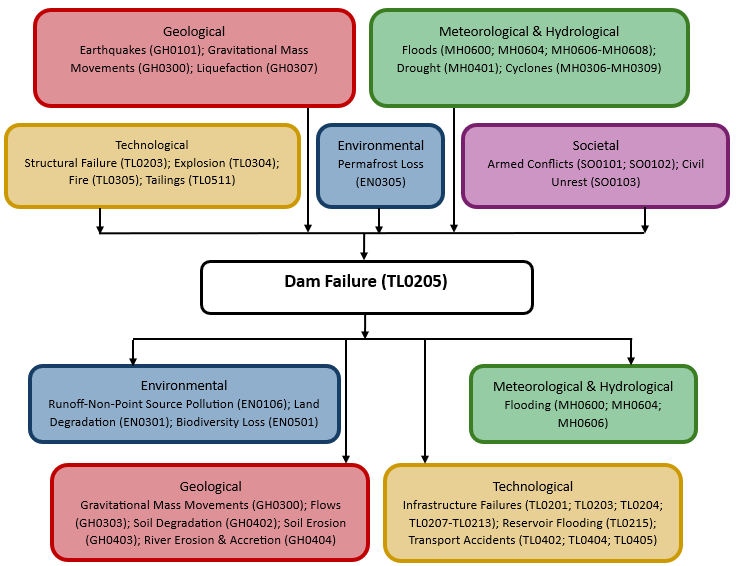
The figure below summarises common interactions between dam failure and other hazards. This information should be used with caution and not be solely relied upon in Disaster Risk Management, particularly as some interactions may not have been included. Note that hazardous events occurring together or locally in space or time may not necessarily cause, amplify or be otherwise related to each other. Specific examples of multi-hazard context can be found in the ‘Hazard drivers’ and ‘Impacts’ sections above.
Multi-hazard diagram
Risk Management
Following recent dam failure disasters, many countries put safety first and invest in prevention largely using Dam Safety Laws. This includes applying the UNECE’s safety standards ‘Safety Guidelines and Good Practices for Tailings Management facilities’ (UNECE, 2016). Such guidelines, developed by the Joint Expert Group on Water and Industrial Accidents under UNECE’s Industrial Accidents Convention and Water Convention, provide authorities with recommendations for practical applications to limit accidents and the severity of their consequences (UNECE, 2016).
The Conference of the Parties to the United Nations Economic Commission for Europe Industrial Accidents Convention sets the future direction for technological disaster risk reduction towards 2030 (UNECE, 2018).
For what concerns the relation between Flood risk and Dam Failure, the FEMA P-1085 (2023) is the main resource for risk modelling and flood mapping related to dams. It provides guidelines for creating maps to visualize flood risks from dam incidents or failures. These maps help assess hazards, support emergency action planning, and guide resource allocation to protect lives and property. It incorporates advanced modelling, GIS tools, and collaborative input from stakeholders, integrating these maps into emergency plans to enhance community preparedness.
An early warning system (EWS) is a critical tool for preventing or mitigating potential disasters caused by dam failures. Pre-event planning focuses on assessing risks, developing appropriate plans, and implementing mitigation measures and preparedness activities to reduce risks effectively. Risk assessment involves analysing threats and vulnerabilities to exposed people and assets to estimate potential losses. Planning actions include efforts by federal, state, local, and tribal entities to support long-term risk reduction, emergency response, and post-event recovery. These activities strengthen community resilience and response capacity, minimizing the impact of dam failures (FEMA, 2017).
Monitoring
Compressive and regular deformation of a dam can be monitored using satellite Interferometric Synthetic Aperture Radar (InSAR) (Wang et al., 2023).
References
Cambridge, M., Shaw, D., 2019. Preliminary reflections on the failure of the Brumadinho tailings dam in January 2019. Dams and Reservoirs, 29:113-123.
Duffaut, P., Larouzée, J., 2019. Geology, engineering & Humanities: 3 sciences behind the Malpasset dam failure (France, Dec. 2, 1959. Quarterly Journal of Engineering Geology and Hydrology. Accessed 15 February 2025.
Federal Emergency Management Agency (FEMA), 2004. Federal Guidelines for Dam Safety: Hazard Potential Classification System for Dams. Prepared by the Interagency Committee on Dam Safety. Federal Emergency Management Agency (FEMA) Accessed 24 April 2025
Federal Emergency Management Agency (FEMA), 2012. Assessing the Consequences of Dam Failure – A How to Guide, Federal Emergency Management Agency. Accessed 24 January, 2025
Federal Emergency Management Agency (FEMA), 2013. Federal Guidelines for Inundation Mapping of Flood Risks Associated with Dam Incidents and Failures (FEMA). Accessed 13 December 2024.
Federal Emergency Management Agency (FEMA), 2017. Risk Reduction Measures for Dams. Federal Emergency Management Agency (FEMA). Accessed 24 January 2025
Federal Emergency Management Agency (FEMA), 2017. Risk Exposure and Residual Risk Related to Dams. Federal Emergency Management Agency (FEMA). Accessed 15 February 2025.
International Commission on Large Dams (ICOLD), no date. Dam-break Problems, Solutions and Case Studies. International Commission on Large Dams (ICOLD). Accessed 3 November 2020.
International Commission on Large Dams (ICOLD), 2019. Statistical analysis of dam failure. Definition of a Large Dam. International Commission on Large Dams (ICOLD). ICOLD CIGB > Dams Safety. Accessed 15 January 2025.
International Commission on Large Dams (ICOLD), 2023. ICOLD Bulletin No. 194: Tailings Dam Safety.Accessed 15 January 2025.
Jonkman, S.N. and J.K. Vrijling, 2008. Loss of life due to floods. Journal of Flood Risk Management, 1:43-56.
Lyu, Z., J. Chai, Z. Xu, Y. Qin and J. Cao, 2019. A comprehensive review on reasons for tailings dam failures based on case history. Advances in Civil Engineering. Accessed 15 January 2025.
Oyekanmi, M. O., Mbossoh, E. R., 2018. Dams and Sustainable Development Goals: A vital interplay for sustainability. Journal of Environment and Earth Science, 8:4. Microsoft Word - JEES-Vol.8 No.4 2018.docx Accessed 15 January 2025.
Primary and Secondary Causes of Dam Failure in the U.S., no date. Accessed 15 January 2025.
Thompson, F., de Oliveira, B. C., Cordeiro, M. C., Masi, B. P., Rangel, T. P., Paz, P., Freitas, T., Lopes, G., Silva, B. S., Cabral, A. S., Soares, M., Lacerda, D., dos Santos Vergilio, C., Lopes-Ferreira, M., Lima, C., Thompson, C., de Rezende, C. E., 2020. Severe impacts of the Brumadinho dam failure (Minas Gerais, Brazil) on the water quality of the Paraopeba River. Science of The Total Environment, 705:135914. Accessed 15 January 2025.
Ujaczki, É., Klebercz, O., Feigl, V., Molnár, M., Magyar, Ádám, Uzinger, N., Gruiz, K., “2015. Environmental Toxicity Assessment of the Spilled Ajka Red Mud in Soil Microcosms for Its Potential Utilisation as Soil Ameliorant”. Periodica Polytechnica Chemical Engineering, 59(4), pp. 253–261, 2015. Accessed 15 January 2025.
United Nations Department of Economic and Social Affairs (UNDESA), 2021. The 17 Goals. United Nations Department of Economic and Social Affairs (UNDESA). Accessed 15 January 2025.
United Nations Office for Disaster Risk Reduction (UNDRR), 2015. Sendai Framework for Disaster Risk Reduction. 2015-2030. United Nations Office for Disaster Risk Reduction (UNDRR). Accessed 15 January 2025.
United Nations Economic Commission for Europe (UNECE), 2013. Convention on the Protection and Use of Transboundary Watercourses and International Lakes – Guide to implementing The Water Convention. United Nations Economic Commission for Europe (UNECE). Accessed 15 January 2025.
United Nations Economic Commission for Europe (UNECE), 2016. Checklist for contingency planning for accidents affecting transboundary waters. United Nations Economic Commission for Europe (UNECE). Accessed 15 January 2025.
United Nations Economic Commission for Europe (UNECE), 2018. Conference of the Parties to UNECE Industrial Accidents Convention (2018) sets future direction for technological disaster risk reduction towards 2030. United Nations Economic Commission for Europe (UNECE). Accessed 15 January 2025.
Wang, Q., Gao, Y., Gong, T., Liu, T., Sui, Z., Fan, J., & Wang, Z., 2023. Dam Surface Deformation Monitoring and Analysis Based on PS-InSAR Technology: A Case Study of Xiaolangdi Reservoir Dam in China. Water, 15(18), 3298. Accessed 15 January 2025.