
Bridge Failure
Bridge failure is the inability of a bridge, or its components, to perform as specified by its design and construction requirements (Wardhana and Hadipriono, 2003).
Note: This definition includes bridges that have totally collapsed, partially collapsed and those that experienced distress, such as, exhibiting excessive deformation.
Primary reference(s)
Wardhana, K. and F.C. Hadipriono, 2003. Analysis of recent bridge failures in the United States. Journal of performance of constructed facilities, 17:144-150.
Annotations
Additional scientific description
Urbanization leads to a continuous increase in demand for urban infrastructure, including bridges, highways and roads. The service life of infrastructure such as bridges is often shorter than expected due to natural phenomena and lack of sustainable concept in design and construction. Bridge failures are one of the most severe infrastructure problems faced today and pose an imminent threat to life and property. This reinforces the need to conduct sustainability assessments and optimal risk mitigation measures. A key aspect of engineering failures is the relationship between the failure and growth in engineering knowledge, which ensures the sustainable development of society.
Metrics and numeric limits
The estimated average annual bridge collapse rate in the United States is between 87 and 222 with an expected value of 128 (Cook, 2014)
The United States National Bridge Inventory, reports that on average, 188 million trips take place across a structurally deficient bridge per day in the USA. Between 1989 and 2000, a total of 503 bridges failed, resulting in 76 fatalities and 161 injuries. Of the 503 failures, 386 occurred during bridge's service life rather than during construction (US Department of Transportation, 2020).
Key relevant UN convention / multilateral treaty
While there isn't a single UN convention specifically addressing bridge failures, several relevant treaties and agreements touch upon aspects related to infrastructure safety and resilience:
United Nations Sustainable Development Goals (UNDESA, 2015).
Sendai Framework for Disaster Risk Reduction 2015-2030: This framework emphasizes the importance of building resilient infrastructure and reducing disaster risk. It encourages countries to incorporate disaster risk considerations into infrastructure planning, design, and construction.
Paris Agreement on Climate Change: Climate change increases the risk of extreme weather events (floods, hurricanes) that can impact bridge infrastructure. The Paris Agreement aims to strengthen the global response to the threat of climate change, which indirectly contributes to bridge safety.
UN Convention on the Rights of Persons with Disabilities: This convention emphasizes the importance of accessible and inclusive infrastructure, including bridges, for people with disabilities.
Drivers
The collapse of bridges due to extreme weather events is a global issue. Earthquakes, erosion, floods, and other factors can cause bridge collapses, and especially when earthquakes and floods occur simultaneously or consecutively, they can pose a serious risk to bridges (Ganesh Prasad & Banerjee, 2012). The more common causes and mechanisms of bridge failures around the world may be classified into two groups: natural factors (flood, scour, earthquake, landslide, cyclones etc.) and human factors (poor design and construction method, collision, overloading, fire, corrosion, lack of inspection and maintenance etc.) (Choudhury and Hasnat, 2015).
Earthquakes can cause severe structural damage or collapse of bridges, especially if they are not designed to withstand such forces. Similarly, landslides and associated movement of soil and rock can impact the stability of bridge foundations and approaches. Tsunamis can also inundate coastal areas and damage bridges.. Scour, the erosion of soil around foundations by flowing water, can weaken support and lead to collapse. Heavy rainfall and river overflow can lead to significant flooding, which can undermine bridge foundations and cause structural failures. Hurricanes, cyclones, and severe storms can cause widespread damage to bridge through high winds, heavy rainfall, storm surges, and debris impacts, especially in coastal areas (Zhu et al., 2021). Climate change will also worsen the risks faced by bridges in the future (Markogiannaki, 2019)
Inadequate design calculations, use of substandard materials, faulty construction techniques, and errors in planning and execution can all contribute to failure. Insufficient or inadequate inspections, delayed or inadequate repairs, and neglect of routine maintenance can lead to deterioration and eventual failure. Fire and corrosion can also weaken structural elements over time. Exceeding the bridge's weight capacity can cause structural failure
Collisions with vehicles, ships, or trains can severely damage the bridge structure while industrial accidents near the bridge, including spills of hazardous chemicals, cyberattacks on bridge control systems may also cause bridge collapse or stop activities on bridges.
Impacts
Bridge collapses pose a significant risk to human life. By disrupting transportation networks, bridge collapse causes delays, traffic congestion, and increased transportation costs. This has economic and social impacts, leaving communities isolated, hindering emergency response, and disrupting essential services. Critical infrastructure, including bridges, is essential for national security and defense.
Multi-hazard context
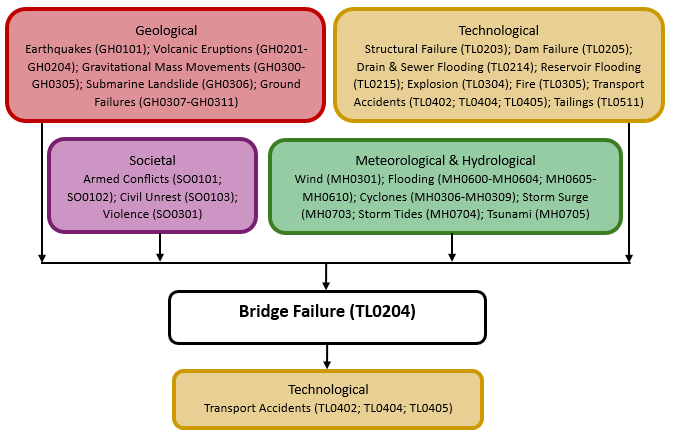
The figure below summarises common interactions between bridge collapse and other hazards. This information should be used with caution and not be solely relied upon in Disaster Risk Management, particularly as some interactions may not have been included. Note that hazardous events occurring together or locally in space or time may not necessarily cause, amplify or be otherwise related to each other. Specific examples of multi-hazard context can be found in the ‘Hazard drivers’ and ‘Impacts’ sections above.
In August 2018, a large section of the Genoa Morandi bridge in Genoa Italy, collapsed resulting in 43 fatalities and required over 400 people to evacuate the surrounding area. The collapse led to widespread human displacement and created an economic disaster (Bellini and Calevo, 2019). Lack of maintenance work and/or bridge design, combined with excessive load and bad weather have been suggested as the reason(s) for the bridge collapse (Rymza, 2021; Villani, 2019).
Multi-hazard diagram
Risk Management
Lessons identified from past bridge failures should inform the development of new materials, and more efficient forms of substructure and superstructure as well as new technology of construction, are now leading to longer life spans of bridges (Choudhury and Hasnat, 2015). In response to recent bridge failures, research has had a growing focus on three aspects: the general situation and development trend of bridge failures; bridge safety based on structural monitoring and mechanism analysis; and risk assessment and control for sustainability and environmental health (Tan et al., 2020).
However, a bridge designed to current standards and properly maintained can still fail. This is largely due to the gap in research about how exceptional stresses and especially the interaction of different exceptional stresses can compromise bridge integrity. Wardhana and Hadipriono (2003) concluded in the United States, that hydraulics (flooding and flood-related debris strikes), collisions, and overloading failures accounted for 73.4% of bridge failures, with the vast majority caused by external events that subjected the bridges to conditions with which they could not cope. Bridge overload and lateral impact forces from trucks, ships and trains, resulted in 20% of total bridge failures.
To avoid bridge failures in the future, both design countermeasures and management guidelines should be implemented.
To improve bridge management, consideration should be given to social, environmental and economic sustainability (Tan et al., 2020). Environmental factors are one of the biggest risk factors engineers must consider in future bridge design. Climate change is a growing concern, with rising sea levels and increased frequency and severity of storms two examples of relevance to bridge design. Adapting to the potential impacts and loads caused by floods, storms and earthquakes are also key considerations for bridge resilience.
Engineering has an important role in the planning, construction and ongoing maintenance of bridges in order to support their function, safety and integrity. Incorporating cutting-edge design principles, advanced materials, and sophisticated analysis techniques, strict adherence to building codes and rigorous quality control throughout the construction process are essential to ensure good bridge design. Key considerations for bridge design include: surpasses national standards and guidelines; allows for higher flood levels than experienced historically, ensures the bridge can withstand significant loads and debris, and design bridges to withstand earthquakes in seismically active regions implement measures to reduce scour and erosion.
Monitoring
Regular Inspections using various methods (visual, non-destructive testing) to identify potential problems early on and timely and effective repair and maintenance of identified deficiencies are also essential to maintain the bridge. A range of different monitoring techniques are available, including routine on-site visual inspections (possibly only conducted annually), continuous 24-hour camera surveillance, and non-destructive testing (NDT) methods such as fibre-optic grating sensors (Maaskant et al., 1997), polarimetric ground-based real aperture and radar system (Zou et al;, 2024), and microwave sensor interferometry (Zou & Alani, 2024).
References
Bellini, C., Calevo, M. G., 2019. Genoa, Italy bridge collapse: effects on neonatal emergency transport service. Prehospital and Disaster Medicine, 34:458-459.
Cardone, D., 2014. Displacement Limits and performance displacement profiles is support of direct displacement based seismic assessment of bridges. Earthquake Engineering & Structural Dynamics, Vol. 43, Issue 8. Cardone - 2014 Accessed 14 February 2025.
Choudhury, J., Hasnat, A., 2015. Bridge collapses around the world: Causes and mechanisms. IAPSE-JSCE Joint Conference on Advances in Bridge Engineering – III, 21-22 August 2015, Dhaka, Bangladesh.
Cooper, W., 2014. Bridge Failure Rates, Consequences, and Predictive Trends. All Graduate Theses and Dissertations. 2163. Accessed 14 February 2025.
Ganesh Prasad, G., Banerjee, S., 2013. The Impact of Flood-Induced Scour on Seismic Fragility Characteristics of Bridges. Journal of Earthquake Engineering, 17(6), 803–828. Accessed 24 January, 2025.
Maaskant, R., Alavie, T., Measures, R. M., Tadros, G., Rizkalla, S. H., Guha-Thakurta, A., 1997. Fiber-optic Bragg grating sensors for bridge monitoring. Cement and Concrete Composites 19 (1), 21-33. Accessed 24 January, 2025.
Markogiannakis, O., 2019. Climate Change and Natural Hazard Risk Assessment Framework for Coastal Cable-Stayed Bridges. Front. Built Environ., Sec. Bridge Engineering, Volume 5 - 2019. Accessed 14 February 2025.
National Cooperative Highway Research Program (NCHRP), 2013. Performance based seismic bridge design. NCHRP Report 2013/440; Performance-based Seismic Bridge Design | The National Academies Press Accessed 14 February 2025.
Rymsza, J., 2021. Causes of the Collapse of the Polcevera Viaduct in Genoa, Italy. Applied Sciences, 11(17):8098. Accessed 14 February 2025.
Tan, J.-S., Elbaz, K., Wang, Z.-F., Shen, J., Chen, J., 2020. Lessons learnt from bridge collapse: a view of sustainable management. Sustainability, 12:1205. 10.3390/su12031205.
United Nations Department of Economic and Social Affairs (UNDESA), no date. Sustainable Development Goals. United Nations Department of Economic and Social Affairs (UNDESA). Accessed 14 February 2025.
United Nations Office for Disaster Risk Reduction (UNDRR), 2015. Sendai Framework for Disaster Risk Reduction 2015-2030. United Nations Office for Disaster Risk Reduction (UNDRR). Accessed 14 February 2025.
US Department of Transportation, 2020. Bridges and Structures: National Bridge Inventory. Accessed 14 February 2025.
Villani, P., 2019. Dynamics and causes of the collapse of the Morandi viaduct in Genoa. Presentation to the Session: 30. Damage Assessment on Bridges of the 26th World Road Congress. Accessed 14 February 2025.
Wardhana, K. and F.C. Hadipriono, 2003. Analysis of recent bridge failures in the United States. Journal of performance of constructed facilities, 17:144-150.
Zhu, D., Li, Y., Dong, Y. et al., 2021. Long-term loss assessment of coastal bridges from hurricanes incorporating overturning failure mode. ABEN 2, 10. Accessed 14 February 2025.
Zou, L., Alani, A. M., 2024. Infrastructure structural health monitoring of bridge with polarimetric radar sensor. In: Bridge Maintenance, Safety, Management, Digitalization and Sustainability, Sanger et al;, Eds. Taylor & Francis. Infrastructure structural health monitoring of bridge Accessed 14 February 2025.
Zou, L., Nico, G., Alani, A. M., Sato, M., 2024. Strategy for vertical deformation of railway bridge monitoring using polarimetric ground-based real aperture radar system. Structural Health Monitoring 23(6):3719-3730. doi:10.1177/14759217231226128 Accessed 14 February 2025.