Radio and Other Telecommunication Failures
Radio and other telecommunication failures occur when there is an internal or external interruption of communications by either party that results in difficulty transporting a message as it was intended (adapted from Dainty et al., 2007).
Primary reference(s)
Dainty, A., D. Moore and M. Murray, 2007. Communication in Construction: Theory and Practice. Routledge. Accessed 19 May 2025
Annotations
Additional scientific description
Radio and communication technology is integrated into everyday life and has significantly advanced in recent decades. Communication channels such as radio, cellular networks, and satellites aim to broadcast or convey information and warnings to populations. In a disaster response event, the goal of any communication system is to maximise the number of people who act on and take appropriate and timely actions to protect property and ensure life safety (Khaled & Mcheick, 2019; ITU, 2019).
Efficient and effective communication linkages are critical prior to, during and following a disaster event, particularly among emergency personnel to assist with disaster response and recovery. However, failure of communication systems, whether complete or partial such as radio or satellites systems has caused inefficiency and delays in emergency relief efforts and response, which leads in turn to loss of life and preventable injuries. Failure of communication systems can cause catastrophic damage to human life and economic activities as people are unable to communicate with each other in a timely manner and with a good quality of service (Khaled & Mcheick, 2019).
A notable example of radio and communications failure was caused by the 2004 Indian Ocean earthquake and tsunami: A magnitude 9.0 earthquake struck the west coast of Sumatra, Indonesia, generating tsunami waves with maximum heights ranging from 2 to 30 m, inundating the coastal areas of many surrounding countries. Although this event was the first global natural disaster where practitioners and the public mediated their experience of it through the internet, communication technology was not used to its fullest extent during the immediate response, which resulted in a lower delivery of humanitarian aid. The main reasons for the communication failure were the destruction of technology infrastructure, accumulated debris, and extensive flooding that affected the power systems and cabins that contained the base transceiver station (BTS) equipment. There were also other telecommunications limitations such as limited network coverage, lack of early warning systems, and a lack of rescue equipment (Khaled & Mcheick, 2019).
Key reasons for communications systems failure include damage and/or destruction of communication system components; damage and/or disruption in supporting network infrastructure; and disruption due to congestion.
Damage and/or destruction of communication system components is considered the most common and well-documented cause of telecommunications failures in recent disasters. Because of the time and funding needed to repair and replace systems, disruption caused by physical damage tends to be more severe and time-consuming to restore as it may require maintenance or replacement of complex hardware, particularly essential components such as cell towers or cables. The fragility of communication systems is due to the lack of a high degree of redundancy (Townsend and Moss, 2005).
Communication outages caused by damage and/or disruption in supporting network infrastructure tend to be far more widespread and damaging during response and recovery efforts. Some communication systems are reliant on many other local and regional technical systems to ensure effective operation. Supporting infrastructure often lacks resiliency to physical damage (Townsend and Moss, 2005).
Disruption due to congestion is another type of major communication failure during disaster, and is a direct result of network congestion or overload, and results in blocked calls and messages unsent. Historically, disasters are one of the most intense generators of communications traffic, and the resulting surge of demand can clog even the most well-managed networks.
However, communication can be restored relatively rapidly (Khaled & Mcheick, 2019).
Lessons identified from previous disaster events, conclude that radio and satellite-based communications were most effective, while conventional communications outlets (i.e. wireless phones and landlines) were either damaged or overwhelmed in many disaster events hindering the efficient and timely transfer of information (Khaled & Mcheick, 2019).
Metrics and numeric limits
The ITU is currently developing global guidelines for countries to develop National Emergency Telecommunications Plans (NETS) to be used for early warning and in times of emergency (GMSA, 2021). The framework seeks to address a country’s exposure to natural hazards and disasters prior to developing emergency data and communication systems (ITU, 2019).
Key relevant UN convention / multilateral treaty
Sustainable Development Goals (SDGs) (UNDESA, 2021).
The Tampere Convention on the Provision of Telecommunication Resources for Disaster Mitigation and Relief Operations was established in 2005. This international treaty allows countries to remove regulatory issues to immediately provide emergency telecommunications where a disaster has occurred (United Nations Treaty Collection, 1998).
Drivers
Natural hazards can destroy telecommunications infrastructure and cause severe network disruptions. Electrical power is essential for these emergency communication systems to operate and power outages are directly linked to the drivers of this hazard (Townsend & Moss, 2005; Chang et al., 2007).
Impacts
Radio and other telecommunication networks should be able to step in if emergency telecommunications failure occurs as it can lead to the malfunction of early warning systems, increasing the potential for secondary damages. It also diminishes disaster response capabilities by causing delays or reducing the efficiency of emergency response operations. Furthermore, due to its interdependency with power and ICT systems, telecommunications infrastructure can become a target for cyber-attacks, creating additional vulnerabilities in the system (CISA, 2023).
Failure in radio and other telecommunication networks will have more impact in the context of other hazards, for example, wildfires are the most frequent type of emergencies, particularly affecting transmission network circuits (Salema & Caldeirinha, 2024). Issues around emergency telecommunications failure increase the risk of physical damage and financial losses, where quick service restoration, to enhance disaster response capabilities for improving emergency connectivity are vital.
Multi-hazard context
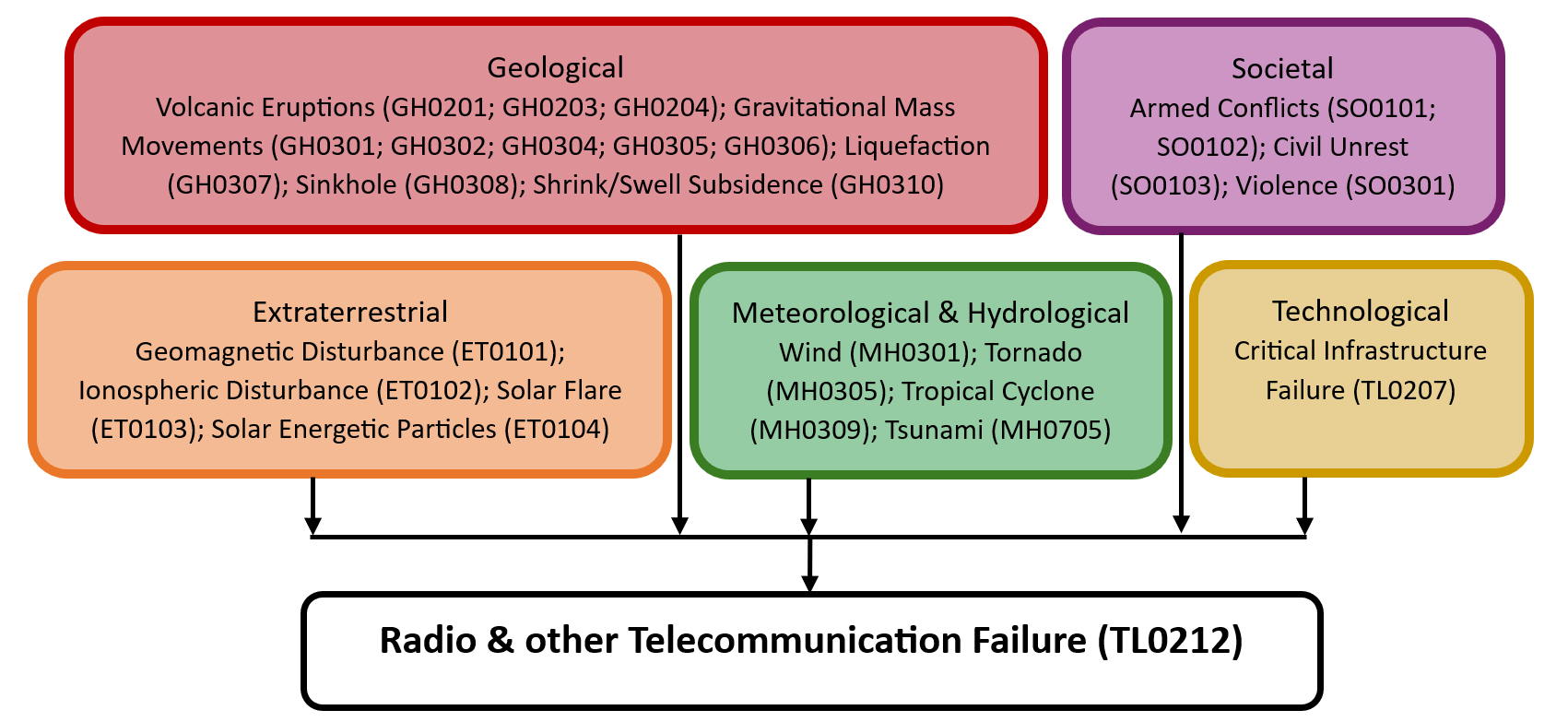
The figure below summarises common interactions between radio and other telecommunication failures and other hazards. This information should be used with caution and not be solely relied upon in Disaster Risk Management, particularly as some interactions may not have been included. Note that hazardous events occurring together or locally in space or time may not necessarily cause, amplify, or be otherwise related to each other. Specific examples of multi-hazard context can be found in the ‘Hazard drivers’ and ‘Impacts’ sections above.
Multi-hazard diagram
Risk Management
Developing and implementing common technical characteristics and guidelines for radio communication systems for early warning and disaster response and relief, would promote a common technical basis in planning for and responding effectively to an emergency. A guide to Radio Communications Standards for Emergency Responders was developed and prepared under the United Nations Development Program and the European Commission Humanitarian Office through the Disaster Preparedness Programme. The aim of the manual is to provide a standard of operation and a guide for training message handling techniques and net procedures for Radio Emergency Service operators for national and local radio networks (UNDP, 2010). In 2017, the United Nations Children Fund (UNICEF), developed an Emergency Telecommunications Handbook which presents a set of guidelines and detailed instructions to support teams facilitating and delivery of effective emergency telecommunications in the field. The handbook captures the nature of integration of various telecommunication systems (UNICEF, 2017).
In addition, the International Telecommunication Union has developed numerous resources including:
- Radio Regulations Navigation Tool (regulations that govern the global use of the radio-frequency spectrum and satellite orbits) (ITU, no date).
- Space Networks Systems Database of the Radiocommunication Bureau of the International Telecommunication Union. The database contains AP4 data of geostationary satellite filings, non-geostationary satellite filings and earth station filings (ITU, no date).
- Definitions of world telecommunication/ICT Indicators (ITU, no date).
Radio-based early warning systems (EWS) are among the oldest and most reliable communication technologies, having been extensively tested in various disaster scenarios. Radio has the unique advantage of reaching large populations in areas where infrastructure has been severely damaged, making it a cost-effective means of communication. During the immediate response phase of various natural disasters, radio has been instrumental in delivering critical messages, information, and advice to affected communities, often in collaboration with diverse stakeholders. One of the key strengths of radio is its ability to reach individuals in resource-limited settings, where other forms of communication may not be feasible due to limited infrastructure or high costs. In situations where electricity is unavailable, and thus mobile phones, televisions, or other media channels cannot be used, solar or wind-powered radios offer a sustainable and easily deployable solution, ensuring that vital early warnings continue to reach communities without requiring advanced technology or significant resources. This makes radio an invaluable tool in ensuring communication continuity, even when other communication infrastructures fail (Hugelius K. et a.l, 2019).
Monitoring
Emergency telecommunications failures exacerbate disaster risks by hindering communication and coordination among responders, potentially leading to delayed or ineffective emergency responses, and increased physical and financial damage. Quick service restoration is crucial for enhancing disaster response capabilities, as it enables timely communication, information sharing, and coordinated actions to mitigate damage and aid affected populations (OECD, 2025).
References
Chang S.E., McDaniels T.L., Mikawoz J., Peterson K. Infrastructure failure interdependencies in extreme events: power outage consequences in the 1998 Ice Storm. Natural Hazards, 41 (2) (2007), pp. 337-358. Accessed 19 May 2025.
Cybersecurity and Infrastructure Security Agency (CISA), 2023. Emergency Services sector cyber risk assessment. Cybersecurity and Infrastructure Security Agency (CISA). Accessed 26 January 2025.
Hugelius K., Adams M., Romo-Murphy E., 2019. The power of Radio to promote health and resilience in disasters: A review. International Journal of Environmental Research and Public Health. 2019; 16(14):2526. DOI: 10.3390/ijerph16142526. Accessed 26 January 2025.
International Telecommunication Union (ITU), 2014. Gap Analysis of Disaster Relief Systems, Network Resilience and Recovery. ITU-T Focus Group on Disaster Relief Systems, Resilience and Recovery Network. International Telecommunication Union (ITU). Accessed 26 January 2025.
International Telecommunication Union (ITU), no date. ITU Radiocommunication Sector. International Telecommunication Union (ITU). Accessed 19 May 2025.
Khaled, Z. and H. Mcheick, 2019. Case studies of communication systems during harsh environments: A review of approaches, weaknesses, and limitations to improve quality of service. International Journal of Distributed Sensor Networks, 15(2).
Organisation for Economic Co-operation and Development (OECD), 2025. Enhancing the resilience of communication networks. OECD digital economy papers May 2025 No. 374. Organisation for Economic Co-operation and Development (OECD). Accessed 19 May 2025.
Salema, C, and Caldeirinha R. 2024. ‘Perspective Chapter: Mobile Radio Emergency Communications for Large-Scale Wildfire Fighting – Portugal as a Case Study’. Fire Safety Engineering - Measures, Policies, and Applications [Working Title]. IntechOpen. doi:10.5772/intechopen.1007773. Accessed 19 May 2025.
Townsend, A. and M. Moss, 2005. Telecommunications Infrastructure In Disasters: Preparing Cities for Crisis Communications. Accessed 26 January 2025.
United Nations Development Programme (UNDP), 2010. A guide to radio communications standards for emergency responders. Accessed 26 January 2025.
United Nations General Assembly (UNGA), 2015. Transforming Our World: The 2030 Agenda for Sustainable Development. United Nations General Assembly (UNGA). Accessed 12 February 2025.
United Nations Children's Fund (UNICEF), 2017. Emergency Telecommunications Handbook. Accessed 26 January 2025.
United Nations Treaty Collection, 1998.Chapter XXV: Telecommunications: 4. Tampere Convention on the provision of telecommunication resources for disaster mitigation and relief operations. Accessed 10 May 2025.