
Rogue Wave
Rogue waves are extreme waves with overall or crest heights that are abnormally high relative to the background significant wave height (WMO, 2018).
Primary reference(s)
WMO, 2018. Guide to Wave Analysis and Forecasting, WMO No. 702. World Meteorological Organization (WMO). Accessed 16 May 2025.
Annotations
Additional scientific description
Rogue waves, called ‘extreme storm waves’ by scientists, are those waves which are greater than twice the size of surrounding waves. They are very unpredictable, and often come unexpectedly from directions other than those of the prevailing wind and waves. Since these waves are uncommon, measurements and analysis of this phenomenon are extremely rare (NOAA, 2019).
Metrics and numeric limits
Not identified.
Key relevant UN convention / multilateral treaty
Sendai Framework for Disaster Risk Reduction 2015-2030.
Drivers
Exactly how and when rogue waves form is still under investigation, but there are several known causes.
- Constructive interference: Extreme waves often form because swells, while travelling across the ocean, do so at different speeds and directions. As these swells pass through one another, their crests, troughs, and lengths sometimes coincide and reinforce each other. This process can form unusually large, towering waves that quickly disappear. If the swells are travelling in the same direction, these mountainous waves may last for several minutes before subsiding (NOAA, 2019).
- Focusing of wave energy: When waves formed by a storm develop in a water current against the normal wave direction, an interaction can take place which results in a shortening of the wave frequency. This can cause the waves to dynamically join together, forming very big 'rogue' waves. Currents where these are sometimes seen include the Gulf Stream and the Agulhas Current. Extreme waves developed in this fashion tend to be longer-lived than those formed by constructive interference (NOAA, 2019).
Impacts
Rogue waves have destructive effects on ships and offshore structures and activities. A review of ship accident reports showed several vulnerabilities to damage from rogue waves. In various rogue wave-related ship accident cases, “the wave smashed bridge windows and flooded instrument panels, disabling critical instruments and, in a number of cases, caused a complete loss of power (Gasparotti and Rusu, 2016).
Rogue waves can also impact and, in some cases, lead to the destruction of “offshore wind farms or wave energy farms operating in the coastal environment” (Gasparotti and Rusu, 2016). These impacts highlight the importance of accounting for meteorological (temperature, pressure and wind) and oceanographic conditions (waves, current) in ship and offshore standards in order to ensure marine safety (Gasparotti and Rusu, 2016).
Multi-hazard context
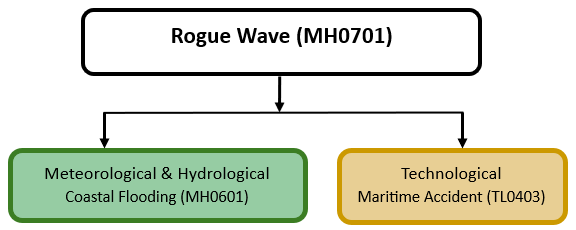
The figure below summarises common interactions between rogue waves and other hazards. This information should be used with caution and not be solely relied upon in Disaster Risk Management, particularly as some interactions may not have been included. Note that hazardous events occurring together or locally in space or time may not necessarily cause, amplify, or be otherwise related to each other. Specific examples of multi-hazard context can be found in the ‘Hazard drivers’ and ‘Impacts’ sections above.
Multi-hazard diagram
Risk Management
A good knowledge of the extreme wave environment and related wave/structure interactions is required for the design of safe and economic offshore structures and ships (Clauss, 2002).
Monitoring
The section above and the table below offer an overview of monitoring rogue waves. This information can be used for forecasting within a national early warning system (EWS). Since EWS capacities and processes differ across countries, the most current and specific information regarding EWS should be obtained from the appropriate national or regional agency/authority responsible for disaster management.
| Which institution(s) produce(s) Disaster Risk Data/Information? |
|
| How is the Hazard Observed/Monitored/Forecast? | Rogue waves are monitored using ocean buoys that track sudden changes in wave height and sea conditions, as well as other remote sensing technologies. Scientists analyse wind patterns, ocean currents, and storm activity to understand the factors that contribute to these rare but powerful waves. While forecasting rogue waves is challenging due to their unpredictable nature, they can be monitored with ocean buoys that track changes in wave height and sea conditions, along with other remote sensing technologies. |
References
Clauss, G.F. (2002) ‘Dramas of the sea: episodic waves and their impact on offshore structures’, Applied Ocean Research, 24, pp. 147–161.
Gasparotti, C. and Rusu, E. (2016) ‘A review concerning the rogue waves and their impact on navigation conditions’, Mechanical Testing and Diagnosis, 3, pp. 10–21.
National Oceanic and Atmospheric Administration (NOAA), 2019. What is a rogue wave? National Ocean Service, National Oceanic and Atmospheric Administration. Accessed 16 May 2025.