Carbon Monoxide
Carbon monoxide is a colourless, odourless gas that can be poisonous to humans and is considered a significant public health hazard (WHO, 1999).
Primary reference(s)
WHO, 1999. Environmental Health Criteria 213: Carbon monoxide. Second Edition. International Programme on Chemical Safety, World Health Organization (WHO). Accessed 11 May 2024.
Annotations
Additional scientific description
Carbon monoxide (CO) is one of the most common and widely distributed air pollutants. It is a colourless, odourless and tasteless gas that is poorly soluble in water. Carbon monoxide has a slightly lower density than air. In the human body, it reacts readily with haemoglobin to form carboxyhaemoglobin. Small amounts of carbon monoxide are also produced endogenously. Carbon monoxide exposure is still one of the leading causes of unintentional and suicidal poisonings and causes a large number of deaths annually (WHO, 2000).
It is a product of the incomplete combustion of carbon-containing fuels and is also produced by natural processes or by biotransformation of halomethanes within the human body (Anders, 1985). With external exposure to additional carbon monoxide, subtle effects can begin to occur, and exposure to higher levels can result in serious symptoms and death. The health effects of carbon monoxide are largely the result of the formation of carboxyhaemoglobin (COHb), which impairs the oxygen-carrying capacity of the blood (WHO, 1999).
The total annual global emissions of carbon monoxide into the atmosphere have been estimated to be as high as 2600 million tonnes, of which about 60% are from human activities and about 40% from natural processes such as wildfires. Anthropogenic emissions of carbon monoxide originate mainly from the incomplete combustion of carbonaceous materials. The largest proportion of these emissions are produced as exhaust gases from internal combustion engines, especially by motor vehicles with petrol engines. Other common sources include various industrial processes, power plants using coal, and waste incinerators.
Petroleum-derived emissions have greatly increased over the past few decades. Some widespread natural non-biological and biological sources, such as plants, oceans and oxidation of hydrocarbons, give rise to the background concentrations outside urban areas. In indoor environments, space heaters fuelled with oil, gas or kerosene, gas stoves and some other combustion appliances (e.g., wood stoves), and tobacco smoking are also responsible for significant emissions of carbon monoxide (WHO, 2000).
Metrics and numeric limits
Indoor air: 100 mg/m3 (87 ppm) for 15 minutes, 35 mg/m3 (30 ppm) for 1 hour, 10 mg/m3 (8.7 ppm) for 8 hours, 7 mg/m3 (6.1 ppm) for 24 hours (WHO, 2010).
Emergency response and acute exposure: Emergency Response Planning Guidelines (ERPG) (NOAA, 2016) and Acute Exposure Guideline Values for Airborne Chemicals (AEGLs) (US EPA, no date) exist for carbon monoxide.
Key relevant UN convention / multilateral treaty
United Nations Framework Convention on Climate Change (UNFCCC). Carbon monoxide, as a product of incomplete combustion, is relevant because its emissions are often associated with the burning of fossil fuels, which also produces carbon dioxide (CO2), a major greenhouse gas.
Stockholm Convention on Persistent Organic Pollutants (POPs). While carbon monoxide is not a persistent organic pollutant, the Stockholm Convention addresses the broader issue of air quality and the reduction of harmful chemicals released into the atmosphere.
Convention on Long-Range Transboundary Air Pollution (CLRTAP). This convention specifically aims to reduce and prevent air pollution, including carbon monoxide, which can travel long distances across borders.
World Health Organization (WHO) Air Quality Guidelines. The WHO provides global guidelines for air quality, including specific recommendations for acceptable levels of carbon monoxide exposure to protect human health.
Drivers
Carbon monoxide is produced when fossil fuels burn without enough oxygen. The most important source of exposure to carbon monoxide for the general public is from cooking or other fuel-burning appliances which are poorly installed, faulty or used inappropriately (including inadequate ventilation).
Carbon monoxide can be related to: (1) Natural hazards: Example: Wildfires and forest fires can produce large amounts of carbon monoxide due to incomplete combustion of organic material. (2) Industrial Processes: Example: Industrial accidents, such as explosions or fires at manufacturing plants or refineries, can release significant quantities of carbon monoxide. (3) Urban Environments: Example: Heavy traffic and poorly ventilated urban areas can have high concentrations of carbon monoxide from vehicle exhaust. (4) Residential Heating and Cooking: Example: Improperly vented or malfunctioning heating systems and cooking appliances can produce dangerous levels of carbon monoxide indoors. (5) Climate Change: Example: Increased temperatures and altered weather patterns can influence the frequency and intensity of wildfires, thereby increasing carbon monoxide emissions.
Impacts
An example on the impacts of carbon monoxide contamination includes home boilers that are installed incorrectly, and the use of BBQs and portable generators inside homes, caravans and tents. Inhaling smoke from a house fire may lead to carbon monoxide exposure. For smokers, cigarettes are the major source of carbon monoxide. Use of shisha/hookah pipes may also lead to exposure. Exposure to low levels of carbon monoxide can occur outdoors, as it is produced by vehicle exhausts and industrial processes (PHE, 2019).
In emergency situations where power is lost, using an improperly vented generator inside a home or building or using gas grills, charcoal grills, or hibachis indoors can lead to dangerous levels of carbon monoxide. Breathing high levels of carbon monoxide can be fatal. Breathing lower levels of carbon monoxide can permanently harm the heart and brain. Carbon monoxide tends to be more harmful to people with heart or lung disease (ATSDR, 2012). Similarly, the use of generators after meteorological and hydrological hazards such as gale, squall, storms and cyclones, can lead to dangerous levels of carbon monoxide.
Multi-hazard context
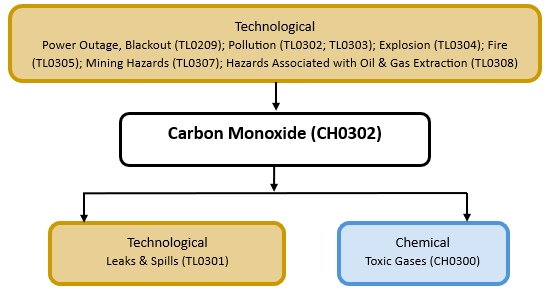
The figure below summarises common interactions between carbon monoxide and other hazards. This information should be used with caution and not be solely relied upon in Disaster Risk Management, particularly as some interactions may not have been included. Note that hazardous events occurring together or locally in space or time may not necessarily cause, amplify or be otherwise related to each other. Specific examples of multi-hazard context can be found in the ‘Hazard drivers’ and ‘Impacts’ sections above.
Multi-hazard diagram
Risk Management
Measures to limit impacts of carbon monoxide exposure include:
- Encourage means to reduce exposure in the home and indoor environment by discouraging the use of solid fuels, such as charcoal and biomass and encouraging cooking in well-ventilated spaces.
- Educate emergency services, volunteers and others to eliminate the use of generators in confined spaces where people may be exposed. This is particularly relevant during emergency and disaster response and recovery activities where main power supplies are lost.
- Public awareness campaigns contribute to prevention of carbon monoxide poisoning in residential contexts.
- Consider regulating for safe installation of indoor heating appliances.
- Separate dwelling spaces from vehicle garages.
- Discourage the indoor running of combustion engine vehicles or require adequate ventilation where this is not possible.
- Avoid cigarette smoke and smoking (particularly pregnant women and children) as these are a source of carbon monoxide (and other hazardous chemicals).
Examples of early warning systems include detection and monitoring technologies such as CO detectors; environmental surveillance from fixed and mobile monitoring stations; and public health notifications using alert systems.
Monitoring
The section and the table below offer an overview of monitoring carbon monoxide. This information can be used for forecasting within a national early warning system (EWS). Since EWS capacities and processes differ across countries, the most current and specific information regarding EWS should be obtained from the appropriate national or regional agency/authority responsible for disaster management.
Which institution(s) produce(s) Disaster Risk Data/Information? | World Health Organisation (WHO) |
| How is the Hazard Observed/Monitored/Forecast? | Detection and monitoring technologies such as CO detectors; environmental surveillance from fixed and mobile monitoring stations; and public health notifications using alert systems. |
References
Anders, 1985. Anders, M. W. and Jakobsen, I. Biotransformation of halogenated solvents. Scand J Work Environ Health 1985;11(1):23-32. Accessed 9 May 2025.
ATSDR, 2012. Public Health Statement: Carbon monoxide (CAS#: 630-08-0). Agency for Toxic Substances & Disease Registry (ATSDR) Carbon Monoxide | Public Health Statement | ATSDR . Accessed 9 May 2025.
NOAA, 2016. Emergency Response Planning Guidelines. National Oceanic and Atmospheric Administration (NOAA). Accessed 11 May 2024.
UNECE, 2023. Globally Harmonised System (GHS) of Classification and Labelling of Chemicals (2023). United Nations Economic Commission for Europe (UNECE). Accessed 11 May 2024.
PHE, 2019. Carbon monoxide: Health effects, incident management and toxicology. Public Health England (PHW). Accessed 11 May 2024.
US EPA, no date. Acute exposure guideline levels (AEGLs) for airborne chemicals. United States Environmental Protection Agency (US EPA). Accessed 11 May 2024.
WHO, 1999. Environmental Health Criteria 213: Carbon monoxide. Second Edition. International Programme on Chemical Safety, World Health Organization (WHO). Accessed 11 May 2024.
WHO, 2000. Air quality guidelines, 2nd ed. Chapter 5.5: Carbon monoxide. World Health Organization (WHO). Accessed 11 May 2024.
WHO, 2010. Guidelines for indoor air quality: Selected pollutants. World Health Organization (WHO).