
Toxic Gases
Toxic gases are substances in the gaseous state that cause hazardous physiological effects when inhaled, affecting the respiratory, cardiovascular, and nervous systems, making them major public hazards (WHO 2000).
Primary reference(s)
WHO, 2000. Air Quality Guidelines for Europe, Second Edition (2000). World Health Organisation (WHO). Accessed 4 May 2024.
Annotations
Additional scientific description
Toxic gases work by complex mechanisms. Some toxic gases are naturally occurring, while others are produced as byproducts of industrial processes, combustion, or chemical reactions. Toxic gases include some that are naturally occurring ground gases released from magma in the ground, an example being radon. Polluted air is defined as air which contains gases and particles emitted to the atmosphere by a variety of human activities and natural sources or formed in the atmosphere. At critical levels toxic gases have harmful effects on human health, animals, plants and ecosystems, or reduce visibility and corrode materials, buildings and cultural heritage sites (HIPs EN0101-EN0103). This polluted air is mainly composed of particulate matter, ground level ozone (O3) and nitrogen dioxide (NO2).
Properties of toxic gases include their volatility, density and reactivity. Many toxic gases are highly volatile, meaning they can easily vaporise and spread through the air. Their density can affect their behaviour, for example a gas heavier than air settles in low-lying areas, while lighter gases rise. Toxic gases can also be highly reactive and can form more harmful compounds when they interact with other substances or environmental elements. They can also be naturally occurring, or produced as byproducts of industrial processes, combustion or chemical reactions. (ATSDR, 2024; EPA, 2024; NIOSH, 2020; WHO, 2000) The different classifications and examples include:
- Respiratory irritants: These gases destroy the mucosal barrier and produce inflammatory changes leading to a damaged respiratory tract. Examples are ammonia (HIP CH0301; ICSC 0414), chlorine (HIP CH0303; ICSC 0126), formaldehyde (ICSC 0275), hydrogen sulphide (ICSC 0165), methyl bromide (ICSC 0109), methyl isocyanate (ICSC 0004), phosgene (ICSC 0007) and sulphur dioxide (ICSC 0074).
- Systemic/chemical asphyxiants: Inhaling these gases at high concentrations act by displacing or excluding oxygen. They have specialised mechanisms, such as combining with haemoglobin or inhibiting cytochrome C oxidase causing inhibition of cell oxygen utilisation resulting in histotoxic anoxia, which causes significant systemic toxicity. Examples are carbon monoxide (HIP CH0302; ICSC 0023), carbon disulfide (ICSC 0022) and hydrogen cyanide (ICSC 0494).
- Volatile compounds: Once absorbed, these compounds have little or no irritant effect; they act like anaesthetic agents, or they may exhibit toxicity towards the liver, kidneys, etc. Examples are anaesthetic gases; aliphatic, aromatic and halogenated hydrocarbon gases.
Metrics and numeric limits
Limits for air contaminants (OSHA, 2013; OSHA, 2017a, b; OSHA, 2021):
- Chlorine:1 ppm; 3 mg/m3
- Hydrogen cyanide: 10 ppm; 11 mg/m3
- Methyl bromide: 20 ppm; 80 mg/m3
- Methyl isocyanate: 0.02 ppm; 0.05 mg/m3
- Phosgene: 0.05 ppm
- Sulphur dioxide: 5 ppm; 13 mg/m3
8-hour time weighted average:
- Formaldehyde: 0.5 ppm
- Phosphene: 0.3 ppm (0.4 mg/m3)
Acceptable ceiling concentration:
- Hydrogen sulphide: 20 ppm
Key relevant UN convention / multilateral treaty
Organisation for the Prohibition of Chemical Weapons (OPCW), Chemical Weapons Convention (OPCW, 2024a,b).
United Nations Environment Programme (UNEP), Basel Convention on the Control of Transboundary Movements of Hazardous Wastes and Their Disposal (UNEP, 2011).
United Nations Environment Programme (UNEP), Rotterdam Convention on the Prior Informed Consent (PIC) Procedure for Certain Hazardous Chemicals and Pesticides in International Trade (UNEP, 2010).
United Nations Environment Programme (UNEP), Stockholm Convention on Persistent Organic Pollutants (POPs) (UNEP, 2019).
World Health Organization (WHO), International Health Regulations (WHO, 2016).
World Health Organization (WHO), Environmental Health Criterion (WHO, 1981).
Drivers
In industry, chemical manufacturing processes often use gases during production, and can release gases such as carbon dioxide. The Dakar Ammonia Accident in 1992, where ammonia was used to detoxify the peanut oil product, involved a pressurised overfilled, poorly repaired ammonia tank which failed releasing 22 tonnes of ammonia. In this incident, there were 129 lives lost, with 1,150 other workers and citizens injured.
Another driver of toxic gases is their transportation, which can lead to accidental releases, particularly in the case of chemical spills or accidents involving tankers. Agricultural practices and waste management can also drive the release of toxic gases, such as ammonia and hydrogen sulphide from certain pesticides and fertilisers, and improper handling and disposal of hazardous wastes, leading to environmental contamination and human exposure. (EPA, 2024; NIOSH, 2020; WHO, 2000)
Some toxic gases are naturally occurring and can be released or created upon natural disasters, such as volcanic eruptions, wildfires, and certain geological formations. Examples of natural disasters include limnic eruptions, where dissolved carbon dioxide suddenly erupts from the deep waters of lakes. Carbon monoxide is also often released during power outages, including load shedding. (CDC, 2024)
Impacts
Impacts of toxic gases include human health effects from inhalation; harm to ecosystems, soil quality, water quality and biodiversity, leading to long-term environmental degradation; economic losses due to cleanup and remediation efforts, healthcare expenses, property damage, and loss of productivity; and evacuations causing displacement of communities and social unrest. (EPA, 2024; NIOSH, 2020; WHO, 2000)
Multi-hazard context
The figure below summarises common interactions between toxic gases and other hazards. This information should be used with caution and not be solely relied upon in Disaster Risk Management, particularly as some interactions may not have been included. Note that hazardous events occurring together or locally in space or time may not necessarily cause, amplify or be otherwise related to each other. Specific examples of multi-hazard context can be found in the ‘Hazard drivers’ and ‘Impacts’ sections above.
Multi-hazard diagram
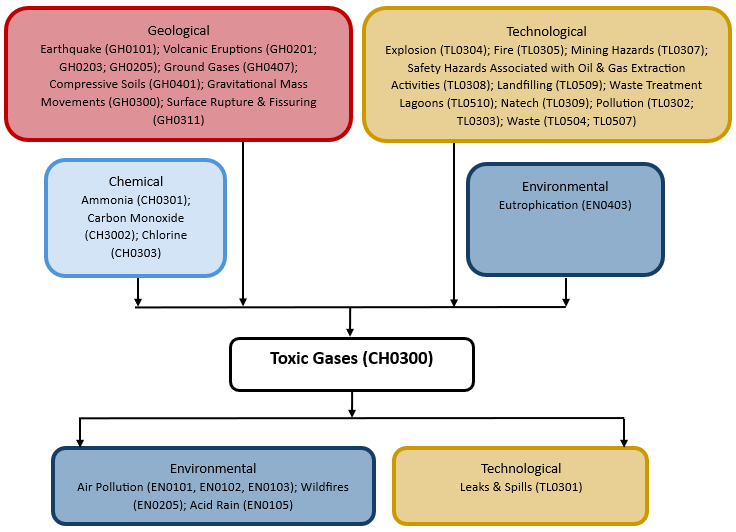
Risk Management
Risk management strategies include implementing engineering work to minimise toxic gas generation and release. Air quality monitoring systems and gas detection technologies can be used to detect and respond to toxic gas leaks or releases promptly. Also developing emergency response plans, conducting drills, and providing training to personnel can mitigate impacts of incidents. Reporting of emissions and releases is vital for adhering to regulatory requirements and standards. Educating the public about the risks and encouraging community engagement in pollution prevention efforts can minimise risks of toxic gases. (EPA, 2024; NIOSH, 2020; WHO, 2000)
Monitoring
The section and the table below offer an overview of monitoring toxic gases. This information can be used for forecasting within a national early warning system (EWS). Since EWS capacities and processes differ across countries, the most current and specific information regarding EWS should be obtained from the appropriate national or regional agency/authority responsible for disaster management.
| Which institution(s) produce(s) Disaster Risk Data/Information? | Depending on the source of the gases, national geological agency, private company, fire management services |
| How is the Hazard Observed/Monitored/Forecast? | Detectors and sensors; communication systems; monitoring and control centres |
References
Australia Group, 2021a. Australia Group Common Control List Handbook: Volume 1: Chemical Weapons-Related Common Control Lists, Revision 6. Accessed 6 April 2024.
Australia Group, 2021b. Australia Group Common Control List Handbook: Volume 2: Biological Weapons-Related Common Control Lists, Revision 6. Accessed 6 April 2024.
ATSDR, 2024. Toxicological Profiles (2024). Agency for Toxic Substances and Disease Registry (ATSDR). Accessed 4 May 2024.
CDC, 2024. Carbon monoxide poisoning Fact sheets and other resources. Center for Disease Control and Prevention (CDC). Fact Sheets and Other Resources | Carbon Monoxide Poisoning | CDC Accessed 15 May 2025.
EPA, 2024. Hazardous Air Pollutants (2024). United States Environmental Protection Agency (EPA). Accessed 4 May 2024.
ICSC 2024. International Chemical Safety Cards (ICSC). International Labour Organization (ILO). Accessed 29 Aug 2024.
NIOSH, 2020. NIOSH Pocket Guide to Chemical Hazards (2020). The National Institute for Occupational Safety and Health (NIOSH). Centre for Disease Control and Prevention (CDC). Accessed 4 May 2024.
OPCW, 2024a. Chemical Weapons Convention: Article II: Definitions and criteria. Organisation for the Prohibition of Chemical Weapons (OPCW). Accessed 6 April 2024.
OPCW, 2024b. Chemical Weapons Convention: Verification Annex, Part IV(A), paras. 15-19. Organisation for the Prohibition of Chemical Weapons (OPCW). Accessed 6 April 2024.
OSHA, 2013. 1910.1048 Formaldehyde. Occupational Safety and Health Administration. Accessed 14 April 2024.
OSHA, 2017a. 1910.1000 Table Z-1. Occupational Safety and Health Administration. Accessed 14 April 2024.
OSHA, 2017b. 1910.1000 Table Z-2. Occupational Safety and Health Administration. Accessed 14 April 2024.
OSHA, 2021. Phosphine (2021). Occupational Safety and Health Administration. Accessed 14 July 2024.
UNECE, 2023. Globally Harmonised System (GHS) of Classification and Labelling of Chemicals (2023). United Nations Economic Commission for Europe (UNECE). Accessed 11 May 2024.
UNEP, 2011. Basel Convention on the Control of Transboundary Movements of Hazardous Wastes and Their Disposal (2011). United Nations Environment Programme (UNEP). Accessed 4 May 2024.
UNEP, 2010. Rotterdam Convention on the Prior Informed Consent (PIC) Procedure for Certain Hazardous Chemicals and Pesticides in International Trade (2010). United Nations Environment Programme (UNEP). Accessed 4 May 2024.
UNEP, 2019. Stockholm Convention on Persistent Organic Pollutants (POPs) (2019). United Nations Environment Programme (UNEP). Accessed 4 May 2024.
WHO, 1981. Environmental Health Criteria 19 (1981). World Health Organization. Accessed 30 April 2024.
WHO, 2016. International Health Regulations (2005), Third Edition. World Health Organization (2016). Accessed 30 April 2024.
WHO, 2000. Air Quality Guidelines for Europe, Second Edition (2000). World Health Organisation (WHO). Accessed 4 May 2024.