Fluoride and Iodine/Iodide Excess or Inadequate Intake
Fluoride is a naturally occurring mineral to which the public are often exposed via drinking water. Depending on dose intake, fluoride may have both beneficial effects (reducing the incidence of dental caries) or negative effects (causing tooth enamel and skeletal fluorosis following prolonged high exposure) (adapted from NCBI, 2020 and WHO, no date). Some water supplies are fluoridated in order to achieve improved dental health.
Iodine is a non-metallic element essential for the human body, as it is a crucial component of thyroid hormones, which regulate various metabolic processes, including growth and energy expenditure. Iodine, usually as iodide salts in the diet, is absorbed throughout the gastrointestinal tract. Iodine is essential for healthy brain development in the foetus and young child. A deficiency in iodine can lead to thyroid gland problems, such as goitre and hypothyroidism. Iodine deficiency negatively affects the health of women, as well as economic productivity and quality of life (WHO, 2023). Food fortification (often with potassium iodide, KI) is sometimes used to address iodine deficiency.
Primary reference(s)
NCBI, 2020. PubChem Fluoride Compound Summary for CID 19800730. National Center for Biotechnology Information (NCBI). Accessed 8 October 2020.
WHO, no date. Inadequate or excess fluoride. World Health Organization (WHO). Accessed 8 October 2020.
WHO, 2023. Iodization of salt for the prevention and control of iodine deficiency disorders. Accessed 31 July, 2024.
Annotations
Additional scientific description
Fluorine and iodine, together with chlorine, bromine, astatine and tennessine are elements from Group 17 in the Periodic Table, also known as the Halogen family. Halides, the anions from Group 17 such as fluoride, chloride, bromide, iodide, etc., are considered additionally as phytotoxic air pollutants and can have a severe impact on health at high or low concentrations.
Fluoride is the anion (negatively charged ion with the symbol “F-“ of fluorine (chemical element with the symbol “F” and atomic number 9), and it is found in various forms, both in nature and in synthetic products. Fluoride can be released into the environment in several ways: (i) natural activities, such as volcanic emissions, weathering of minerals and dissolution, particularly into groundwater; (ii) human activities, such as the production and use of phosphate fertilizers; manufacture and use of hydrofluoric acid and production of aluminium, steel and oil; and (iii) remobilization of historic sources, such as water flow and sediment movement from aluminium production plants. The beneficial effect of fluoride includes minimization of tooth decay and caries. Public health action to provide sufficient fluoride intake can be achieved through drinking water fluoridation or, when this is not possible, through salt or milk fluoridation or use of dental care products containing fluoride (WHO, no date). Excessive fluoride intake usually occurs through the consumption of groundwater naturally rich in fluoride, particularly in warm climates where water consumption is greater, or where high-fluoride water is used in food preparation or irrigation of crops such as rice. In these areas, means should be sought to manage intakes by providing drinking-water with a moderate (i.e., safe) fluoride level or using alternative sources of water for drinking, cooking or irrigation. The preparation of food using fluoride-rich coal also contributes to excessive fluoride intake via ingestion and inhalation (WHO, 2019). |
Iodine is a chemical element with the symbol "I" and atomic number 53. Iodine is essential for healthy brain development in the foetus and young children. Iodine deficiency negatively affects the health of women, as well as economic productivity and quality of life. Iodine physiologic role in the human body is in the synthesis of thyroid hormones by the thyroid gland. Dietary iodine is converted into the bio-available iodide ion "I-" before it is absorbed from food and water, enters the circulation as plasma inorganic iodide, which is cleared from circulation by the thyroid and kidney. Excess iodide is excreted by the kidney with urine. For determining the iodine requirements, the important indexes are serum T4 and TSH levels (indicating normal thyroid status) and urinary iodine excretion (FAO 2002). Most people need an additional source of iodine as it is found in relatively small amounts in the diet. Iodization is the process of fortifying salt for human consumption with iodine and is an effective strategy to increase iodine intake at the population level. Monitoring the levels of iodine in salt and the iodine status of the population are critical for ensuring that the population's needs are met and not exceeded. Iodine contamination poses significant health risks, including thyroid dysfunction and increased cancer risk, particularly from radioactive isotopes like iodine-131 (CDC, 2024). Environmental impacts include disruption of aquatic ecosystems and soil quality degradation (Cox et al. 2014). Effective monitoring and management strategies are essential to mitigate these risks and protect both public health and the environment. |
Metrics and numeric limits
Fluoride World Health Organization (WHO) fluoride guideline values (WHO, 2019): Drinking-water: The guideline value for fluoride in drinking water is 1.5 mg/l, based on increasing risk of dental fluorosis at higher concentrations and that progressively higher levels of fluoride lead to increasing risk of skeletal fluorosis. This value is higher than that recommended for artificial fluoridation of water supplies for prevention of dental caries, which is usually 0.5-1.0 mg/l. The WHO recommends that, in setting a standard, Member States should take into account drinking-water consumption and fluoride intake from other sources. Air: The guideline value is 1 μg/m3 (developed to prevent effects on livestock and plants, and is also considered sufficiently protective of human health). |
Iodine / Iodide World Health Organization (WHO) iodine deficiency values. From: Vitamin and Mineral Nutrition Information System (VMNIS). Micronutrients database (http://www.who.int/vmnis/database/en/) Accessed 31 July 2024. Iodine deficiency measured by median urinary iodine concentration (μg/L) in school-age children (≥6 years): <20 μg/L - Insufficient - Severe deficiency, 20-49 μg/L - Insufficient - Moderate deficiency, 50-99 μg/L - Insufficient - Mild deficiency, 100- 199 μg/L - Adequate, Adequate iodine nutrition, 200-299 μg/L - Above requirements - May pose a slight risk of more than adequate iodine intake in these populations, ≥300 μg/L - Excessive - Risk of adverse health consequences (e.g. iodine-induced hyperthyroidism or autoimmune thyroid disease). Iodine deficiency measured by median urinary iodine concentration (μg/L) in pregnant women: <150 μg/L - Insufficient, 150-249 μg/L - Adequate, 250-499 μg/L - Above requirements, ≥500 μg/L - Excessive. Iodine deficiency measured by median urinary iodine concentration (μg/L) in lactating women and children aged <2 years: <100 μg/L - Insufficient, ≥100 μg/L - Adequate |
Key relevant UN convention / multilateral treaty
The World Health Organization (WHO), United Nations Children's Fund (UNICEF), and other international bodies advocate for universal salt iodization (USI) as a strategy to eliminate iodine deficiency disorders (IDD) globally.
Drivers
Fluoride contamination: Natural Sources: Geological Activity and Hot Springs. Anthropogenic (Human-Caused) Sources: Industrial Processes, Agricultural Activities, and Coal Burning.
Iodine contamination: Natural Sources: Geological Activity and Hot Springs. Anthropogenic (Human-Caused) Sources: Industrial Processes, Agricultural Activities, and Coal Burning. In addition, iodine release into the atmosphere could occur from volcanic eruptions, which eventually deposits onto land and water bodies. Iodine-131, a radioactive isotope of iodine, can be released during nuclear accidents or improper disposal of nuclear waste, leading to contamination of air, soil, and water.
Impacts
Fluoride contamination: Two worldwide public health concerns related to fluoride need to be addressed: the need to reduce dental caries and the need to mitigate the effects of excessive fluoride intake. Thus, public health actions are required to provide sufficient fluoride intake where this is lacking, to minimize tooth decay, as well as to provide drinking water with a moderate (i.e., safe) fluoride level in areas where groundwater contains high fluoride levels (WHO, 2019).
To provide guidance on the need to control population exposure to fluoride and establish the balance between caries prevention and protection against adverse effects of fluoride, community health programmers can estimate total exposure by measuring renal fluoride excretion and compare these levels with established optimal levels using methods published by the WHO. However, risk mitigation measures implemented should also take into consideration local contexts and sensitivities (WHO, 2019).
Iodine contamination on human health: Thyroid Dysfunction: Both excessive and insufficient iodine intake can disrupt thyroid function. Excessive iodine can lead to hyperthyroidism, while insufficient iodine can cause hypothyroidism and goitre. Iodine Toxicity: Acute iodine toxicity can result from high levels of iodine intake, leading to symptoms such as abdominal pain, vomiting, and diarrhoea. Chronic exposure to high iodine levels may cause more severe health issues, including thyroiditis and thyroid cancer. Radioactive Iodine Exposure: Exposure to iodine-131 from nuclear accidents can increase the risk of thyroid cancer, particularly in children.
Multi-hazard context
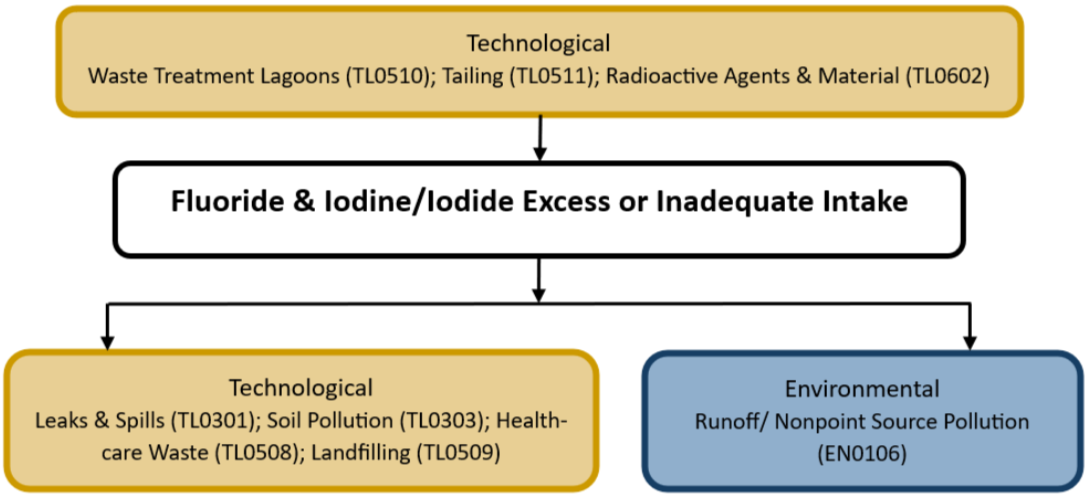
The figure below summarises common interactions between fluoride and Iodine/iodide excess or inadequate intake and other hazards. This information should be used with caution and not be solely relied upon in Disaster Risk Management, particularly as some interactions may not have been included. Note that hazardous events occurring together or locally in space or time may not necessarily cause, amplify, or be otherwise related to each other. Specific examples of multi-hazard context can be found in the ‘Hazard drivers’ and ‘Impacts’ sections above.
Multi-hazard diagram
Risk Management
The WHO recommends (WHO, 2019) that the following actions are required to provide adequate fluoride or control excess through the following measures.
Inadequate fluoride intake:
- Fluoridating low-fluoride drinking water where practicable, as well as considering alternatives, such as salt or milk fluoridation.
- Reduce the incidence of dental caries by: Developing effective and affordable fluoridated toothpastes for use in developing countries. Promoting optimal oral hygiene, based on the use of effective fluoridated toothpaste, guidance on the amount of fluoridated toothpaste to and exposure to other sources of fluoride in the community. Supporting the use of silver diamine fluoride and atraumatic restoration treatment, and other minimally invasive techniques, using glass ionomer cement to stabilize caries lesions.
Irrespective of fluoride exposure, advocating a low-sugar diet in accordance with the WHO recommendation that free (added) sugars should not exceed 10% of total energy intake by both adults and children (strong recommendation); the WHO further suggests reduction to below 5% of total energy intake (conditional recommendation).
Excess fluoride:
- Where practicable, monitor the prevalence of enamel fluorosis using scoring guidance systems such as those developed by the WHO.
- Provide drinking water with fluoride levels that do not produce adverse health effects, by:
- Seeking alternative water sources in areas with fluoride-rich groundwater, particularly where water consumption is high due to elevated temperatures.
- Defluoridation of water for drinking and cooking, where an alternative source is not an option, using methods such as bone charcoal adsorption, contact precipitation, coagulation–flocculation/ sedimentation using aluminum sulphate (Nalgonda process), activated alumina adsorption and clay considering local context. Research the appropriateness of community fluoridation schemes in view of natural fluoride levels in water. Water Treatment Technologies for iodine removal include activated carbon filtration, reverse osmosis, ion exchange or alternative water sources.
- Setting Standards: Governments and regulatory bodies should establish and enforce guidelines for maximum allowable fluoride levels in drinking water and industrial emissions.
- Monitor fluoride levels in the environment, especially in areas where there is exposure to elevated fluoride levels due to human activities and determine the overall exposure to fluoride.
- Encourage mothers to breastfeed, even in areas with high fluoride intake because breast milk is optimal for infant health and usually low in fluoride.
Discourage the use of fluoride-rich coal for cooking purposes.
The WHO recommends (WHO, 2019) that the following actions are required to provide adequate iodine or control excess through the following measures
Inadequate iodine intake:
- Awareness and Education: Public health campaigns can educate communities on the risks of iodine contamination, safe iodine intake levels, and the importance of proper monitoring.
- Iodine Supplementation Programs: In regions where iodine deficiency is a concern, carefully managed iodine supplementation programs can help ensure adequate iodine intake without exceeding safe levels.
Excess iodine:
- Monitor iodine levels in the environment, especially in areas where there is exposure to elevated iodine levels due to human activities and determine the overall exposure to iodine.
- Implement Nuclear Safety Regulations: Stricter regulations and safety measures should be in place to prevent the release of radioactive iodine from nuclear facilities and ensure proper disposal of nuclear waste.
Monitoring
The section and the table below offer an overview of monitoring fluoride and Iodine/iodide excess or inadequate intake. This information can be used for forecasting within a national early warning system (EWS). Since EWS capacities and processes differ across countries, the most current and specific information regarding EWS should be obtained from the appropriate national or regional agency/authority responsible for disaster management.
| Which institution(s) produce(s) Disaster Risk Data/Information? | World Health Organization (WHO): “Guidelines for Drinking-water Quality". Food and Agriculture Organization of the United Nations (FAO): “Global assessment of soil pollution Report”. Environmental Protection Agency (EPA): "National Primary Drinking Water Regulations”. |
| How is the Hazard Observed/Monitored/Forecast? | WHO provides comprehensive guidelines on the permissible levels of various contaminants, including fluoride and iodide, in drinking water to ensure safety and health. EPA sets standards for drinking water contaminants, including fluoride and iodide, under the Safe Drinking Water Act. These regulations ensure the safety of public drinking water supplies in the United States. |
References
Agency for Toxic Substances and Disease Registry (ATSDR). (2020). "Toxicological Profiles." - Provides detailed information on the health effects of various hazardous substances, including trace elements. (Available at ATSDR Profiles) Accessed 20 July 2024.
Agency for Toxic Substances and Disease Registry (ATSDR), 2003. Agency for Toxic Substances and Disease Registry (ATSDR): "Toxicological Profile for Fluorides, Hydrogen Fluoride, and Fluorine". Provides detailed information on the toxicology of fluoride compounds, their health effects, and safety guidelines. Accessed 20 July 2024.
Cox, E.M. & Arai, Y. 2014: "Chapter Two - Environmental Chemistry and Toxicology of Iodine," Advances in Agronomy, Academic Press, Volume 128, Pages 47-96.
Environmental Protection Agency (EPA), 2024. Environmental Protection Agency (EPA): "National Primary Drinking Water Regulations". Sets standards for drinking water contaminants, including fluoride and iodide, under the Safe Drinking Water Act. These regulations ensure the safety of public drinking water supplies in the United States. Accessed 20 July 2024.
European Chemicals Agency (ECHA), no date. The ECHA website offers specific classification and labeling information for various substances, including trace elements. (Available at ECHA Website) Accessed 20 July 2024.
European Union (EU). (1998). "Council Directive 98/83/EC on the quality of water intended for human consumption." - Sets standards for drinking water quality in the EU. (Available at EU Directive) Accessed 20 July 2024.
FAO, 2022. Human Vitamin and Mineral Requirements. Accessed 7 August 2024.
National Research Council, 2006. "Fluoride in Drinking Water: A Scientific Review of EPA's Standards" Washington, DC: The National Academies Press. Discusses the presence of fluoride in drinking water, its sources, health impacts, and mitigation strategies. Accessed 20 July 2024.
National Center for Biotechnology Information (NCBI), 2020. PubChem Fluoride Compound Summary for CID 19800730. National Center for Biotechnology Information (NCBI). Accessed 31 July 2024.
Occupational Safety and Health Administration (OSHA) - OSHA's hazard communication provide practical information on hazard classification and labeling. (Available at OSHA Hazard Communication) Accessed 20 July 2024.
Toxicological Profile for Iodine, 2004. Offers comprehensive data on the health effects, exposure risks, and safety measures related to iodine and iodide compounds. Accessed 20 July 2024.
United Nations Economic Commission for Europe (UNECE), 2023. Globally Harmonised System (GHS) of Classification and Labelling of Chemicals (2023). United Nations Economic Commission for Europe (UNECE). Accessed 11 May 2024.
United Nations Environment Program (UNEP): "Global Environment Monitoring System for Freshwater (GEMS/Water)". UNEP’s GEMS/Water program provides data and guidelines on water quality, including the monitoring of fluoride and iodide and other contaminants in freshwater systems. Accessed 20 July 2024.
United States Center for Disease Control (CDC): "Iodine-131". Overview of Iodine-131. Accessed 8 August 2024.
United States Environmental Protection Agency (EPA), 2021a. "National Primary Drinking Water Regulations." - Establishes legal limits on the levels of certain contaminants in drinking water. (Available at EPA Regulations) Accessed 20 July 2024.
United States Environmental Protection Agency (EPA), 2021b. "Regional Screening Levels (RSLs) for Chemical Contaminants at Superfund Sites." - Offers risk-based concentrations for contaminants in soil and other media. (Available at EPA RSLs) Accessed 20 July 2024.
World Health Organization (WHO), no date. Inadequate or excess fluoride. World Health Organization (WHO). Accessed 31 July 2024.
World Health Organization (WHO), 2017. World Health Organization (WHO): "Guidelines for Drinking-water Quality". Provides comprehensive guidelines on the permissible levels of various contaminants, including fluoride and iodide, in drinking water to ensure safety and health. Accessed 20 July 2024.
World Health Organization (WHO), 2019. Inadequate or excess fluoride: A major public health concern. World Health Organization (WHO). WHO/CED/PHE/EPE/19.4.5. Accessed 31 July 2024.