
Heavy Metals and Other Trace Elements
Heavy metals are metallic trace elements with either high relative atomic weights or occurring in materials with high densities. Trace Elements is the term used for elements that are generally found in soil at low concentrations but can still have significant impacts on human health and ecosystems when their levels exceed safe limits, as in the case of many heavy metals. Trace element contaminants that have biological significance are generally found in soil at concentrations of less than 100 mg/kg, and sometimes in aquatic ecosystems or as particulates in the atmosphere. Biological significance would include elements that are essential or toxic to any organism; some elements can be both, depending on their concentration. Many of the trace elements of importance are metals, while others are metalloids, alloys, non-metals, actinoids, and halogens occurring in a variety of chemical states (elemental, cations, anions, oxyanions, methylated, etc.). This category can overlap or be used synonymously with terms such as potentially toxic elements, heavy metals, persistent inorganic contaminants, and inorganic contaminants, and halides, such as fluoride and iodide. For the clarity of this document, the term trace elements will be used (FAO and UNEP, 2021a).
Primary reference(s)
FAO and UNEP. 2021a. Global assessment of soil pollution. Report. Rome, FAO. Accessed 20 July 2024
Annotations
Additional scientific description
Trace elements can become contaminants when their concentrations significantly exceed natural levels due to anthropogenic activities, such as industrial processes, mining, agriculture, and waste disposal. These contaminants can accumulate in soil, water, and biota, potentially causing adverse effects on ecosystems and human health.
- Essential Trace Elements: These are elements required in small amounts for normal physiological functions. Examples include iron (Fe), zinc (Zn), copper (Cu), and selenium (Se).
- Non-Essential or Toxic Trace Elements: These are elements that can be toxic to organisms even at low concentrations. See other Hazard Information Profiles for examples, which include lead (Pb, CH0103), mercury (Hg, CH0104), cadmium (Cd, CH0102), and arsenic (As, CH0101).
- Metals: The term "metal health hazard" refers to the potential risks posed to human health by exposure to metallic substances. Metals are naturally occurring elements that are found in various forms in the environment, and while many metals are essential for life and have beneficial uses, some can be harmful when encountered in certain forms or concentrations. Health hazards associated with metals can result from exposure through inhalation, ingestion, or skin contact, depending on factors such as the specific metal involved, its chemical form, and the duration and intensity of exposure. Some common occurrences of metals: Ores, Mineral Deposits, Soil and Sediments, Water Bodies, Vegetation, Atmosphere, Manufactured Products, Waste and Recycling.
- Metalloids: elements that exhibit some metal and some nonmetal properties.
- Alloys: Metals can be combined with other elements to form alloys, which often exhibit properties superior to those of the individual elements. Common alloys include brass (copper and zinc), bronze (copper and tin), stainless steel (iron, chromium, and nickel), and aluminum alloys.
- Non-Metal Contaminants: elements or ions that have the potential to be contaminants in soil and water. Because of their high ionic potential, non-metals of Groups 13 to 16 of the Periodic Table in their normal oxidation states form oxyanions.
- Halides, the anions from Group 17 such as fluoride, chloride, bromide, and iodide are considered additionally as phytotoxic air pollutants and can have a severe impact on health at high concentrations. High bromide concentrations can have lethal effects on aquatic organisms. In addition, halides are scavengers of hydroxyl radical during advanced oxidation processes, reducing efficiency of several water treatment efforts.
Unlike organic contaminants, which can be degraded when metabolized by different organisms, trace elements cannot be degraded by metabolic processes. However, an essential peculiarity of trace elements is the potential to exist as different species (e.g. different oxidation states as in chromium III/chromium VI or arsenic III / arsenic V) and the tendency to form bioavailable metal-organic compounds (e.g. methylmercury or tetramethyl-lead), which effectively determines the bioavailability and toxicity. In practice, most assessments of trace elements measure and report total concentrations (e.g. of chromium) rather than the specific chemical form of the element (e.g. chromium III or chromium VI) due to the complexity of analyses and interpretation of sequential extraction methods in laboratories.
Fluoride, a non-metal contaminant, is a naturally occurring mineral to which the public is often exposed via drinking-water. Depending on the dose intake, fluoride may have both beneficial effects (reducing the incidence of dental caries) or negative effects (causing tooth enamel and skeletal fluorosis following prolonged high exposure) (adapted from NCBI, 2020 and WHO, no date), see CH0105.
Iodide, contamination poses significant health risks, including thyroid dysfunction and increased cancer risk, particularly from radioactive isotopes like iodine-131. Environmental impacts include disruption of aquatic ecosystems and soil quality degradation. Effective monitoring and management strategies are essential to mitigate these risks and protect both public health and the environment, see CH0105.
Metrics and numeric limits
Guidance values are complex but in summary the following may be helpful:
- Arsenic: Limits range from 10 µg/L in drinking water to 0.39 mg/kg in residential soil.
- Cadmium: Limits range from 3-5 µg/L in drinking water to 0.43 mg/kg in residential soil.
- Lead: Limits are typically around 10-15 µg/L in drinking water and 400 mg/kg in soil.
- Mercury: Limits range from 1-6 µg/L in drinking water to 1.3 mg/kg in residential soil.
- Chromium: Limits range from 50-100 µg/L in drinking water to 0.3 mg/kg for Cr(VI) in residential soil.
- Fluoride: The guideline value for fluoride in drinking water is 1.5 mg/l. In air: the guideline value is 1 μg/m3.
- Iodide: The Tolerable Upper Intake Level (UL) for iodine intake for adults is 1,100 micrograms per day. Permissible Exposure Limit according to OSHA for iodine in the workplace is 0.1 parts per million. Iodine-131 (a radioactive isotope of iodine) in drinking water with an MCL of 3 picocuries per liter (pCi/L).
Key relevant UN convention / multilateral treaty
Basel Convention: Controls transboundary movement of hazardous wastes including trace elements.
Rotterdam Convention: Implements prior informed consent for hazardous chemicals, including certain trace elements.
Stockholm Convention: Focuses on persistent pollutants, including some trace elements.
Minamata Convention: Specifically targets mercury, a key trace element.
CLRTAP: Addresses air pollution, including heavy metals like lead, cadmium, and mercury.
Drivers
Hazard Ddrivers of heavy metal/trace element contamination include:
(1) Industrial Activities; Example: Mining, quarrying, and smelting of metals can release trace elements such as lead (Pb), cadmium (Cd), and arsenic (As) into the environment.
(2) Agricultural Practices; Example: The use of phosphate fertilizers can introduce cadmium (Cd) into soils.
(3) Urbanization and Infrastructure Development; Example: Construction activities can lead to increased levels of trace elements such as chromium (Cr) and lead (Pb) from building materials, road construction and waste.
(4) Waste Management Practices; Example: Inadequate disposal and treatment of electronic waste and used batteries can release trace elements such as mercury (Hg) and lead (Pb) into the environment.
(5) Climate Change. Example: Increased temperature and precipitation can alter the mobility and bioavailability of trace elements, affecting their distribution and concentration.
(6) Disasters: Example: Flooding can mobilize trace elements from contaminated soils and sediments into water supplies.
Impacts
(1) Environmental Impact; Example: Bioaccumulation of mercury (Hg) in aquatic ecosystems can harm wildlife and disrupt food chains.
(2) Human Health Effects; Example: Chronic exposure to arsenic (As) in drinking water can lead to skin lesions, cancer, and cardiovascular diseases.
(3) Soil Degradation; Example: Accumulation of cadmium (Cd) in agricultural soils can reduce soil fertility and crop yields.
(4) Economic Impact; Example: Contaminated land may require expensive remediation efforts, affecting property values and development potential.
Multi-hazard context
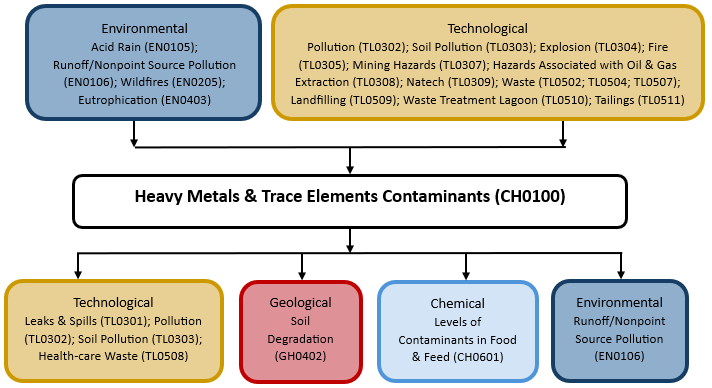
The figure below summarises common interactions between heavy metals & trace elements and other hazards. This information should be used with caution and not be solely relied upon in Disaster Risk Management, particularly as some interactions may not have been included. Note that hazardous events occurring together or locally in space or time may not necessarily cause, amplify, or be otherwise related to each other. Specific examples of multi-hazard context can be found in the ‘Hazard drivers’ and ‘Impacts’ sections above.
Multi-hazard diagram
Risk Management
(1) Regulation and Legislation; Example: The European Union's REACH (Registration, Evaluation, Authorisation, and Restriction of Chemicals) regulation controls the use of hazardous substances, including trace elements.
(2) Pollution Prevention and Control; Example: Implementing best practices in industrial processes to minimize emissions of trace elements.
(3) Environmental Monitoring and Assessment; Example: Regular monitoring of soil, water, and air to detect and quantify trace element contamination.
(4) Remediation and Cleanup; Example: Using phytoremediation to clean up soils contaminated with heavy metals such as cadmium (Cd) and lead (Pb).
(5) Public Awareness and Education; Example: Educating communities about the risks of trace elements and promoting safe practices.
Monitoring
The section and the table below offer an overview of monitoring heavy metals & trace elements. This information can be used for forecasting within a national early warning system (EWS). Since EWS capacities and processes differ across countries, the most current and specific information regarding EWS should be obtained from the appropriate national or regional agency/authority responsible for disaster management.
Which institution(s) produce(s) Disaster Risk Data/Information? | Water Agencies, Health Agencies, Environmental Agencies, Food & Agriculture Agencies |
| How is the Hazard Observed/Monitored/Forecast? | Monitoring Technologies can be used to detect heavy metals and trace element levels in water, soil and air both in staggered and in real-time; Fixed and portable sensors, such as ion-selective electrodes and spectrophotometers, could provide accurate and continuous measurements for data analysis. Data from these sensors are collected and analyzed through automated systems, which trigger immediate alerts when contamination level excess safe threshold. |
References
Agency for Toxic Substances and Disease Registry (ATSDR), (2020). "Toxicological Profiles." - Provides detailed information on the health effects of various hazardous substances, including trace elements. (Available at ATSDR Profiles) Accessed 20 July 2024.
Agency for Toxic Substances and Disease Registry (ATSDR), 2003. Agency for Toxic Substances and Disease Registry (ATSDR): "Toxicological Profile for Fluorides, Hydrogen Fluoride, and Fluorine". Provides detailed information on the toxicology of fluoride compounds, their health effects, and safety guidelines. Accessed 20 July 2024.
Codex Alimentarius Commission. 2014. Report of the Eighth Session of the Codex Committee on Contaminants in Foods. Joint FAO/WHO Food Standards Programme Codex Alimentarius Commission 37th Session Geneva, Switzerland
Environmental Protection Agency (EPA) 2024. Environmental Protection Agency (EPA): "National Primary Drinking Water Regulations". Sets standards for drinking water contaminants, including fluoride and iodide, under the Safe Drinking Water Act. These regulations ensure the safety of public drinking water supplies in the United States. Accessed 20 July 2024.
European Chemicals Agency (ECHA) - The ECHA website offers specific classification and labeling information for various substances, including trace elements. (Available at ECHA Website) Accessed 20 July 2024.
European Union (EU). (2020). "Directive (EU) 2020/2184 of the European Parliament and of the Council of 16 December 2020 on the quality of water intended for human consumption (recast)." Accessed 2 May 2025.
Food and Agriculture Organization (FAO) and United Nations Environment Programme (UNEP), 2021b. Global Assessment of soil Pollution—Summary for Policy Makers. FAO, Rome, ISBN 978-92-5-134448-4.
National Research Council, 2006. "Fluoride in Drinking Water: A Scientific Review of EPA's Standards" Washington, DC: The National Academies Press. Discusses the presence of fluoride in drinking water, its sources, health impacts, and mitigation strategies. Accessed 20 July 2024.
National Center for Biotechnology Information (NCBI), 2020. PubChem Fluoride Compound Summary for CID 19800730. National Center for Biotechnology Information (NCBI). Accessed 20 July 2024.
Occupational Safety and Health Administration (OSHA) - OSHA's hazard communication provide practical information on hazard classification and labeling. (Available at OSHA Hazard Communication) Accessed 20 July 2024.
Rodríguez Eugenio, N., McLaughlin, M.J. & Pennock, D. 2018. Soil pollution: a hidden reality. Rome, Italy, Food and Agriculture Organization of the United Nations.
Toxicological Profile for Iodine, 2004. Offers comprehensive data on the health effects, exposure risks, and safety measures related to iodine and iodide compounds. Accessed 20 July 2024.
United Nations Environment Program (UNEP): "Global Environment Monitoring System for Freshwater (GEMS/Water)". UNEP’s GEMS/Water program provides data and guidelines on water quality, including the monitoring of fluoride and iodide and other contaminants in freshwater systems. Accessed 20 July 2024.
United States Environmental Protection Agency (EPA). (2021). "National Primary Drinking Water Regulations." - Establishes legal limits on the levels of certain contaminants in drinking water. EPA Regulations Accessed 20 July 2024.
United States Environmental Protection Agency (EPA). (2021). "Regional Screening Levels (RSLs) for Chemical Contaminants at Superfund Sites." - Offers risk-based concentrations for contaminants in soil and other media. EPA RSLs Accessed 20 July 2024.
World Health Organization (WHO). (2017). "Guidelines for Drinking-water Quality, 4th Edition." - Provides recommended limits for various contaminants in drinking water, including trace elements. WHO Guidelines Accessed 20 July 2024.
WHO, no date. Inadequate or excess fluoride. World Health Organization (WHO). Accessed 20 July 2024.