Mercury
Mercury is a naturally occurring element that is found in air, water and soil. Exposure to mercury – even small amounts – may cause serious health problems and is a threat to the development of the foetus in utero and for children early in life (WHO, 2021).
Primary reference(s)
WHO, 2024. Mercury (WHO). Mercury. Accessed 2 May 2025.
Annotations
Additional scientific description
Mercury (chemical symbol Hg, atomic number 80) exists in various forms: elemental mercury (metallic or vapour) and inorganic mercury compounds (to which people may be exposed, for example, through their occupation); and organic (or organometallic) mercury compounds (for example, methylmercury, to which people may be exposed through their diet). These forms of mercury differ in their degree of toxicity and toxic effects (WHO, 2021).
Mercury occurs naturally in the Earth's crust (UNEP, 2018). It is released into the environment from volcanic activity, weathering of rocks and as a result of human activity. Human activity is the main cause of mercury releases, particularly coal-fired power stations, residential coal burning for heating and cooking, industrial processes, waste incinerators and as a result of mining for mercury, gold and other metals (WHO, 2021). Mercury has been used in dental amalgam for tooth fillings. Methylmercury has a history as fungicide. Organic mercury compounds are used as protective agents in biochemistry.
Mercury may have toxic effects on the nervous, digestive and immune systems, and on lungs, kidneys, skin and eyes. The World Health Organization considers mercury to be one of the top ten chemicals or groups of chemicals of major public health concern. People are mainly exposed to mercury in the form of methylmercury, an organometallic compound, when they eat fish and shellfish that contain this compound (WHO, 2021).
Once in the environment, elemental mercury can be transformed into methylmercury and consumed by phytoplankton in seawater and by sulphate-reducing bacteria in freshwater sediments. Methylmercury then bioaccumulates (the process by which an organism contains progressively higher concentrations of the substance than its surroundings) in fish and shellfish. Methylmercury also biomagnifies up food chains: for example, large predatory fish are more likely to have high levels of methylmercury as a result of eating many smaller fish that have acquired methylmercury through ingestion of plankton (WHO, 2021).
Use of elemental mercury in some traditional therapies, religions and practices (e.g., Santería, Espiritismo) represents a risk of exposure due to the practice itself or from accidental spills. However, the extent of the problem is unknown. Use of mercury- containing beauty creams, hair treatment and other cosmetic products may cause significant exposure (WHO, 2021).
Health effects from mercury (WHO, 2021) are summarised as follows:
- Inhalation of mercury vapour can produce harmful effects on the nervous, digestive and immune systems, lungs and kidneys, and may be fatal. The inorganic salts of mercury are corrosive to the skin, eyes and gastrointestinal tract, and may induce kidney toxicity if ingested.
- Neurological and behavioural disorders may be observed after inhalation, ingestion or dermal application of different mercury compounds. Symptoms include tremors, insomnia, memory loss, neuromuscular effects, headaches and cognitive and motor dysfunction. Mild subclinical signs of central nervous system toxicity can be seen in workers exposed to an elemental mercury level in the air of 20 μg/m3 or more for several years. Kidney and immune effects have been reported. There is no conclusive evidence linking mercury exposure to cancer in humans.
- Children are especially vulnerable to mercury and may be exposed directly by eating contaminated fish. Methylmercury bioaccumulate in fish and consumed by pregnant women may lead to neurodevelopmental problems in the developing foetus. Transplacental exposure is the most dangerous, as the foetal brain is very sensitive. Neurological symptoms include mental retardation, seizures, vision and hearing loss, delayed development, language disorders and memory loss. In children, a syndrome characterised by red and painful extremities called acrodynia has been reported to result from chronic mercury exposure.
Metrics and numeric limits
Guidance values are complex but in summary the following may be helpful:
- Drinking-water: 0.006 mg/L (6 μg/L) for inorganic mercury (WHO, 2011).
- Provisional tolerable weekly intake: for methylmercury in food of 1.6 μg/kg body weight (JECFA, 2007).
- Air: lowest-observed-adverse-effect level (LOAELs) for mercury vapour are around 15-30 μg/m3 (WHO, 2000).
Key relevant UN convention / multilateral treaty
Minamata Convention on Mercury (UNEP, 2013).
Drivers
Mercury is emitted to the atmosphere by (a) primary anthropogenic sources, including artisanal and small-scale gold mining (ASGM), fossil fuel combustion, and metal smelting; (b) re-emissions of historical anthropogenic (“legacy”) Hg from ocean and land; and (c) geogenic sources.
Impacts
All humans are exposed to mercury. Factors that determine whether health effects occur, and their severity include: the chemical form of mercury concerned; the dose; the age or developmental stage of the person exposed (the foetus is most susceptible); the duration of exposure; and the route of exposure (inhalation, ingestion or dermal contact) (WHO, 2021).
Generally, two groups are more sensitive to the effects of mercury. Foetuses are most susceptible to developmental effects due to mercury potentially leading to impaired neurological development with cognitive thinking, memory, attention, language, and fine motor and visual spatial skills affected. The second group is people who are regularly exposed (chronic exposure) to high levels of mercury (such as populations that rely on subsistence fishing or people who are occupationally exposed). Among selected subsistence fishing populations, between 1.5/1000 and 17/1000 children showed cognitive impairment (mild mental retardation) associated with the consumption of fish containing mercury (WHO, 2021).
A significant example of mercury exposure affecting public health occurred in Minamata, Japan, between 1932 and 1968, where a factory producing acetic acid with a mercury catalyst discharged inorganic mercury into Minamata Bay. The bay was rich in fish and shellfish, providing the main livelihood for local residents and fishermen from other areas. For many years, no one realised that the fish were contaminated with mercury, and that it was causing a strange disease in the local community and in other districts. At least 50,000 people were affected to some extent and more than 2000 cases of Minamata disease were certified. Minamata disease peaked in the 1950s, with severe cases suffering brain damage, paralysis, incoherent speech and delirium. The continued release of mercury into the environment from human activity, the presence of mercury in the food chain, and the demonstrated adverse effects on humans are of such concern that in 2013 governments agreed to the Minamata Convention on Mercury. The Convention obliges Parties to take a range of actions, including to address mercury emissions to air and to phase-out certain mercury-containing products (WHO, 2019).
Documented accidents involving mercury have occurred in various industries and settings, leading to significant health and environmental impacts.
Accidental spills or releases of mercury, particularly in industrial settings such as chemical plants, laboratories, and gold mining operations, can lead to contamination of air, soil, and water. Exposure to mercury vapor or ingestion of mercury-contaminated food or water can cause acute poisoning, with symptoms including respiratory problems, neurological disorders, and gastrointestinal issues (ATSDR, 2022).
Improper handling and disposal of mercury-containing dental amalgam waste have led to environmental contamination and health risks for dental professionals and patients. Mercury released from dental amalgam fillings during placement, removal, or cremation can contribute to environmental pollution and human exposure.
Artisanal and Small-Scale Gold Mining (ASGM): Mercury is often used in ASGM to extract gold from ore. Improper handling and disposal of mercury during gold extraction processes can lead to environmental contamination, particularly in water bodies. ASGM communities and workers are at risk of mercury exposure, resulting in health problems such as neurological disorders, kidney damage, and developmental issues in children (Spiegel et al., 2018).
Multi-hazard context
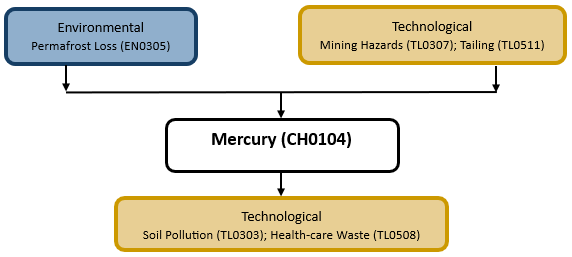
The figure below summarises common interactions between mercury. This information should be used with caution and not be solely relied upon in Disaster Risk Management, particularly as some interactions may not have been included. Note that hazardous events occurring together or locally in space or time may not necessarily cause, amplify or be otherwise related to each other. Specific examples of multi-hazard context can be found in the ‘Hazard drivers’ and ‘Impacts’ sections above.
Multi-hazard diagram
Risk Management
There are several ways to prevent adverse health effects of mercury, including promoting clean energy, stopping the use of mercury in gold mining, eliminating the mining of mercury and phasing out non-essential mercury-containing products.
- Promote the use of clean energy sources that do not burn coal. Burning coal for power and heat is a major source of mercury. Coal contains mercury and other hazardous air pollutants that are emitted when the coal is burned in coal-fired power plants, industrial boilers and household stoves (WHO, 2021).
- Eliminate mercury mining and use of mercury in gold extraction and other industrial processes. Mercury is an element that cannot be destroyed; therefore, mercury already in use can be recycled for other essential uses, with no further need for mercury mining. Mercury use in artisanal and small-scale gold mining is particularly hazardous, and health effects on vulnerable populations are significant. Non-mercury (non-cyanide) gold-extraction techniques need to be promoted and implemented, and where mercury is still used, safer work practices need to be employed to prevent exposure (WHO, 2021).
- Phase out use of non-essential mercury-containing products and implement safe handling, use and disposal of remaining mercury-containing products including batteries, measuring devices, such as thermometers and barometers, electric switches and relays in equipment, lamps (including some types of light bulbs), dental amalgam (for dental fillings), skin lightening products and other cosmetics and pharmaceuticals (WHO, 2021).
- Establish a sentinel system to detect hazardous substances.
Key aspects of mercury risk management include:
Objectives:
- Monitoring: Track mercury levels in air, water, soil, and biota (plants and animals).
- Data Collection: Gather data on mercury emissions from various sources, including natural sources like volcanic activity and anthropogenic sources like industrial processes.
- Risk Assessment: Assess the risk posed by mercury exposure to human health and the environment.
- Policy Support: Provide data to inform and support policies aimed at reducing mercury emissions and exposure.
Components:
- Sensors and Sampling Stations: Deploy sensors and sampling stations globally to continuously measure mercury concentrations.
- Data Analysis: Use advanced analytical techniques to interpret the collected data and identify trends.
- Modelling: Develop models to predict the dispersion and deposition of mercury in the environment.
- Reporting and Communication: Communicate findings to stakeholders, including governments, environmental agencies, and the public.
Challenges:
- Coverage: Ensuring comprehensive global coverage to accurately monitor mercury levels in different regions.
- Accuracy: Maintaining the accuracy and reliability of data collected from various sources.
- Collaboration: Coordinating efforts among multiple countries and organizations to create a unified monitoring system.
- Response: Developing effective response strategies to mitigate the impact of mercury exposure.
Importance:
- Health Impact: Mercury exposure can lead to serious health issues, including neurological and developmental problems, particularly in children and foetuses.
- Environmental Impact: Mercury can bioaccumulate in the food chain, affecting wildlife and ecosystems.
- Policy Development: Accurate data on mercury levels is essential for creating effective environmental policies and regulations.
Monitoring
The section and the table below offer an overview of monitoring mercury. This information can be used for forecasting within a national early warning system (EWS). Since EWS capacities and processes differ across countries, the most current and specific information regarding EWS should be obtained from the appropriate national or regional agency/authority responsible for disaster management.
| Which institution(s) produce(s) Disaster Risk Data/Information? | The United Nations Environment Programme (UNEP) works on global initiatives to reduce mercury emissions and exposure. |
| How is the Hazard Observed/Monitored/Forecast? | The Global Mercury Observation System (GMOS) is an early warning system designed to monitor mercury levels in the environment. |
References
Agency for Toxic Substances and Disease Registry (ATSDR), 2022. Mercury - ToxFAQs (2022). Agency for Toxic Substances and Disease Registry (ATSDR). Accessed 21 July 2024.
GMOS, n.d. Global Mercury Observation System (GMOS). official website
Joint FAO/WHO Expert Committee on Food Additives (JECFA), 2007. Methylmercury. Joint FAO/WHO Expert Committee on Food Additives (JECFA). Accessed 2 May 2025.
Spiegel et al., 2018. Phasing Out Mercury? Ecological Economics and Indonesia's Small-Scale Gold Mining Sector (2018). Ecological Economics 144, 1–1.
United Nations Economic Commission for Europe (UNECE), 2023. Globally Harmonised System (GHS) of Classification and Labelling of Chemicals (2023). United Nations Economic Commission for Europe (UNECE). Accessed 11 May 2024.
United Nations Environment Programme (UNEP), 2013. Minamata Convention on Mercury. United Nations Environment Programme (UNEP). Accessed 25 November 2019.
United Nations Environment Programme (UNEP), 2018. Global Mercury Assessment 2018. United Nations Environment Programme (UNEP). Accessed 22 September 2020.
World Health Organization (WHO), 2011. Guidelines for Drinking-Water Quality: 389-90. World Health Organization (WHO). Accessed 2 May 2025.
World Health Organization (WHO), 2000. Air quality guidelines for Europe, Second Edition. European series, no. 91. World Health Organization (WHO). Accessed 10 April 2025.
World Health Organization (WHO), 2019. Strategic planning for implementation of the health-related articles of the Minamata Convention on Mercury. World Health Organization (WHO). Accessed 10 April 2025.
World Health Organization (WHO), 2021. Preventing disease through healthy environments: exposure to mercury: a major public health concern, 2nd ed Preventing disease through healthy environments: exposure to mercury: a major public health concern, 2nd ed Accessed 2 May 2025