
Educating for the future: A teacher’s journey to hands-on climate change education

Today’s school students are navigating a world where climate impacts are not abstract future threats but daily realities—from rising temperatures in classroom buildings to exposure to increasing flood risks. High-quality climate education does more than build scientific understanding: it equips young people with the critical thinking, resilience and collective imagination needed to face complexity and participate meaningfully in the transformations ahead.
By grounding learning in local experiences and empowering students to act, such education lays the foundation for informed, engaged citizens capable of shaping a more sustainable and just future. Julien Calas, a teacher of modern literature and French close to Paris, is leading interdisciplinary projects on climate change with junior high-school students. In a powerful combination of science, French, and active learning his lessons help students better understand—and imagine—the world of tomorrow.
Julien Calas was interviewed by PreventionWeb to find out how his work is educating pupils about climate change and giving them the confidence to take on today's challenges.
What motivated you to start integrating climate change into your French curriculum?
Given the climate emergency and the institutional shortcomings at the time on the issue, it seemed essential to me from 2018 to integrate sustainable development into the subject I teach, French, and climate change more specifically from 2021.
Two works in particular allowed me to approach the subject through literature: The Storytelling Species by Nancy Houston and Petit Manuel de Résistance Contemporaine (A Short Manual of Contemporary Resistance) by Cyril Dion. These works invite us to consider how stories serve as the main driver of societies' evolution.
By grounding climate change education in a local issue, [students] feel more involved but also less anxious.
But as school curricula in France began including climate change, biodiversity and sustainable development in 2020, students had trouble grasping their complexities when they were only taught by a few teachers in a sporadic and isolated way.
Similarly, while the requirement of secondary school classes to elect an eco-delegate started with good intentions, managing this small group of students often falls to a single person (the school's Sustainable Development Education coordinator, when there is one) who is not always trained and may struggle to bring these delegates together in a systematic manner.
Consequently, education for sustainable development is still often more about raising awareness than about education, and, as my pupils put it, climate change was reduced "collecting and sorting waste" or, even worse, to an opinion rather than a fact on which there is a scientific consensus.
Have you personally witnessed the effects of climate change in the Paris region and around your school? Could you tell us about it?
Living and working in Créteil [a suburb of Paris], yes, especially with the amplified effects of urban heat islands. In recent years, during heat waves, several nights have been difficult. At the middle school, with rising temperatures and the lack of functional blinds in most classrooms, end-of-year classes are now more trying for both students and staff. Sitting or grading the National Diploma of the Brevet exams in late June and early July in overheated rooms is truly uncomfortable. Holding classes outside isn't a solution when the courtyard is almost entirely covered in asphalt, although we have a nature area, which includes an orchard, an educational garden, and soon a pond, which I tend with volunteer students during lunch breaks. But only one class at a time can fit in that space.
Can you tell us more about the different climate change education projects you have participated in so far?
As the sustainable development education coordinator for my school, during the 2023/2024 school year I initiated the first large-scale project on climate change involving 75 students, about ten teachers, and numerous external partners. The objective was to bring together the interdisciplinary project of three classes towards a single final product: an awareness-raising multimedia exhibition on climate change, and a concrete local action (creation of a "cool island").
In Year 10, the project focused on a local issue that the students had personally experienced: urban heat islands (UHIs). After understanding the mechanisms and causes of climate change in Life and Earth Sciences and Physical Education classes, the students were asked to demonstrate the reality of climate change on a global scale in their French, English, and Spanish classes. They then explored, in French and Physics/Chemistry, the current impacts of climate change on living organisms in urban environments at the local level and anticipated future impacts through foresight and fiction. The students then became aware of human responsibility in History/Geography [these are taught together in France] and Technology classes before taking action: informing and raising awareness about climate change with posters, showing that local adaptation and mitigation solutions already existed in their area through short video reports, and proposing a desirable yet realistic future rooted in their daily lives through a writing workshop on the emergence of a "low-carbon" Créteil.
Climate change education is a transdisciplinary education, open to complexity and critical thinking, with a transformative objective.
Meanwhile, a more modest project carried out with a Year 9 class focused on biomimetic buildings in a futuristic Créteil subject to the constraints of climate change.
Finally, the Year 8 students collaborated with a Year 7 class to prepare a tree-planting plan for the school with the department's technical services.
During the 2024-2025 school year, we developed the project further with two classes testing two new methods of presenting their findings. Both classes used speculative fiction to explore adaptation and mitigation solutions and to inspire action through writing realistic, desirable future narratives. One class worked with post-graduate students in graphic and multimedia design to create educational tools in the form of board games. The other took part in workshops with a theatre company and performed in an episode of a production about climate migration.
This year, together with several teaching teams, we're taking part in a new inter-academy project on education for sustainable development. By linking climate, health and land use to the theme of soil, we aim to turn our asphalt courtyard into a living "oasis"-a true island of coolness.

How were students directly involved in activities related to climate change adaptation?
They were first invited to visit nearby adaptation or mitigation measures: a school with a green roof and solar panels, the municipal technical centre of a neighbouring town, a bioclimatic socio-cultural centre, a footbridge facilitating walking and cycling, canals and an artificial lake as islands of coolness, a geothermal power plant, and other locations.
The normalisation of outdoor learning
strengthens the connection between learning and "real life."
Next, they applied what they had learned by producing awareness-raising materials (posters, podcasts or short video reports, live performances) and then by writing, in groups, stories of realistic and desirable futures. The goal here is to renew our collective representations and imaginations through fiction that questions-or even redefines-our notions of individual and collective success and happiness, by portraying values and social norms that are more respectful of life. Underlying these "new narratives" is the desire to profoundly transform our society and, above all, to make these social, environmental, economic and cultural transformations desirable to the greatest number of people.
Finally, the students reflect on and implement concrete changes within our school by, for example, planting, digging a pond, and reducing, sorting and recycling waste.
In your opinion, what impact have these projects and activities had on the students?
It is clear they have a better understanding of the mechanisms of climate change and its impacts. They have developed skills such as constructive communication, cooperation and mutual support, problem-solving, critical thinking, how to apply knowledge from various disciplines, and how to behave more ethically and responsibly towards the environment and human societies. By grounding climate change education in a local issue, they feel more involved but also less anxious.
Finally, there is a clear appetite for interdisciplinary approaches and a welcome return of key concepts such as climate, and the greenhouse effect across multiple disciplines at various times throughout the school year, but presented in unique ways and from a specific perspective. This helps to reinforce the acquisition of knowledge, skills and attitudes. Furthermore, the normalisation of outdoor learning strengthens the connection between learning and "real life."

Are there any particular teaching methods or tools that you would recommend, based on your experience, for teaching climate change?
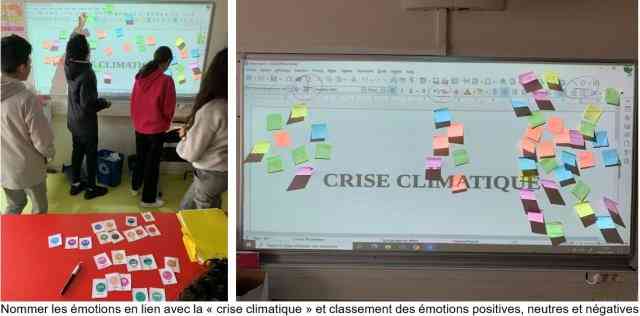
There are steps we always go through, although their order will vary depending on the project and the entry point chosen. These include: questioning students' preconceptions and diagnosing feelings related to climate change; understanding the mechanisms of the phenomena involved; observing and demonstrating their impacts at the global and local level; linking these issues to specific territories, raising awareness of the responsibility of human activities; foresight; and taking action.
As a teacher of French, science teachers are essential to me for bringing scientific rigour to the climate change projects I initiate.
Our tools include project-based learning and active learning methods such as inquiry-based approaches, as well as anything that empowers students as active participants and subjects. I am also committed to integrating climate change education with arts and cultural education, both to break down disciplinary barriers and to allow everyone to express themselves, raise awareness, or be made aware of the issue through diverse means-not exclusively scientific ones. Outdoor learning also seems to me an essential pedagogical approach.
In March 2023, the French Higher Council for Curricula published a skills framework to strengthen education for sustainable development from primary to secondary school, supplemented the following year by progress benchmarks and end-of-cycle expectations. These institutional tools will enable everyone to develop genuine climate change education that goes beyond mere awareness-raising or prescriptive measures. Furthermore, the Créteil Academy's website dedicated to education for sustainable development hosts numerous interdisciplinary project scenarios, lesson plans, and teaching activities.
What advice would you give to young teaching professionals interested in integrating climate change into their teaching?
For climate change education to be meaningful, it should be interdisciplinary and open to complexity, since it involves different kinds of data presented in various forms and coming from several disciplinary fields. This also prevents us from embarking on this project alone and enriches disciplinary approaches and perspectives without replacing our colleagues. As a teacher of French, science teachers are essential to me for bringing scientific rigour to the climate change projects I initiate. I have no authority to give a scientific lecture on the functioning of complex systems, and it is important that students understand this at a time when social media offers a platform to anyone.
I would recommend a project-based approach involving a concrete, transformative initiative within their school so that the fight against climate change takes tangible form. It's a powerful motivator for students to act, both individually and collectively, to help build a sustainable world and introduce them to ethical and responsible behaviour towards the environment and human societies. Practically speaking, if your specific objective is ambitious and costly, always have a feasible "Plan B" to avoid frustrating students and subsequently leading to demotivation and inaction.
Climate change education is therefore a transdisciplinary education, open to complexity and critical thinking, with a transformative objective.
Julien Calas is a modern literature teacher (since 2005) and focal point on sustainable development education at the Albert Schweitzer college in Créteil, France. He is member of the academic group Les Jardins de Créteil / la Classe dehors and trainer on sustainable development education, and liaison teacher at CAUE 94 for the DAAC (Academic Delegation for Artistic and Cultural Education) of the Créteil academy.