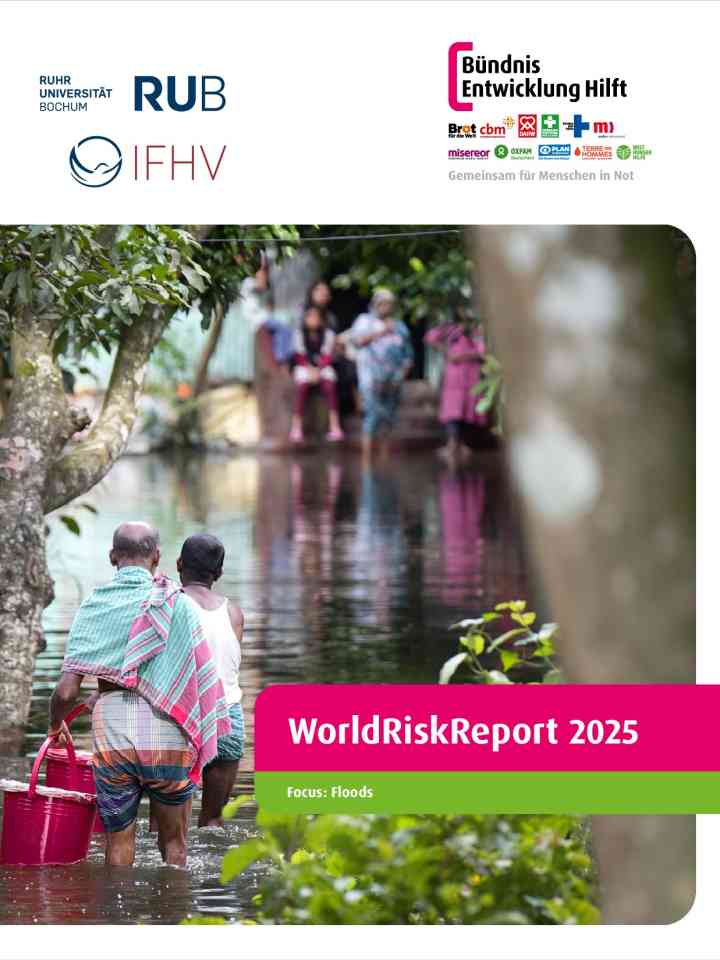
World Risk Report 2025 - focus: floods
The World Risk Index indicates the disaster risk from extreme natural events and negative climate change impacts for 193 countries in the world. It is calculated per country as the geometric mean of exposure and vulnerability. Exposure represents the extent to which populations are exposed to and burdened by the impacts of earthquakes, tsunamis, coastal and riverine floodings, cyclones, droughts, and sea level rise. For the first time, all 193 member states of the United Nations are represented.
Some of the key findings include:
- In 2025, risk hotspots remain concentrated in Asia and the Americas. At the same time, Africa continues to show the highest levels of vulnerability worldwide: almost 80 percent of the continent is classified as high- or very high risk-areas. +
- The top 10 highest-risk countries show only minor changes: China re-enters the group, while Bangladesh drops to 11th place. Indonesia and India switch positions, with India now ranking second worldwide.
- The Philippines is once again at the top of the WorldRiskIndex this year: a country characterized by high geographic fragmentation and high exposure to weather-related extremes.
- Floods are among the most frequent and devastating extreme natural events. Between 2000 and 2019, they affected over 1.6 billion people and caused economic damage of over 650 billion US-Dollars worldwide.
- There are three main types of floods: fluvial, pluvial, and coastal. This differentiation is important for developing targeted prevention strategies and assessing specific risks more accurately.
Explore further
Hazards
Flood
ISBN/ISSN/DOI
978-3-946785-20-0 (ISBN)
Number of pages
72 p.
Publication year
2025