
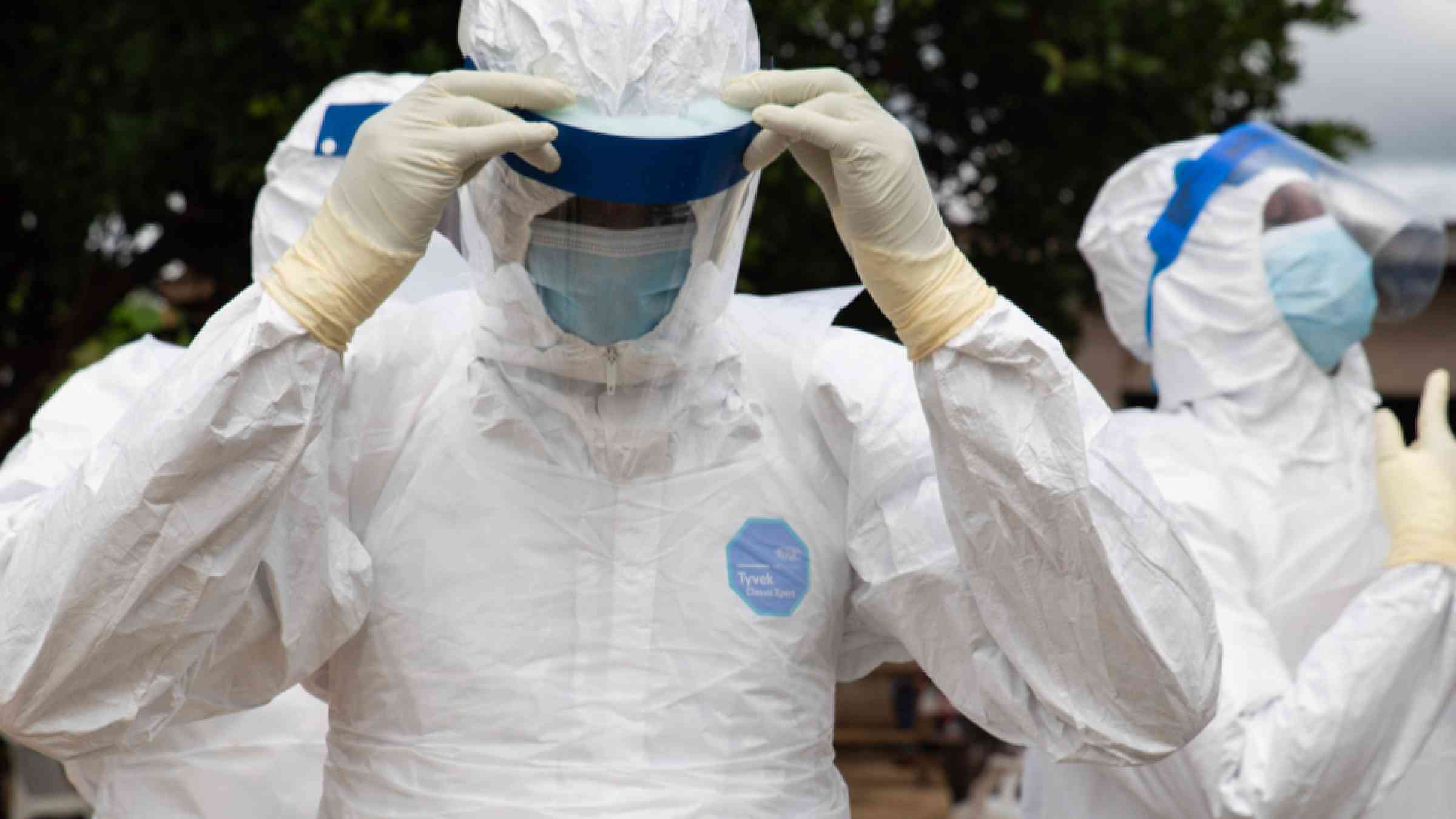
The outbreak in the Democratic Republic of Congo and Uganda is caused by the Bundibugyo ebolavirus, which has no approved vaccines, treatments or rapid diagnostics.
A decade ago, the response to the Zaire species showed that investing in infectious disease R&D saves lives. Now that sustained investment must extend to all Ebola species.
Summary
- The 2026 Bundibugyo Ebola outbreak is affecting the Democratic Republic of Congo and Uganda.
- It is caused by Bundibugyo ebolavirus, which has no approved vaccines, treatments or rapid diagnostics.
- Existing Ebola vaccines mainly target the Zaire species.
- The success of Zaire Ebola vaccines shows that sustained infectious disease R&D can save lives.
- Investment now needs to extend to all Ebola species, alongside trusted community-led outbreak responses.
The 2026 Bundibugyo Ebola outbreak
In May 2026, an outbreak of Ebola caused by the Bundibugyo ebolavirus was confirmed in Ituri Province of the Democratic Republic of Congo (DRC). On 17 May, the World Health Organization (WHO) declared it a Public Health Emergency of International Concern (PHEIC), followed by the Africa CDC declaring a Public Health Emergency of Continental Security on 18 May .
The Bundibugyo ebolavirus is one of four Ebola species that cause disease in humans . Each one is genetically distinct, with different severity profiles: without treatment, the case fatality rate for Ebola can vary from 25–90 percent. The limited available evidence suggests that vaccines developed for one species may not adequately protect against others.
There are currently no approved vaccines, treatments or rapid diagnostic tests specifically targeting the Bundibugyo species. That diagnostic gap has had real consequences. The outbreak is thought to have been spreading for several weeks, possibly months, before it was formally recognised, in part because confirming Bundibugyo requires specialist laboratory testing. Rapid diagnostic tests do exist for Ebola, but they generally target the Zaire species.
The outbreak is occurring in a region affected by armed conflict, population displacement and high population mobility, all of which complicate surveillance, contact tracing and delivery of healthcare. Cases have been confirmed in Uganda, indicating cross-border spread.
Ebola is transmitted through close contact with the bodily fluids of sick or deceased individuals . It does not spread through the air and does not carry the same pandemic potential as airborne viruses such as influenza. Public health officials in the DRC and Uganda have significant experience responding to Ebola – this is the 17th outbreak recorded in the DRC alone since the virus was first identified in 1976 – and response capacity is considerably stronger today than a decade ago.
For the latest case numbers and situation updates, see WHO's disease outbreak page and Africa CDC .
What the Zaire vaccine story shows us
The 2014-16 West African Ebola epidemic is the clearest example of what happens when the global health community faces Ebola without the right tools – and what changes when investment follows.
When the epidemic began, there were no approved vaccines or treatments for any Ebola species. It resulted in more than 28,000 suspected cases and 11,000 deaths . Without medical countermeasures, the fundamentals of Ebola control were what mattered most: contact tracing, case isolation, early detection, patient care, safe and dignified burials, and community engagement informed by social and behavioural science. National public health agencies and partners worked closely with affected communities to adapt traditional burial practices in ways that were both medically safe and culturally acceptable. Local volunteers played a central role in building trust, and working with Ebola survivors helped communities understand the disease and encouraged people to follow best practices. These lessons have shaped every Ebola response since. Meaningfully engaging communities is as vital to containment as any medical intervention, and remains critical in the current outbreak.
The epidemic also galvanised the global health community to accelerate research that had been underway but underfunded. Public health officials and the pharmaceutical company Merck fast-tracked the rVSV-ZEBOV vaccine, approved by US and EU regulators in 2019 . A second two-dose vaccine developed by Johnson & Johnson received WHO prequalification in 2021 . Both have since been used to contain subsequent Zaire outbreaks, including through ring vaccination, where healthcare workers and close contacts of confirmed cases are vaccinated to break chains of transmission.
And it led to systemic change. WHO created the R&D Blueprint for Epidemics , identifying priority pathogen families for accelerated research. The Coalition for Epidemic Preparedness Innovations (CEPI), a global partnership co-founded by Wellcome and partners, was established to accelerate vaccine development against epidemic and pandemic threats. CEPI has since adopted a 100 Days Mission, aiming to respond to a new pandemic threat with a vaccine within 100 days of identifying the pathogen. In January 2026, CEPI announced $26.7 million in funding , alongside the European Union's Horizon Europe programme, for the University of Oxford and partners to develop multivalent vaccines targeting multiple filoviruses – the viral family that includes all Ebola species as well as Marburg virus. That work is now being put to the test.
Why is there no vaccine for Bundibugyo?
Research and development for Ebola has focused heavily on the Zaire species, and for understandable reasons. Zaire has caused the majority of outbreaks – including more than a dozen in the DRC alone since 1976 – and the largest epidemics, providing both the urgency and the clinical trial opportunities to advance vaccines and treatments. The Sudan species has caused fewer outbreaks, though it was responsible for an outbreak in Uganda in 2022. The Bundibugyo species had been recorded just twice before 2026, in Uganda in 2007 and in the DRC in 2012, limiting the evidence base and the opportunity to generate data in outbreak settings.
The result is a significant gap. When Ebola Sudan emerged in Uganda in 2022 , there was no approved vaccine. Health officials contained the outbreak through the full range of public health measures – from contact tracing and case isolation to community engagement and safe burials – though without the vaccines or treatments that sustained R&D investment could have provided. The Bundibugyo ebolavirus presents a similar challenge. Vaccine candidates are in development, including one built on a similar platform to the proven Zaire vaccine , but none have yet reached human trials.
Even if vaccines do not reach affected communities before this outbreak is brought under control, investing in Bundibugyo research and development now is an investment in protecting the communities and generations who will face future outbreaks.
How Wellcome and partners are supporting the Ebola response
Wellcome has invested in epidemic preparedness for over a decade, including through CEPI for vaccine research and development, and through the International Severe Acute Respiratory and emerging Infection Consortium (ISARIC) for treatment assessment. The current outbreak demonstrates the value of that research infrastructure that already exists – and the need to sustain it.
Several Wellcome-supported programmes are contributing to the response, not because of new funding decisions, but because they were designed for this kind of situation.
ISARIC co-developed the PARTNERS adaptive clinical trial platform with the WHO, funded by the Foreign, Commonwealth and Development Office and the Medical Research Council. PARTNERS is built to assess treatments across all filovirus types, including Bundibugyo, and is being adapted for the current outbreak in discussion with the DRC’s Institut National de Recherche Biomédicale (INRB).
In addition, Wellcome-supported researcher Placide Mbala and his team at INRB are leading the sequencing effort that confirmed the Bundibugyo identification, with the ARTIC 2.0 network providing further support. In the middle of a fast-moving outbreak in a deeply challenging security environment, complete genomes were shared through open data-sharing platforms within days of outbreak confirmation – a powerful example of why investing in scientific capacity and leadership within outbreak-affected countries matters.
The International Pandemic Preparedness Secretariat (IPPS), hosted and funded by Wellcome, activated its emergency response immediately following the PHEIC declaration, publishing a Day Zero statement and tracking the availability of diagnostics, therapeutics and vaccines – identifying the gaps that need investment and providing structured intelligence for funders and responders, with updates to be published every 15 days.
Since 2014, Wellcome has provided more than £41 million, in partnership with others, to support the global response to Ebola, including funding for vaccines, treatments, diagnostics and social science research.
How can we prevent future Ebola outbreaks?
Research during outbreaks is essential. It helps us understand what drives the spread of disease, how communities experience the threat and the response, and which interventions work. Research outside of outbreaks is just as critical, both to build this knowledge in advance and to ensure we are not starting from scratch when crises hit. This outbreak reinforces why that investment needs to be sustained rather than crisis-driven.
Approaches like CEPI's strategy – aligned with the WHO R&D Blueprint for Epidemics – of developing vaccines across high-risk viral families, and ISARIC's pre-positioned trial protocols, show how the global health community can prepare for outbreaks caused by rarer or less well-characterised pathogens. Extending these approaches and accelerating R&D for all Ebola species are the priorities.
But the tools are only as effective as the communities they serve. Trust, communication and public health measures are the essentials of every outbreak response. Investing in social and behavioural science alongside R&D ensures that diagnostics, treatments and vaccines are developed and delivered in ways that communities understand, trust and can access.
Closing these gaps requires long-term, sustained investment – not cycles of panic and neglect. Wellcome is being guided by the WHO's technical analysis. We’re prepared to support research and accelerate actions that will limit the scale and impact of this outbreak, and strengthen the tools available for future ones.