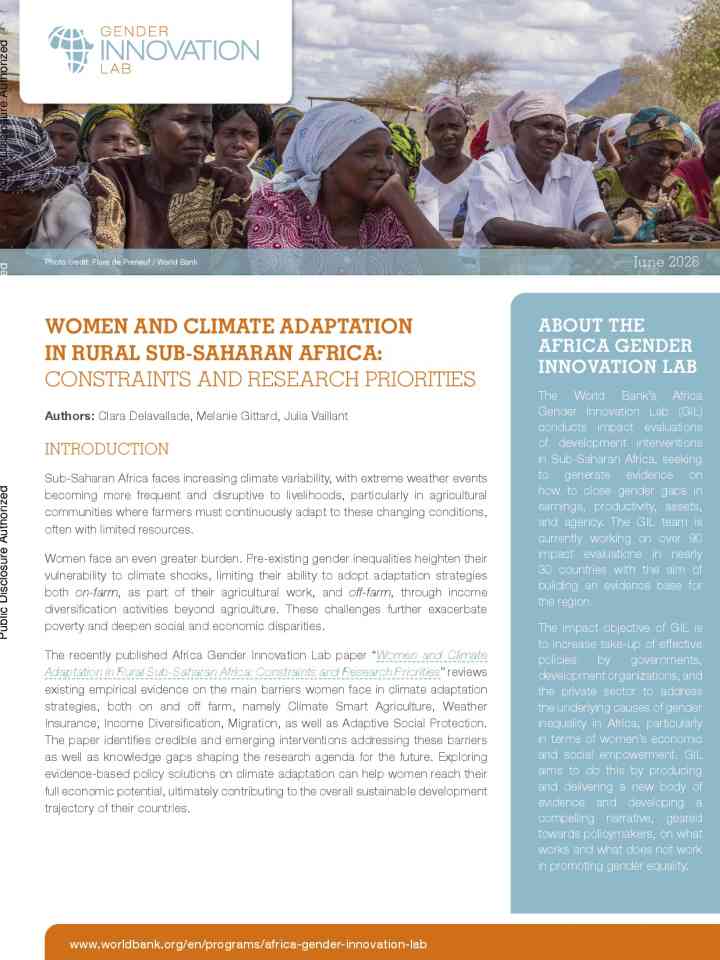
Women and climate adaptation in rural sub-Saharan Africa: constraints and research priorities
This brief reviews the empirical evidence on the barriers women face in adapting to climate change in rural Sub-Saharan Africa. As the region confronts rising climate variability and more frequent extreme weather, agricultural communities must continuously adapt, often with limited resources — and women bear an even heavier burden, since pre-existing gender inequalities heighten their vulnerability to climate shocks and constrain their ability to pursue adaptation strategies both on and off the farm. The brief examines five such strategies — climate-smart agriculture (CSA), weather insurance, income diversification, migration, and adaptive social protection — mapping the main obstacles to each, cataloguing interventions by strength of evidence ("credible," "emerging," or "frontier"), and identifying the knowledge gaps that should shape the future research agenda.
Across all five strategies, the brief finds that women's adaptation is constrained by a recurring set of financial, informational, and normative barriers — limited land ownership and insecure tenure, restricted access to credit and information, heavy domestic and caregiving workloads, gender norms, and weaker social networks. In climate-smart agriculture, women adopt practices less often than men, with credible interventions including ICT-based and peer-led training, subsidized inputs, and land titling. Weather insurance remains underutilized because products rarely reflect women's life-cycle risks (such as pregnancy and childbirth) or their lack of land tenure, though bundling insurance with mobile money to pay women directly is emerging as promising. Income diversification is hampered by time poverty and norms, with cash transfers, economic inclusion packages, and childcare services among the credible responses, while climate migration is found to be predominantly male-driven owing to liquidity constraints, safety risks, and caregiving duties. Adaptive social protection can help women withstand shocks but is limited by their financial autonomy, mobility, and decision-making power. The brief concludes that frontier interventions — digital climate information services, gender-responsive weather insurance, social-network strengthening, and norm-changing initiatives — are especially promising and warrant rigorous evaluation, since stronger causal evidence will be essential to inform climate policies that enable women to adapt.
Explore further