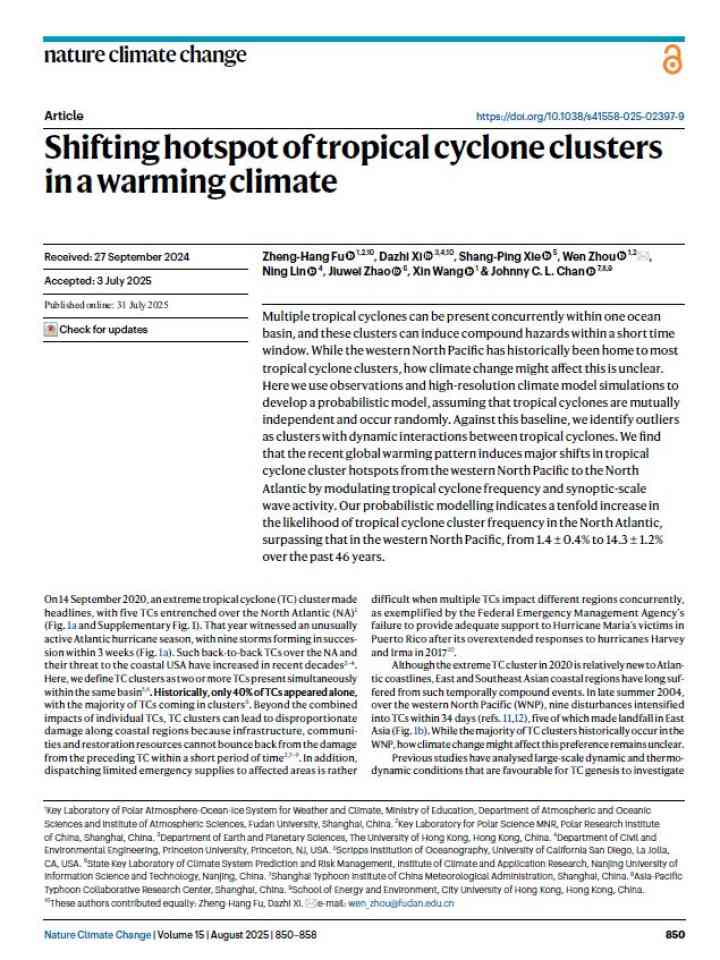
Shifting hotspot of tropical cyclone clusters in a warming climate
This study is interested in how climate change might be affecting cyclone pattern. It uses observations and high-resolution climate model simulations to develop a probabilistic model, assuming that tropical cyclones are mutually independent and occur randomly. Against this baseline, the authors identify outliers as clusters with dynamic interactions between tropical cyclones.
The study finds that the recent global warming pattern induces major shifts in tropical cyclone cluster hotspots from the western North Pacific to the North Atlantic by modulating tropical cyclone frequency and synoptic-scale wave activity. The probabilistic modelling indicates a tenfold increase in the likelihood of tropical cyclone cluster frequency in the North Atlantic, surpassing that in the western North Pacific, from 1.4 ± 0.4% to 14.3 ± 1.2% over the past 46 years.
Explore further