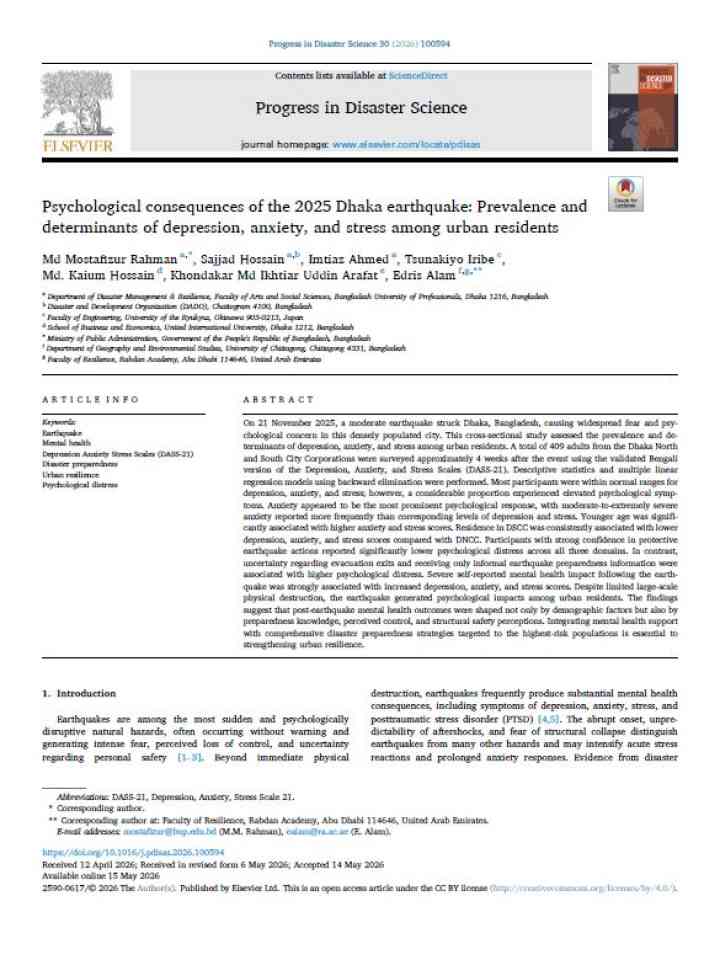
Psychological consequences of the 2025 Dhaka earthquake: Prevalence and determinants of depression, anxiety, and stress among urban residents
This article intends to assess the prevalence and determinants of depression, anxiety, and stress among urban residents in Dhaka, Bangladesh. A total of 409 adults from the Dhaka North and South City Corporations were surveyed approximately 4 weeks after the event using the validated Bengali version of the Depression, Anxiety, and Stress Scales (DASS-21). Descriptive statistics and multiple linear regression models using backward elimination were performed. Most participants were within normal ranges for depression, anxiety, and stress; however, a considerable proportion experienced elevated psychological symptoms. Anxiety appeared to be the most prominent psychological response, with moderate-to-extremely severe anxiety reported more frequently than corresponding levels of depression and stress.
Younger age was significantly associated with higher anxiety and stress scores. Residence in DSCC was consistently associated with lower depression, anxiety, and stress scores compared with DNCC. Participants with strong confidence in protective earthquake actions reported significantly lower psychological distress across all three domains. In contrast, uncertainty regarding evacuation exits and receiving only informal earthquake preparedness information were associated with higher psychological distress. Severe self-reported mental health impact following the earthquake was strongly associated with increased depression, anxiety, and stress scores. Despite limited large-scale physical destruction, the earthquake generated psychological impacts among urban residents. The findings suggest that post-earthquake mental health outcomes were shaped not only by demographic factors but also by preparedness knowledge, perceived control, and structural safety perceptions.
Their findings are published in leading journal, Progress in Disaster Science
.
The author of the study, Dr Edris Alam, a Professor in the Faculty of Resilience at Rabdan Academy, Abu Dhabi, UAE. He specialises in disaster risk reduction and public health emergency management and works with governments, universities, United Nations and development agencies globally.
Dr Alam explained: The findings of this research might be significantly valuable for the region to integrate mental health support with comprehensive disaster preparedness strategies targeted to the highest-risk populations is essential to strengthening urban resilience.
Read original story here:
Psychological consequences of the 2025 Dhaka earthquake: Prevalence and determinants of depression, anxiety, and stress among urban residents
Explore further