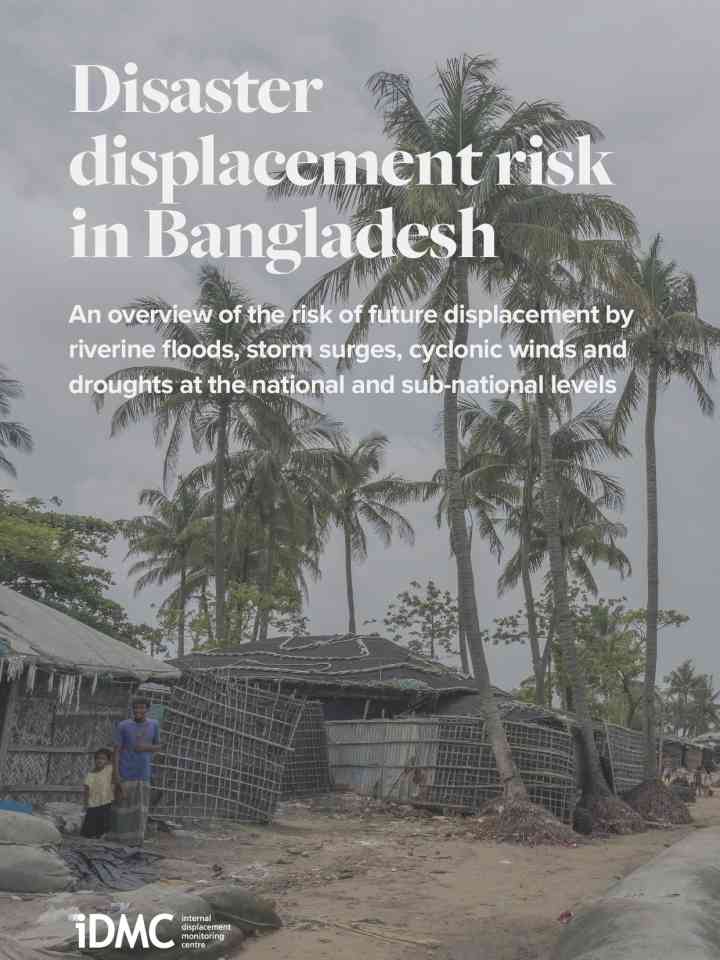
Disaster displacement risk in Bangladesh: An overview of the risk of future displacement
This report presents an assessment of Bangladesh’s current and future disaster‑related displacement risk, focusing on riverine floods, storm surges, cyclonic winds and droughts, and drawing on updated probabilistic modelling that incorporates evolving climate scenarios. It outlines why Bangladesh’s exposure and vulnerability are increasing, how the model was developed with new hazard, exposure and vulnerability layers, and where displacement risk is projected to rise most sharply—particularly in districts such as Dhaka, Sylhet, Chattogram, Khulna and Barisal. This report and accompanying short risk profile are designed to help governments and their partners to reduce risk, strengthen resilience and minimise the impacts of disasters, including internal displacement.
The report recommends strengthening forward‑looking disaster risk reduction measures, including investment in flood‑ and storm‑resilient infrastructure, improved building standards, and targeted support for highly exposed and socio‑economically vulnerable populations. It emphasises the need for better data, higher‑resolution hazard mapping and refined vulnerability assessments to guide national and subnational planning. The authors call for integrated policies that anticipate medium‑ to long‑term displacement, ensure adequate shelter and livelihood protection, and embed climate change adaptation across sectors. They also highlight the importance of coordinated action among government, scientific institutions and international partners to ensure that no one is left behind as Bangladesh’s “riskscape” continues to evolve.
Explore further