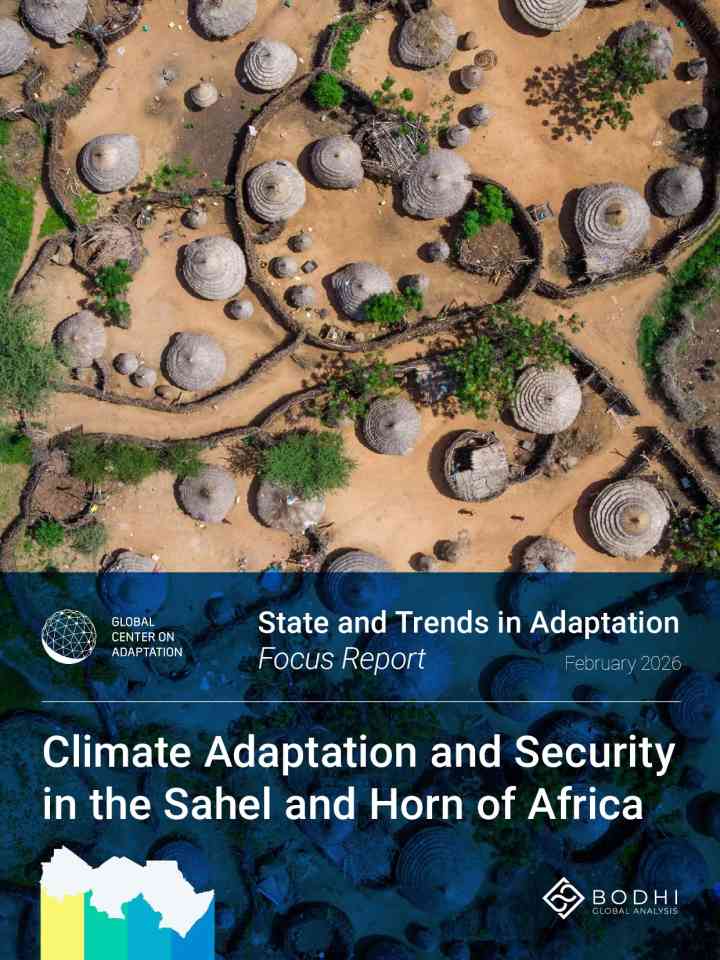
Climate adaptation and security in the Sahel and Horn of Africa
This report outlines how climate change acts as a risk multiplier for fragility and insecurity across the Sahel and the Horn of Africa, where recurrent droughts, floods, temperature extremes and rainfall variability intersect with weak governance, limited institutional capacity and persistent inequalities. Drawing on quantitative, spatial and qualitative analysis across 18 countries, the study examines how climate pressures exacerbate competition over land and water, drive displacement, and heighten social tensions—particularly in contexts such as Somalia, South Sudan, Niger and Mali. It highlights that adaptation is not only a tool for managing climate risks but also a strategic investment in peace and stability, with Chapters 8 and 12 focusing specifically on climate change adaptation as a pathway to reduce disaster risk and address structural drivers of conflict.
The publication recommends strengthening locally led adaptation, inclusive governance, and economic resilience to reduce fragility and prevent climate‑related shocks from escalating into instability. It emphasises the need to integrate governance and stability metrics into adaptation planning, finance local coordination and dispute‑resolution mechanisms, and scale up community‑based natural resource management. The report further calls for enhanced regional cooperation to improve early warning systems and cross‑border resilience. Finally, it encourages governments and financial institutions to track the peace and governance co‑benefits of adaptation, ensuring that climate investments contribute meaningfully to long‑term security and social cohesion.
Explore further