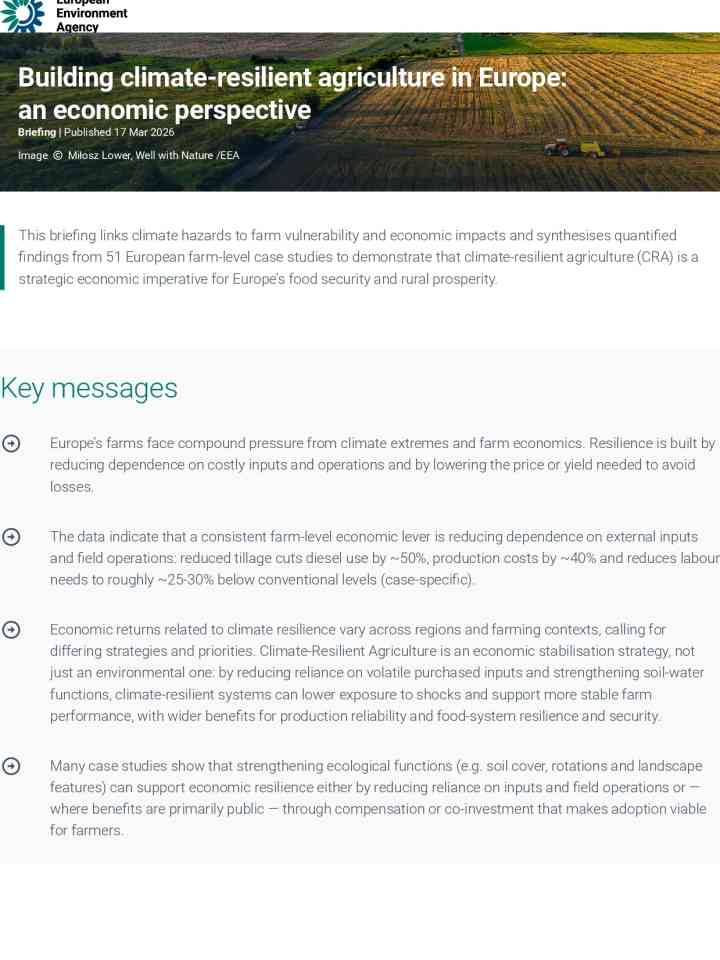
Building climate-resilient agriculture in Europe: An economic perspective
This briefing links climate hazards to farm vulnerability and economic impacts and synthesises quantified findings from 51 European farm-level case studies to demonstrate that climate-resilient agriculture (CRA) is a strategic economic imperative for Europe’s food security and rural prosperity. CRA refers to farming systems that maintain economic viability alongside a reduced vulnerability to climate shocks. This is achieved by lowering dependency on external inputs and restoring soil, water and ecosystem functions. It is an economic strategy to stabilise farm incomes and food production under accelerating climate risk. Europe’s agricultural systems are entering a decade in which climate risk and economic fragility are converging. Rising temperatures, shifting rainfall patterns and increasingly frequent extremes — heatwaves, droughts, floods, storms and compound risks — are disrupting production across all European regions (EEA, 2024). These pressures increase exposure across farming systems and regions, making climate resilience an economic as well as an environmental priority.Key messages from the publication include:
- Europe’s farms face compound pressure from climate extremes and farm economics. Resilience is built by reducing dependence on costly inputs and operations and by lowering the price or yield needed to avoid losses.
- The data indicate that a consistent farm-level economic lever is reducing dependence on external inputs and field operations: reduced tillage cuts diesel use by ~50%, production costs by ~40% and reduces labour needs to roughly ~25-30% below conventional levels (case-specific).
- Economic returns related to climate resilience vary across regions and farming contexts, calling for differing strategies and priorities. Climate-Resilient Agriculture is an economic stabilisation strategy, not just an environmental one: by reducing reliance on volatile purchased inputs and strengthening soil-water functions, climate-resilient systems can lower exposure to shocks and support more stable farm performance, with wider benefits for production reliability and food-system resilience and security.
- Many case studies show that strengthening ecological functions (e.g. soil cover, rotations and landscape features) can support economic resilience either by reducing reliance on inputs and field operations or — where benefits are primarily public — through compensation or co-investment that makes adoption viable for farmers.
Explore further