Accelerated shifts from heatwaves to heavy rainfall in a changing climate
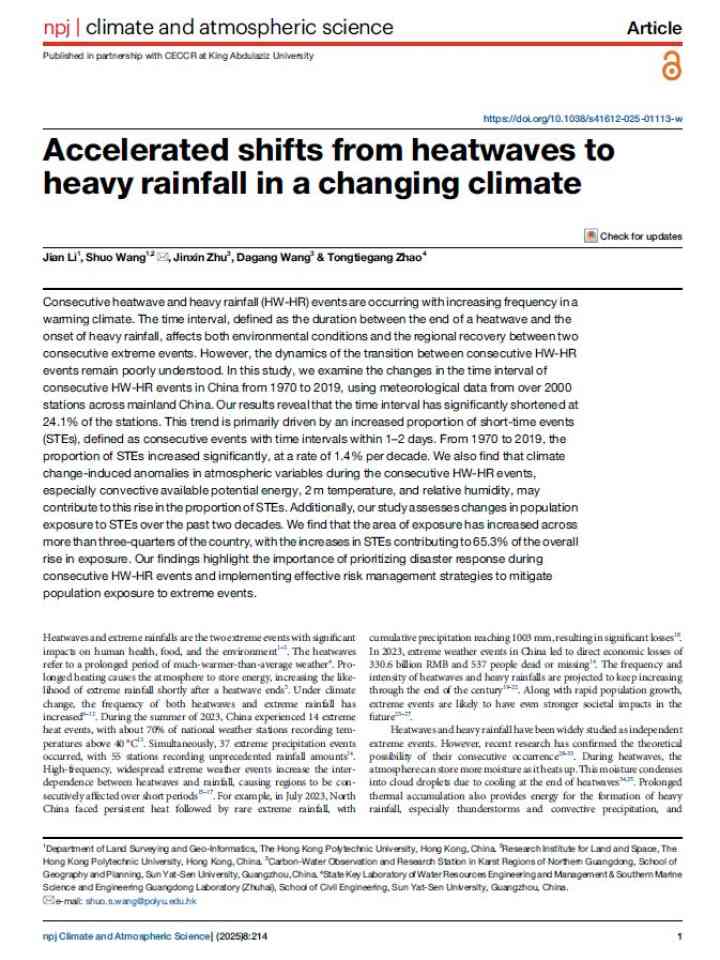
The study examines the changes in the time interval of consecutive heatwave and heavy rainfall (HW-HR) events in China from 1970 to 2019, using meteorological data from over 2000 stations across mainland China. Consecutive HW‐HR events are occurring with increasing frequency in a warming climate. The time interval, defined as the duration between the end of a heatwave and the onset of heavy rainfall, affects both environmental conditions and the regional recovery between two consecutive extreme events. However, the dynamics of the transition between consecutive HW-HR events remain poorly understood.
The study's results reveal that the time interval has significantly shortened at 24.1% of the stations. This trend is primarily driven by an increased proportion of short-time events (STEs), defined as consecutive events with time intervals within 1–2 days. From 1970 to 2019, the proportion of STEs increased significantly, at a rate of 1.4% per decade. The authors also found that climate change-induced anomalies in atmospheric variables during the consecutive HW-HR events, especially convective available potential energy, 2 m temperature, and relative humidity, may contribute to this rise in the proportion of STEs. Additionally, our study assesses changes in population exposure to STEs over the past two decades. The research found that the area of exposure has increased across more than three-quarters of the country, with the increases in STEs contributing to 65.3% of the overall rise in exposure. The findings highlight the importance of prioritizing disaster response during consecutive HW-HR events and implementing effective risk management strategies to mitigate population exposure to extreme events.
Explore further